


Geysers. Part 4
Description
This section is from "The American Cyclopaedia", by George Ripley And Charles A. Dana. Also available from Amazon: The New American Cyclopædia. 16 volumes complete..
Geysers. Part 4
The Cavern has a basin 15 by 20 ft. wide and 20 ft. in depth; the water is of a bright blue tint, and of wonderful clearness. . The mud springs of this group are from an inch or two to 20 or 30 ft. in diameter, their contents varying from turbid water to stiff mud. They are in a constant state of agitation. The mud is of different colors, being pure white in some, in others brown, black, or blue. The sixth group is 2 m. S. W., on a small stream flowing into the Fire-Hole. They are in an open, prairielike valley, for the most part marshy. The temperature of 34 of the springs varied from 106° to 198°. One of them is stronglv chalvb-eate. The seventh group is on the Fire-Hole river, about 2 1/2 m. S. of the preceding. The temperature of 20 of the springs ranged from 132° to 196°, when the air was from 70° to 76°. The largest has a basin over 400 ft. in diameter. Below it is another huge spring, named the Caldron, the view of which is almost obscured by the dense clouds of steam rising from it. The upper geyser basin lies in the valley of the same river, about 8 m. S. of the lower basin. It is not so large as the latter, covering an area of only about 3 sq. m., and it contains fewer springs; but the phenomena exhibited are far more remarkable.
Most of the springs and geysers are near the river, extending along on both banks about 3 m. The temperature of 106 of them ranged from 113° to 196°, the average being over 170°, the temperature of the air being 67°. At the head of the valley, at its southern extremitv, stands
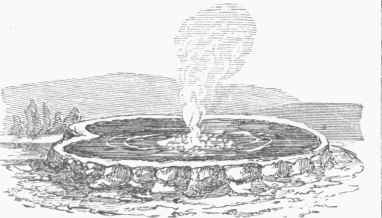
The Thud Geyser.
Old Faithful, a geyser so called for its regularity; it spouts at intervals of about an hour, throwing a column of water 6 ft. in diameter to a maximum height of 130 ft., and holding it up by a succession of impulses from 4 to 6 minutes. The great mass of the water falls directly back into the basin, flowing over the edges and down the sides in streams. When the action ceases, the water recedes out of sight, and nothing but the occasional hiss of steam is heard until the time approaches for another eruption. Its crater is a conical mound of geyserite about 12 ft. high, measuring at the base 145 by 215 ft. and at the top 54 by

The Giantess.
20 ft. Near it are four extinct geyser cones. On the opposite side of the river are the Beehive and the Giantess. The former is a sili-cious cone 3 ft. in height, 20 ft. in circumference at the base, and 3 by 4 ft. in diameter at the top, with an oval orifice 3 by 2 ft. in diameter. When in action, which occurs once in about 24 hours, it throws a column of water entirely filling the crater to a height which, says Langford, was found by triangular measurement to be 219 ft. The eruption lasted 18 minutes, and the stream did not deflect more than 4° or 5° from a vertical line. Dr. Hayden witnessed three eruptions, which lasted from 4 1/2 to 15 minutes; he measured the height of but one, which was over 100 ft. He describes the column as fan-shaped, and says that no water falls from it, but it is resolved into spray which appears to evaporate as soon as formed. At 200 yards from the Beehive is the Giantess, a large geyser with an oval aperture described by Langford to be 18 by 25 ft. in diameter. The inside of the tube is corrugated and covered with a whitish silicious deposit. When not in action, no water can be seen in its basin, although its sides are visible to the depth of 100 ft., but a gurgling sound can be heard at a great distance below.
When an eruption is about to take place, the water rises in the tube with much spluttering and hissing, sending off vast clouds of steam. It will stand sometimes for several minutes within 40 or 50 ft. of the surface, foaming and gurgling, and spurting jets of hot water nearly to its mouth. When it finally bursts forth, it throws up a column of water the full size of its aperture to the height of 60 ft., and through this rise five or six smaller jets, varying from 6 to 15 in. in diameter, to the height of 250 ft. The eruption, which takes place at irregular intervals, continues for about 20 minutes. Dr. Hayden, who examined it in August, 1872, says the basin measures 23 1/2 by 32 1/2 ft. in diameter, and that the water in it, which is level with the rim, is 63 ft. deep. The only eruption witnessed by him lasted 17 minutes, and the maximum height of the water was 39 ft., the steam rising to 69 ft. After the eruption the water sank 20 ft. in the basin. It probably differs in appearance in different seasons. Further down the river on the same side is the Sawmill geyser, which throws a small stream 10 or 15 ft. high almost uninterruptedly. Near it is the Grand geyser, one of the most powerful in the basin. Within a single basin 52 ft. in diameter are two orifices.
One, which is oblong, 2 1/2 by 4 ft., has no rim, and is surrounded for the space of 10 ft. by rounded masses of silica, from a few-inches to 3 ft. in diameter, looking like spongiform coral. When not in eruption the water in this spring is quiet and is as clear as crystal. This is the Grand geyser. The second, called the Turban geyser, is 20 ft. from the first. It has a basin of irregular form, 23 by 11 ft. in diameter and 6 ft. deep. The mouth of its tube, which is at one side of the basin, is 4 by 3 ft. wide. This spring, which apparently has no connection with the former, is in a state of agitation as often as once in 20 minutes, and throws its water to the height of from 15 to 25 ft. It is never wholly quiet. The two eruptions of the Grand geyser witnessed by Prof. Hayden's party in 1871 occurred at an interval of 32 hours. In 1872 three eruptions seen by Hayden took place at intervals of 22 and 26 1/2 hours. An eruption is preceded by a rumbling and a shaking of the ground, followed by a column of steam shooting up from the erater, immediately after which the water bursts forth in a succession of jets, apparently 6 ft. in diameter at the bottom, and tapering to a point at the top, to a height of from 175 to 200 ft., while the steam ascends to 1,000 ft. or more.
Continue to:


My Books

