


An Easy Method Of Teaching Music. Part 3
Description
This section is from the book "The Corner Cupboard; Or, Facts For Everybody", by Robert Kemp Philp. Also available from Amazon: The Corner Cupboard; or Facts for Everybody.
An Easy Method Of Teaching Music. Part 3

The six different kinds of notes, with their names, must again be written upon the slate by the teacher, and left for the pupil to learn before the next lesson.
Of the Value of Notes. - The teacher must now carefully explain to the pupil that as the semibreve is equal to two minims, it must also be equal to four crotchets, or eight quavers, or sixteen semiquavers, or thirty-two demisemiquavers, which must then be written on the slate, thus -

And that the minim also, which is next in value to the semibreve, is equal, not only to two crotchets, but to four quavers, or eight semiquavers, or sixteen demisemi-quavers, thus -

The crotchet, which is next in value to the minim, is also equal not only to two quavers, but to four semiquavers, or eight demisemi-quavers thus -

And the quaver, which is next in value to the crotchet, is also equal, not only to two semiquavers, but to four demisemiquavers, thus and the semiquaver, which is next in value to the quaver, is equal to two demisemi-quavers, thus -
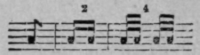
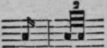
These must all be left upon the slate, for the pupil to study before the next lesson.*
* In order to do which two additional staves must be drawn on the other side of the slate.
11*
Of the Dotted Notes, and of the Rests. - When a dot is placed after a note, it makes the note half as long again as it would be without it, thus -

The teacher should inform the pupil that each note has its rest, or silence, of which there are six, named after the six different kinds of notes, and are made thus - (the teacher must now write the six notes, with their respective rests beneath them, upon the slate) -

The pupil must then repeat after the teacher the following description of these rests, at the same time pointing to them upon the slate, thus: - The semibreve rest is a mark placed under a line ; the minim rest is a mark placed above a line; the crotchet rest turns to the right; the quaver rest turns to the left; the semiquaver rest has two marks ; the demisemiquaver three. The teacher may now show the pupil that a dot placed after a rest lengthens it in the same manner as it does the note from which it derives its name. This lesson must also be left upon the slate for the pupil to study.
Of the Brace, the Bar, and the Measure, and of Triple and Common Time, - Music for the pianoforte is written upon two staves, which are joined together by a brace, made thus: -
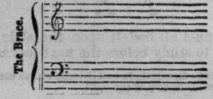
The upper staff is used for the Treble or G clef, the notes in which are played with the right hand ; and the lower staff for the Bass, or F clef, the notes of which are played with the left hand.
Every musical composition is divided into equal portions of time, call measures, by means of upright lines drawn down the staff, called Bars, thus : -
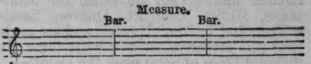
Every measure must contain a certain number of notes, according to the Time marked at the beginning of the staff.
There are two principal sorts of Time; viz.: - Common or Equal Time ; and Triple, or Unequal Time. Common time is expressed either by the initial letter of the word common, or by the figures 2/4. The former indicates that every measure will consist of notes to the value of a semibreve, thus: -

The latter, that every measure will consist of notes to the value of a minim. The upper figure showing how many, and the under figure showing what kinds, of notes the measure should contain. Thus, for example, in the figures 2/4 we know, by the under figure being four, that crotchets are to be counted, four crotchets only being equal to a semibreve ; and the upper figure being two shows us that the number of crotchets each measure must contain will be two, thus: -

Triple time is expressed by the figures 3/2, 3/4, and 3/8. By the figures 3/2, we know that every measure must consist of notes to the value of three minims, two minims being equal to a semibreve, and the upper figure showing that three are to be counted, thus : -

By the figures 3/4 we know that every measure must consist of notes to the value of three crotchets, four crotchets being equal to a semibreve, thus: -

And by the figures 3/8 we know that every measure must consist of notes to the value of three quavers, eight quavers being; equal to a semibreve, thus : -

The pupil may now practice by filling; up the measure with notes of a proper length himself, while the teacher looks on.
In these ten short and simple lessons we have endeavoured to render the rudiments of music as easy to the pupil as possible; and must now leave him entirely to the care of his teacher, who may begin at once to point out to him the different notes upon the piano, with their Sharps and Flats, etc. But we cannot conclude these remarks without strongly advising that no tune, however simple, be taught the pupil for the first twelve months at least, but that his practice should be entirely confined to scales and exercises ; great care being taken (especially at the commencement) by the teacher to form the proper position of the hand, without which, although the pupil may have much natural taste for the art, he will never be able to arrive at any degree of perfection in his execution. [We have to acknowledge our obligations for this valuable article to that universal favourite " The Home Circle."]
Continue to:


My Books

