


Distillation On The Manufacturing Scale. Continued
Description
This section is from the book "Distillation Principles And Processes", by Sydney Young. Also available from Amazon: Distillation Principles And Processes.
Distillation On The Manufacturing Scale. Continued
Other Still-Heads
Various forms of still-head have been devised in which good contact between vapour and liquid is brought about without the actual passage of the vapour through the liquid in the form of bubbles. These still-heads have the advantage that there is very little, if any, rise in pressure from the highest to the lowest section of the column. An early form of still-head of this kind is that of Pistorius (Fig. 66). Here the vapour entering a section of the still-head is deflected from the centre to the circumference by the flat dome, A ; it then passes back to the centre above the dome and is partially condensed by the water in b, above it. It is probable that a considerable improvement in the efficiency of this apparatus would be effected by the simple modification shown in Fig. 67. The condensed liquid, instead of flowing down the outer walls of the section, would drop from the central tube on to the flat dome as in the "evaporator " still-head (p. 134), and the ascending vapour would come into better contact with this hot liquid and would cause some of it to evaporate again.

Fig. 66. - The "Pistorius" still.
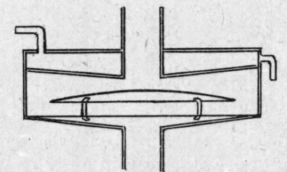
Fig. 67. - Modified "Pistorius" still.
Among the still-heads of this class may be mentioned the various "Ring' columns, such as Raschig's and Lessing's (Figs. 164, 47, pp. 400, 137), Foucar's spiral still-head, and the columns of Kubierschky, Perrier, Guillaume, Ilges, and others (Figs. 115, 111, pp. 308, 304), in which the condensed liquid is caused to fall in drops or spray.
Foucar's apparatus may be regarded as a greatly improved form of spiral still-head; it is simple, compact, and efficient, and is well suited for vacuum distillation.
Kubierschky's still-head contains perforated plates like some of the bubbling columns, but it is the liquid and not the vapour that passes through the perforations; the vapour rises without obstruction alternately through central pipes and circumferential rings nearly to the top of the section in each case, leaving the section near the bottom. This column is very efficient, but, according to Mariller,1 the other "spray" still-heads do not give very satisfactory results.
When large quantities of liquid are to be dealt with there are obvious advantages in making the process of distillation continuous ; the advantages, as well as certain disadvantages, are discussed in the sections on Petroleum and Coal-tar (pp. 319, 359).

Fig. 68. - The "Coffey" still.
The continuous process was first applied to the production of ethyl alcohol from fermented liquors. In the Cofiey plant, which may be regarded as typical of those in general use for the continuous production of alcohol, there is no still, but the fermented liquor is heated by live steam which enters the bottom of the still-head. The plant, in its simplest form, is shown in Fig. 68. The wort is pumped from a reservoir a up the pipe B, and passes down the zigzag pipe c c, where it is heated by the ascending vapour in the rectifier ; then up the pipe d into the highest section of the analyser E. It then descends from section to section through the tubes f, and is finally allowed to escape through the trapped pipe G.
1 Mariller, La Distillation frartionnee, Paris, 1917.
Steam is passed into the analyser by the pipe h, and causes the wort to boil, so that by the time it has reached the bottom it is com-pletely deprived of alcohol. The ascending vapours pass through the perforations in the plates and bubble through the liquid on them, a portion of the aqueous vapour being thus condensed, and the descending wort heated, by each washing.
On reaching the top of the column, the concentrated alcoholic vapour passes through the pipe J into the bottom of the rectifier k, and then ascends through perforated plates similar to those in the analyser; the ascending vapour is, however, not washed by wort in the rectifier, but by the liquid formed by partial condensation of the vapour. In the upper part of the rectifier there are usually only shelves which compel the vapour to take the same zigzag course as the pipes which convey the wort downwards. The purified vapour then passes through the pipe l to the condenser.
The mixture of weak spirit and fusel oil, condensed in the rectifier, flows into a reservoir m, from which (usually after separation of the fusel oil) it is pumped into the top of the analyser, where it mixes with the descending wort.
When such a still is working regularly the composition of liquid and vapour in each section of the rectifier should remain practically constant. The fusel oil tends, however, to accumulate in the lower part of the rectifier, and in modern plants liquid is run off continuously at the level of greatest oil concentration at such a rate that this concentration remains constant.
The vapour also contains impurities more volatile than alcohol, and these would, of course, be contained in the spirit produced with the simple plant described. The alcohol at some little distance from the top of the rectifier is much freer from these impurities than that at the very top, and, at the present time, the alcohol is run off at a suitable rate from the level of greatest purity.
Part of the vapour which leaves the top of the rectifier is condensed in a dephlegmator, the liquid being returned to the rectifier, the rest of it, richest in the volatile impurities, passes on to a condenser ; or the whole of the vapour may be condensed and a part of the liquid returned to the rectifier.
Other still-heads of this class are described in the sections on alcohol, acetone, and coal-tar products.
Such complex mixtures as coal-tar or petroleum could not be distilled in this manner, but various methods of continuous distillation are employed.
The petroleum or coal-tar, usually previously heated in a pre-heater, may, for example, pass through a series of stills at successively slightly lower levels, the temperature rising as the liquid passes from still to still (p. 377). The vapour evolved from each still - and in some cases from the pre-heater - is separately condensed, and it is clear that the vapour from the first still (or the pre-heater if hot enough) will contain the most volatile components and that from the last still the least volatile. The residue from the last still (pitch in the case of coal-tar) is run off continuously and is usually passed through pre-heaters, so that its heat may be utilised (pp. 336, 378). In some cases the number of fractions is increased by the fractional condensation in dephleg-mators of the vapour from each of the stills (p. 338).
Occasionally the crude liquid is strongly and rapidly heated so as to expel all volatile matter at once. Partial separation is then effected by fractional condensation in a series of dephlegmators (pp. 343, 373).
Full details of these and other methods, also methods of vacuum and steam distillation, are given in the different sections dealing with large scale processes.
Continue to:


My Books

