


Purification Of Essential Oils. Continued
Description
This section is from the book "Distillation Principles And Processes", by Sydney Young. Also available from Amazon: Distillation Principles And Processes.
Purification Of Essential Oils. Continued
Florentine Flask
The usual "Florentine flask " is too well known Fig. 210a. to need description, it can be seen in operation in the illustrations on pages 468,469, and 473. Improved designs are shown in Figs. 210, A and B. These receivers can be adjusted to suit the varying specific gravities of the various oil layers by slightly tilting them one way or the other. They afford a double safeguard against loss of oil, having two settling chambers, and have proved to be very satisfactory in operation.
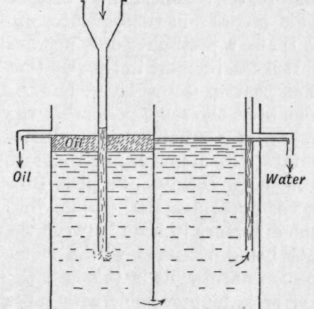

Fig. 210B.
Receiver For Vacuum Work
For vacuum work the receiver is of an entirely different character, and consists essentially of a closed vessel connected to the condenser on the one hand and to the exhausting pump on the other. Receivers do not call for much comment, but of course must be sufficiently strong to withstand the external atmospheric pressure, which may rise as high as 15 lb. per square inch or thereabouts. The construction of these vessels is an engineer's problem. Provision should be made for gauging the amount of the contents, and for this purpose circular disc sight-glasses fixed in the lid are the most satisfactory ; the contents can quite readily be estimated by means of graduations marked on the inside of the receiver and viewed through the sight-glasses. As a refinement, one of the sight-glasses may be in the shape of a "well " ; this will allow an electric light to be lowered so as to be completely within the receiver; this arrangement will illuminate the interior very thoroughly.
Tube gauge-glasses set after the manner of boiler gauges are frequently unsatisfactory, being easily broken, difficult to clean, and apt to become choked up. When two layers of liquid are present the readings registered are quite erroneous, and it must always be remembered that it is the heavier liquid at the bottom of the receiver which is pushed up into the gauge-glass.
Pressure In Still And Receiver
The pressure or "vacuum," as it is generally termed, in the still and in the receiver should be measured separately, for, if the distillation is very rapid or air leaks exist in the apparatus, the pressure as indicated by the two gauges will differ : the cause of any big difference should at once be sought; with distillates like oil of thyme, which are prone to solidify, the condenser may become choked ; the pressure in the still would increase in consequence, up-setting the boiling temperature; there is also a possibility of dangerous "plus " pressures arising in the still. It is the pressure in the still that should be taken account of rather than that in the receiver, but the correct practice is to measure the pressure at the same point that the temperature is measured, e.g. at the top of a fractionating column. Dial gauges are not suitable for accurate measurements, and change their zeros with use. The most suitable gauge consists of a glass tube 1 metre high, connected at the top to the apparatus, and dipping into a trough of mercury at the bottom, the difference in level between the mercury in the trough and in the tube being measured with a metre scale; it is well not to have the tube too narrow, as in this case the capillarity introduces an error - this error is inappreciable with tubes of 1/4 in. bore or more. The pressure indicated should be compared with the barometer, the difference between the readings being the pressure in the apparatus.
I have to express my indebtedness to A. L. Bloomfield, Esq., B.A. of New College, Oxford, for kindly correcting my manuscript, and to Messrs. A. Boake Roberts & Co., Ltd., Stratford, for permission to publish it; also to the following gentlemen and firms for much original information and assistance, which I gratefully acknowledge :
Felix Gutkind, Esq., Malaga, Spain.
John T. Stolz, Esq., Monroe Co., U.S.A.
Messrs. Stafford Allen and Sons, Ltd., London, E.C.
„ Tombarel Freres, Grasse, France.
,, Roure Bertrand Fils, Grasse, France.
„ Antoine Chiris, Grasse, France.
,, Lautier Fils, Grasse, France.
„ Shipkoff & Co., Kazanlik, Bulgaria.
„ Schimmel & Co., Leipzig, Germany.
„ Chas. V. Sparhawk, Inc., N.Y., U.S.A.
Messrs. Ungerer & Co., N.Y., U.S.A.
„ John Dore & Co., London, E.
„ Igranic Electric Co., Ltd., Bedford.
„ Rose, Downs & Thompson, Hull.
„ Bennett Sons & Shears, Ltd., London, E.C.
,, J. Harrison Carter, Ltd., Dunstable.
„ Deroy Fils, Paris XV.
And to the following publications :
The Perfumery and Essential Oil Record, London, The American Perfumer and Essential Oil Record, N.Y., U.S.A., The Chemistry of Essential Oils, E. J. Parry (Scott Greenwood), Rechenberg's Gewinnung and Trennung der atherischen Ole (Schimmel & Co.).
Continue to:


My Books

