


The Distillation Of Essential Oils
Description
This section is from the book "Distillation Principles And Processes", by Sydney Young. Also available from Amazon: Distillation Principles And Processes.
The Distillation Of Essential Oils
By Thos. H. Durrans, M.Sc. (Lond.), F.I.C.
Of Messrs. A. Boake Roberts & CO., Ltd., London
Chapter XL. Theoretical, Steam Distillation
The practice of steam distillation for the isolation and the purification of essential oils is world-wide and dates from the remotest antiquity. There is no fundamental difference between the distillation of essential oils and that of other liquids, but the nature of their origin and their somewhat delicate character render it necessary to employ special methods.
In general the scientific principles underlying these methods do not appear to be understood, and it will be well therefore briefly to state the more important theoretical considerations before dealing with the technical aspect. A few notes of a technical character have been introduced in the theoretical portion at suitable places in order better bo bring out certain points.
Little or no reference is made to the theoretical side of ordinary or "dry" distillation, since this has been fully treated in another section of this book.
The mutual solubility of essential oils and water in one another is, in general, so slight that it can be neglected without serious error. The "steam distillation" of essential oils may in consequence be treated merely as an example of the distillation of completely immiscible liquids.
Dalton's Law
The saturated vapours of such completely immiscible liquids follow Dalton's law, which states that when two or more gases or vapours which do not react chemically with one another are mixed, each gas exerts the same pressure as if it alone were present and that the sum of these partial pressures is equal to the total pressure exerted by the system. The law may be symbolised thus: P=p1 + p2+p3 + . . . +Pn,
P being the total pressure of the system, and p1, p2, etc., the partial pressures of the components.
An important point to be noticed is that the total pressure is not influenced by the relative or the absolute amounts of the constituents.'
Methods Of Steam Distillation
Steam distillation may be divided into two classes, the first comprising distillation at atmospheric pressure - as, for instance, when a mixture of an essential oil and water is boiled ; the second, distillation with steam generated in a separate vessel. In this latter case the pressure of the steam has to be taken into account. These two classes are virtually one and the same when the steam employed in the second case is only under a low pressure (e.g. one or two pounds per square inch), the still is worked at atmospheric pressure and free water is also present.
Distillation Of Immiscible Liquids
In the first case, if a mixture of immiscible liquids be distilled, the boiling point is that temperature at which the sum of the vapour pressures is equal to that of the atmosphere ; this temperature is consequently lower than the boiling point of the most volatile constituent considered separately. When a mixture of immiscible liquids is distilled, the boiling point of the mixture remains constant until one of the constituents has been almost completely removed; the boiling point then rises to that of the liquid remaining in the still. The vapour coming from such a mixture contains all the constituents in proportion (by volume) to the relative vapour pressure of each, and the distillate contains all the ingredients of the original mixture. It is impossible, therefore, by means of steam distillation completely to separate the constituents of an essential oil one from another, although a fair degree of separation may be attained in some instances.
If PA and PB are the vapour pressures of two completely immiscible liquids A and b at t°, the two substances will distil over in the proportion PA : PB by volume of vapour ; if DA and DB are the respective vapour densities of the two vapours at the boiling point of the mixture, the relative quantities by weight, m' and m'B, will be
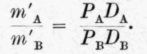
Inasmuch as the vapour density of a substance is a function of its molecular weight, viz. M=2D, we can calculate the weights of the two components that will distil over from a knowledge of their molecular weights and vapour pressures at the boiling point of the mixture. From the above it follows that and that the mixed vapour will consist of
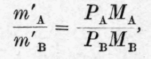

Or if we consider 1 litre of the mixed vapours, this will contain, according to Dalton's law, 1 litre of each component, and the weights of these will be respectively
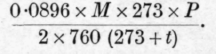
Given, then, the molecular weight of a substance and its vapour pressure at 100° C, we can calculate, approximately, the ratio of the amount of substance that will distil over with steam to the quantity of water required, and from this, as will be shown later, the amount of heat necessary. Consider, for example, benzaldehyde, the chief constituent of oil of bitter almonds. Its molecular weight is 106 and its vapour pressure PB at 100° C. is 61 mm. The partial pressures of water and benzaldehyde at 760 mm. and 100° C.1 are respectively given by for water and for benzaldehyde.


(Note PA + PB = 703.5 + 56.5 = 760.) Substituting in the equation, we get that is, the distillate contains 68 per cent of water and 32 per cent of benzaldehyde.

If an organic substance be not affected by water and have a vapour pressure of even so little as 1 mm. at 100° C, steam distillation is a feasible technical operation, especially so if the molecular weight of the substance be high. It is this latter property that permits many essential oil ingredients of very low vapour pressure to be steam-distilled economically. The following table is instructive :Table 120
Substance. | Boiling point. | Pat 100° C. | M. | Per cent in distillate. |
Carvone . . . | 230° C. | 9 mm. | 150 | 9.7 |
Geraniol . . . | 230 | 5 | 154 | 5.6 |
Anethole . . . | 235 | 8 | 148 | 7.1 |
Eugenol . . . | 250 | 2 | 164 | 1.7 |
a Santalol . . | 301 | <1 | 220 | 0.5 |
The relation m'A: m'B = Mapa : Mbpb indicates the great value of steam distillation, since the smaller the product of Mapa the larger the value of m'B. Water has an exceptionally low molecular weight and has only a relatively moderate vapour pressure, so that its value for MP is low; all other substances have either a high molecular weight or a high vapour pressure and are generally miscible with essential oils. One great advantage of steam distillation is that it allows the sub-stance of high boiling point to be distilled at a temperature not exceeding 100° C.; this is of considerable importance when dealing with essential oils and other delicate or unstable substances. The boiling point of a system of immiscible liquids is lower than that of its most volatile component and it may be very much lower than that of its least volatile. Benzaldehyde under 760 mm. pressure boils at 178.3° C, but a mixture of water and benzaldehyde has a boiling point of 97.9° C.
1 The mixture actually boils at a slightly lower temperature, since the boiling point of such a mixture is lower than that of the component of lower boiling point.
Continue to:


My Books

