


A. Strike-Faults
Description
This section is from the book "An Introduction To Geology", by William B. Scott. Also available from Amazon: An Introduction to Geology.
A. Strike-Faults
Strike-Faults are those which run parallel, or nearly so, to the strike of the beds. To this group belong the great normal faults, great both as to length and throw, though they may be extremely minute, or of any order of magnitude between these extremes. They may die out in a few yards, or run for hundreds of miles, and may be simple or compound, single or branching. A compound fault is made up of a number of parallel dislocations, placed close together, which may hade in the same, or in opposite directions, but in the latter case one hade prevails over the other. A series of parallel faults, wider apart than those of compound faults, and all hading in the same direction, are called step-faults. If two parallel dislocations are inclined toward each other, they form a trough-fault and include a wedge-shaped mass of rock, which is on the downthrow side of both displacements, while if they incline away from each other the inclined mass is on the upthrow side of both. For the latter structure, which is the converse of the trough-fault, there is no English term - many geologists have therefore adopted the German word Horst.
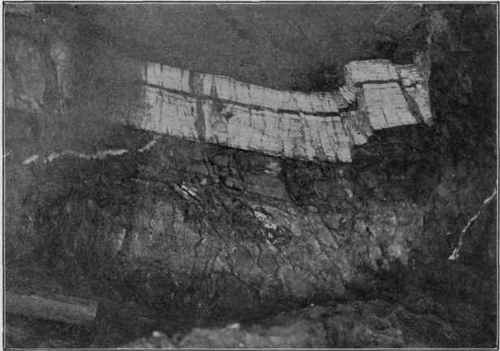
Fig. 174. - Small faults in the roof of a mine, Idaho. Near the right end, a tiny Horst. (U. S. G. S).
However long it may be, a simple fault sooner or later dies away by diminution of the throw, until it vanishes. This implies that the rocks are bent along the dislocation, upward on the upthrow side and downward on the downthrow side. It is comparatively seldom that the upthrow side of a fault is left standing as a line of cliff, ox fault-scarp, which depends upon the length of time during which the scarp has been exposed to denudation. In the majority of instances the two sides of the fault are worn to the same level or to one continuous slope, so that there is no feature of surface topography to indicate the existence of the fault, which must be inferred from the effects of the dislocation upon the outcrops of the strata involved in it. These effects are determined by the direction and throw of the fault, and by the attitude and dip of the beds. Strike-faults of moderate throw which traverse horizontal strata, or strata inclined so that the dip of the beds and the hade of the fault are in opposite directions, repeat the outcrop of the beds, bringing them again to the surface, as shown in Fig. 175. When dislocated by a series of step-faults, a given stratum has a number of outcrops greater by one than the number of faults.
When the surface has been worn down to one continuous slope, such a repetition of the outcrops may be very deceptive.
In Fig. 176, for example, the observer might easily be misled into believing that seven seams of coal were cropping out on the hillside, whereas in reality there are only two such seams with outcrops repeated by faulting.
When the hade of a strike-fault is in the same direction as the dip of the beds, a certain number of the latter abut against the fault-plane and fail to reach the surface, their outcrops being cut out (Fig. 168). In great faults, with displacements of many thousands of feet, the beds cropping out on the two sides of the fault are entirely different. The deep-seated strata which are exposed by denudation on the upthrow side, are carried so far down on the downthrow side that they do not reach the surface at all, or, at least, do not crop out in the neighbourhood of the fault.
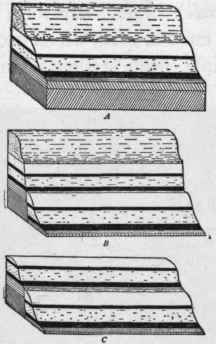
Fig. 175. - Effect of strike-fault on outcrop. A, before faulting; B, with fault scarp standing; C, with upthrow and downthrow sides worn to a continuous slope. (Model by Sopwith).

Fig. 176. - Effect of step-faults in repeating outcrops. (Model by Sopwith).
Continue to:


My Books

