


B. Dip-Faults
Description
This section is from the book "An Introduction To Geology", by William B. Scott. Also available from Amazon: An Introduction to Geology.
B. Dip-Faults
These are, in general, parallel to the dip of the beds and therefore cross or branch out from the strike-faults of the same region, more or less at right angles; they are less important than strike-faults, having generally a smaller throw and less length. Dip-faults cut across the strike of the beds and interrupt the continuity by producing an offset in the outcrop. The outcrop of a given stratum ceases abruptly at the fault-line and when found on the other side is seen to be shifted for some distance along that line. How such a horizontal shifting is brought about by a vertical movement, is shown by the model (Fig. 177). In I is seen the model before faulting, the black band representing a dipping bed; in II the block has been faulted, the upthrow side remaining as a fault-scarp, while III shows the scarp removed by denudation. On the downthrow side the outcrop is shifted away from the dip of the beds and on the upthrow side toward the dip.
When a dip-fault cuts across eroded folds, the distance between the outcrops of the same stratum in the two limbs of an anticline is increased on the upthrow side, diminishing on the downthrow; in the synclines this arrangement is reversed. This is due to the fact that, when both sides are planed down to the same level, the surface of the ground cuts the beds at a lower stratigraphic level on the upthrow than on the downthrow side, and as the limbs of an anticline diverge downward, the outcrops will be the more widely separated, the lower the level at which they reach the surface. The limbs of a syncline, on the other hand, converge downward and the effect of the fault is therefore just the reverse of what occurs in the anticline.

Fig. 177. - Model showing stratum offset by dip-fault, I, before faulting; II, with fault scarp standing; III, with scarp removed by erosion.
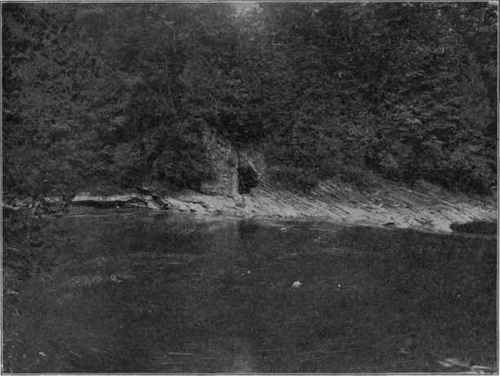
Fig. 178. - Drag of strata near fault-plane. (U. S. G. S.) The hole is an artificial opening along the fault.
C. Oblique Faults
Dip-faults do not always follow the dip, and strike-faults often deviate considerably from the strike of the beds, and sometimes the fault is neither one nor the other, but midway between the two, and then is called an oblique fault. The outcrop of a given bed, obliquely faulted, has an offset, as in the case of a dip-fault, but if the fault inclines with the dip of the strata, there is a gap between the two adjacent ends of the outcrop, the gap widening as the line of fault approximates that of strike. If the fault hades in the opposite direction from the dip, the two ends of the outcrop overlap.
2. Reversed Faults
This group, as usually denned, is made to include thrusts (q.v.), but the latter are here excluded and the term reversed fault comprises only those true, radial faults in which the hanging wall has been pushed up over the foot-wall and therefore forms the upthrow side. A reversed fault, which almost always coincides with the strike of the beds, implies a local compression, for the beds occupy less space than before dislocation. In a large faulted area, normal and reversed faults frequently occur together, compression in one place compensating for tension in another, and the two kinds of displacement appear to have been formed at the same time, or in close succession.
Continue to:


My Books

