


Fissure Eruptions
Description
This section is from the book "An Introduction To Geology", by William B. Scott. Also available from Amazon: An Introduction to Geology.
Fissure Eruptions
There is much reason to believe that the mode of volcanic eruption from a single vent, described in the foregoing pages, is not the only method by which molten lava may reach the surface. It would seem that in past times lava has welled up through great fissures and overflowed immense areas in successive floods. As an example of this may be mentioned the vast fields of lava which occur in Idaho, Oregon, and Washington, covering more than 100,000 square miles to the depth of several hundred feet. On an even larger scale is the lava plateau of the Deccan in India, while similar but smaller lava fields occur in Patagonia, Iceland, Scotland, and other regions.
Eruptions of this type are rare in modern times and are best displayed in Iceland, where lava wells out through great fissures, some of which are 20 miles in length, and, in some cases, repeatedly through the same fissure. Small craters which eject scoriae are ranged along the fissures. At Schemakha, near the west coast of the Caspian Sea, the earthquake of 1902 was accompanied by the formation of a fissure, through which lava was extruded, very unexpectedly because igneous rock had been previously unknown in that area.
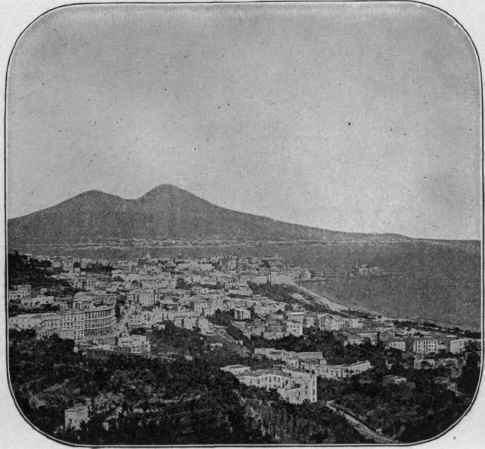
Fig. 30. - Vesuvius and Monte Somma.
Continue to:


My Books

