


Forms In Inclined Strata
Description
This section is from the book "An Introduction To Geology", by William B. Scott. Also available from Amazon: An Introduction to Geology.
Forms In Inclined Strata
Inclined or tilted strata give rise to a different class of topographical forms. If, as is generally the case, harder and softer strata alternate, the latter will be swept away more rapidly than the former, which are left standing as ridges or cliffs, the height and steepness of which are determined by the thickness and inclination of the more resistant rocks. In case the strata are steeply inclined, a succession of hard beds alternating with soft will give rise to a series of ridges and valleys, the slopes of which depend upon the angle of dip. If the beds are standing in a vertical position, the two slopes of each ridge will be nearly equal, the hard strata forming the backbone of the ridge and the softer ones the sloping sides. Often narrow ridges, more or less closely resembling dykes of igneous rocks, are formed by the isolation of hard vertical strata, the softer beds on each side being removed by erosion. As the inclination departs from verticality, the more unequal do the two slopes of each ridge become, the longer and gentler one being in the direction of the dip.
Ridges and valleys of this class are beautifully exemplified in the Appalachian Mountains. Figure 40 (p. 115) shows Kittatinny Mountain, through which the Delaware River has cut the famous Water Gap; the crest of the ridge is formed by very hard and indestructible sandstones and conglomerates, while the broad valley above and below the gap is in slates or other destructible rock.
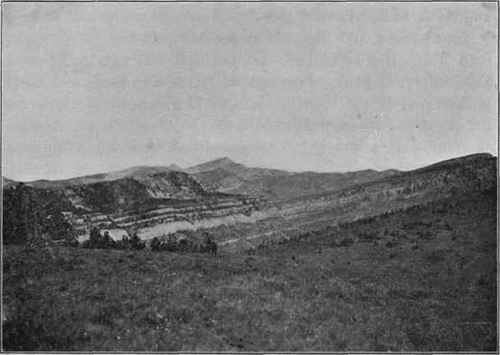
Fig. 233. - Escarpments and dip slopes, Montana. (U. S. G. S).
In gently inclined strata the abruptly truncated and cliff-like outcrops of the hard beds are called escarpments, and follow, with some irregularities and sinuosities, the line of strike.
Whether the general course of the escarpment shall be straight or curved will, therefore, be determined by the constancy or change in the direction of the dip; for, as we have already learned, the strike changes with the dip, always keeping at right angles to the latter. The upper surface of the gently inclined hard stratum may be completely exposed by the stripping away of the softer overlying mass, and then the slope of the ground is the same as that of the resistant stratum, and is called a dip slope. A series of gently inclined strata, made up of alternating harder and softer beds, will thus give rise to parallel ridges and valleys, or escarpments and dip slopes, according to the completeness with which the softer beds are removed and the harder ones exposed. A magnificent example of such escarpments and slopes is displayed in the high plateaus of Utah and Arizona, where the dip slopes are from 20 to 60 miles broad and the escarpments 1500 to 2000 feet high. The amount of denudation involved in the production of these vast amphitheatres staggers belief, though there is no escape from the enormous figures.
Under the influence of denudation escarpments are continually though slowly receding, being cut back in the direction of the dip. Rain and frost act directly upon the hard beds, but work more effectively by cutting away the softer beds below and thus undermining the hard strata, causing them to fall. The fallen masses are gradually disintegrated in their turn and washed away into the water-courses. The escarpments may follow a relatively straight or a very sinuous course. Sinuosities, when present, are commonly due to the action of springs, which undermine the escarpments and, by the recession of their heads, excavate the line of cliffs into bays and amphitheatres. A sinuous escarpment is more rapidly cut back than a straight one, because, in addition to the cooperation of the springs, it offers a larger surface to the attack of the destructive agencies. Every step in the recession of an escarpment lowers the ridge and brings it nearer to base-level, because the direction of retreat follows the line of dip, which carries the beds down to base-level with a rapidity determined by the angle of dip. A steeply inclined bed needs to be cut back only a short distance, when it will be reduced to base-level, whereas a bed dipping very gently remains above base-level for long distances.
Of course the general elevation of the whole region- above base-level is also an important factor in determining the amount of work to be done.
For reasons that will appear later, we assume that when denudation began its work upon a region of inclined strata, that region was a sloping plain, or peneplain, formed by the outcropping edges of the strata. The first lines of drainage established would necessarily follow this slope, and the first valley or valleys cut would be across the strike of the beds, trenching both hard and soft beds. Such valleys are called transverse, or dip valleys, and the streams which flow in them, transverse streams. Transverse streams cut steep-sided, canon-like valleys, the rocks giving way along the joints and making the two valley-walls alike, as though the valley were cut in horizontal strata. A second series of valleys will be excavated along the strike of the softer beds, giving longitudinal, or strike, valleys and streams. In such a longitudinal valley, following the strike of a mass of soft strata, the stream which occupies it will tend to flow along the foot of the escarpment formed by the outcrop of hard strata, and to shift its course laterally in the direction of the dip, cutting away the soft beds in which it flows, and undermining the hard escarpment. Longitudinal or strike valleys tend to have one steep or vertical, and one gently sloping side.
The strata dip across the stream and hence on one side are inclined toward the valley and on the other away from it. The former is the weaker structure, because the loosened joint-blocks glide into the stream, and the ground-water, following the stratification planes, forms springs on that side of the valley. The side on which the dip is away from the stream is attacked chiefly by the undermining action of the stream and thus kept vertical. Such a stream is a potent agent in causing the recession of the escarpment and may remove large areas of both hard and soft strata.
The steep ridges, or "hog-backs," which occur among the foothills of the Rocky Mountains, show interesting examples of streams flowing along the strike of inclined strata, though the ridges are themselves not formed quite in the way already described. They are composed of the steeply dipping limbs of monodinal folds, of which the upper horizontal limbs have been removed by denudation (Fig. 234).

Fig. 234. - Hog-backs, east side of Laramie Mts. Wyo. (U. S. G. S).
Continue to:


My Books

