


Upright Or Symmetrical
Description
This section is from the book "An Introduction To Geology", by William B. Scott. Also available from Amazon: An Introduction to Geology.
Upright Or Symmetrical
In this case the two limbs of the fold dip at the same angle in opposite directions, the plane of the axis of the flexure is vertical and bisects the fold into equal halves. In asymmetrical, or inclined, folds the opposite limbs have different angles of dip, the axial plane is oblique and divides the flexure into more or less dissimilar parts. When one limb has been pushed over past the perpendicular, the fold is said to be overturned or inverted, and when this has gone so far that one of the limbs becomes nearly or quite horizontal, the fold is recumbent.
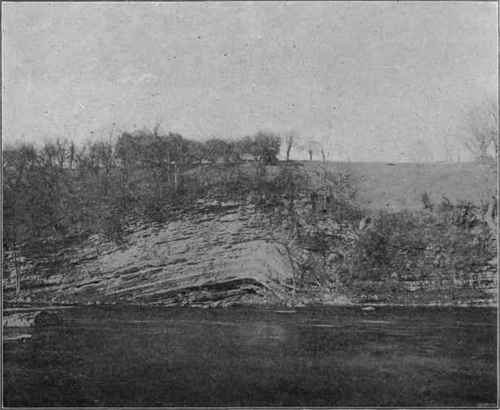
Fig. 159. - Asymmetrical open fold, High Falls, N.Y. (Photograph by van Ingen).
According to the second mode of classification, we have a somewhat different series of terms; but both methods have their uses and must be employed. Open folds are those in which the limbs are widely separated; strata with open, gentle flexures are said to be undulating. Closed folds are those in which the limbs of the flexures are in contact and any further compression must be relieved by a thinning of the beds. Contorted strata are thrown into closed folds, which are connected by sharp, angular turns.
Plications are intense crumplings and corrugations of the strata. Isoclinal folds are those which have been so bent back on themselves that the limbs of the flexures are all parallel, or nearly so. When a series of isoclines has been planed down by erosion to a level, the strata show a continuous, uniform dip and present a deceptive appearance of being a simple succession of tilted beds. A still further compression of isoclinal folds produces fan folds.
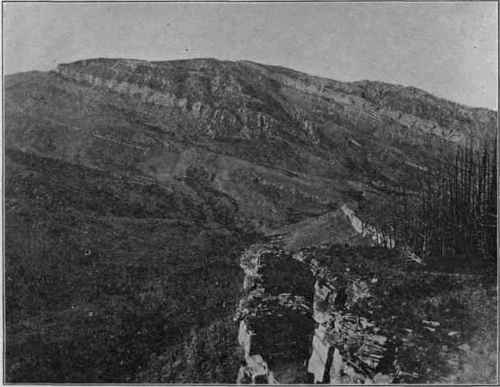
Fig. 160. - Overturned sharp fold; Big Horn Mountains, Wyoming. The conspicuous white stratum is sharply bent on itself about the middle of the mountain face, in reversed Z-shape. (U. S. G. S).
In this structure the anticline is broader at the summit than at the base and the syncline broader below than above, a reversal of the normal arrangement.
The isoclinal and fan folds may be upright, inclined, inverted, or recumbent. In the closed folds there has been such enormous compression that the same strata are of different thickness folds 335 in different parts of the flexure. This is especially marked in fan folding, in which the beds are much thinner on the limbs than at the summit, and sometimes the central beds in the folds have been actually forced to flow upward or downward, forming isolated masses cut off from their original connections.

Fig. 161. - Closed recumbent fold, East Tennessee. (U. S. G. S).

Fig. 162. - Plicated gneiss, Montgomery Co., Pa. (U. S. G. S).

Fig. 163. - Inclined isoclinal folds, eroded. (Willis).
Besides the simple folds above described, there are frequently found complex systems of flexures, in which the compressing force has acted simultaneously or successively in different directions, producing highly complicated cross folds. These are, however, often extremely difficult to work out', and in an elementary book, intended for the beginner, it is not necessary to do more than mention them.
Continue to:


My Books

