


Athletic Meeting Laws. Part 9
Description
This section is from the book "Athletics And Football", by Montague Shearman. Also available from Amazon: Athletics and Football.
Athletic Meeting Laws. Part 9
Had this view prevailed in the Middle Ages the champion knight would not have been he who kept the ring against all comers, but he who knocked down with his lance twenty 'dummies' in the quickest time.
Our complaint against the athletes and the public is that they do not see that it is the competition of equally matched antagonists which brings out all the manly qualities of the Englishman, and that this alone is the true raison d'etre of athletic sports. They did not come into vogue to show the capacities of the human body as a running or jumping machine, but to teach young Englishmen to train themselves in coolness, courage, endurance, and good temper, by pitting themselves against their equals in fair contest. When a man makes a record (as in bicycling) with several pace-makers and no opponent, or when (as often occurs on the running path) a crack starts at scratch in a handicap especially made (as freely stated in advertisements) to give him an opportunity of beating the record, he has everything to win and nothing to lose; he wants no pluck nor skill to defeat his antagonists, as there are none who start level with him. All he has to do is to lay his feet to the ground as fast as nature will permit him, and if he accomplish the task set him, one feels inclined to parody the familiar sentence and say, 'it is magnificent - but it is not sport.'
It would, however, make little difference to the welfare of the sport whether the public liked level races or record-handicaps best, if the taint had not spread to the athletes themselves. A suspicion of bias always attaches to the laudator temporis acti, but at the risk of incurring that suspicion we feel compelled to express an opinion that the great 'cracks' of the present day are not over-fond of meeting each other. The desire of winning the title of champion is still strong enough to bring most of them together once a year, but upon any other occasion it is the greatest difficulty in the world to induce two 'cracks' at the same distance to meet in a race. One day one is seeking a record in the South, and on the same day another is running at a country handicap in the West, while a third who is great at the same distance is at a big Birmingham meeting, also trying for records on the Aston track. On a Bank Holiday the same phenomenon is also to be observed, although the motive on this occasion is not to make records but to win 'pots.' If there are three good quarter-milers in London in the spring, it may be predicted with great confidence that one of them will be at Woodbridge, another at Colchester, and the third at Newmarket. All this cowardice (to use a plain word) is discreditable to the sport, and it is fostered and encouraged by the system which takes as the test of a man's merit, not the quality of the opponents whom he has beaten, but the' time' in which he has performed.
The sooner, therefore, that athletes learn that time is a test of speed but of nothing else, the better for the sport. The race is not always to the speediest, and to possess speed without pluck or judgment is to have very little title to genuine merit. To conclude with an old athletic aphorism, 'Fast times do not make the runner,' and with this remark we will close our case against timing and records.
There is one other practice which, in our opinion, has been carried to absurd limits at athletic meetings. At a great many meetings boys' races are included in the programmes. That a good, strong, lusty schoolboy, who is continually playing cricket or football, should come out and race in public is sensible enough. Athletic sports have now been in full swing for a generation, and many of the runners of the past are bringing up possible young champions of their own. At first sight, therefore, it seems a genial and sportsmanlike notion for races to be given at meetings for the sons or young brothers or nephews of the members of clubs. But this idea, like some other good ideas, has led to cruel absurdities. At the Civil Service and Private Banks and other meetings, little boys of six years old, and even less, are to be seen racing in boys' handicaps, having, of course, prodigious starts from the scratch markers, who are much bigger lads. For our own part, we think it is neither good for the minds or bodies of little boys to run hard races at public meetings at all, and we should like to see boys' races restricted to those over twelve. But even of races for elder boys there are far too many.
There are so many, in fact, that a regular class of boy-champions is springing up, and certain boys run at twenty or thirty meetings during a summer, and bring home as many prizes. This early 'forcing' of juvenile talent can hardly be considered a healthy system, and yet the practice is yearly extending rather than decreasing. Every school, great or small, has its athletic meeting now, and we think that schoolboys had much better confine themselves to their own school races, and their own games and paper-chases, until they are good enough to compete at men's meetings in men's races. Another drawback about these boys' races is the immense amount of squabbling to which they give rise at country meetings. The only way for the handicapper to get his boys together at the finish is to find out the age of each, and a very large number of frauds are perpetrated by boys who either themselves understate their ages or whose friends do the cheating for them. So many of these 'mistakes' have there been that the Athletic Association has been obliged to pass a very stringent rule which confines boys' races in most parts of the country to purely local events.
Only a short time ago a case came before the Southern Committee of the A.A.A. of a boy who had been entered at different sports under four different names, his ages being variously given from 11 1/2 years to 14 years, and his height from 4 ft. 2 in. to 4 ft. 8 in. His real age was 16, and his real height 5 feet. This is no doubt an exceptional case, but the number of instances in which a boy's age has been understated a year, 'quite by accident,' is large enough. A system is not bad in itself because bad people abuse it, but apart from these abuses we think the practice of encouraging boys' races at open meetings a pernicious one. If there are to be boys' races at all, let them be confined to those introduced by members of the club holding the meeting, and to competitors who are over twelve years of age.
Having dealt with the boys, we will end our criticism of athletic meetings with the veterans. Some clubs give races to 'veterans' - a 'veteran' in the athletic sense being usually a man over thirty-five years old. We do not see that there is anything wrong in giving those who are 'rude donati' an opportunity of coming out again to exhibit themselves to the rising generation of runners, but in practice the veterans' race is usually rather an absurd sight than otherwise. At one of these competitions, which is an annual affair, an old gentleman, who must by this time have passed his allotted span of three score years and ten, comes out regularly to exhibit himself, many others who are well over fifty appear in the race, while a good many younger men compete whose bodies from disuse have so far thickened about the middle as to render their movements anything but graceful. On the whole, we think that the veteran who is too slow to take part in the ordinary races 'lags superfluous on the stage' of athletic sports.
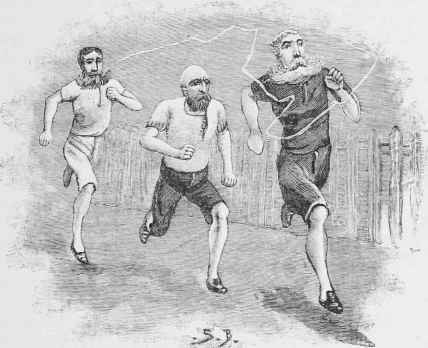
Veterans' Race.
Continue to:


My Books

