


Australian Football. Part 3
Description
This section is from the book "Athletics And Football", by Montague Shearman. Also available from Amazon: Athletics and Football.
Australian Football. Part 3
Once the flag is raised, however, the goal is settled and cannot be annulled. In place of the Association 'tries' the Australian game has what it calls 'behinds.' On each side of the goal, and seven yards away from the goal-posts, there are 'behind-posts,' which therefore make, along with the seven yards between the goal-posts, an entire stretch of twenty-one yards. If a player, trying for a goal, fails in his aim, but goes within the 'behind-posts,' his success is scored as a 'behind.' The match is decided in favour of the club which has kicked the greatest number of goals, the arrangement of 'behinds' being merely to signify in the case of a draw which was on the whole the better team. It has no use except that it satisfies curiosity, for the public has no love for indecisive conflicts.
If a goal has been kicked, the ball is carried by the field umpire to the centre of the field and then bounced for the play to begin again; but if only a 'behind' is scored, the ball is kicked off by one of the team whose goal it is, from a line drawn seven yards in front of the goal and running the full distance from one ' behind-post' to the other. If the ball passes behind the line of the goal in any other part, it is merely thrown back again by the field umpire; but if any one of the defending side has wilfully kicked it behind his own goal-line, the field umpire bounces it five yards inside the boundary opposite the place where it crossed. At any time in the play, if the field umpire sees any tendency on the part of any player to obstruct the quickness of the game by wilfully forcing the ball out of bounds, he is permitted to give a free kick to some player of the other side.
As with the Association game of England, the great aim in the Australian game is to get a team well drilled and accustomed to play into one another's hands. Individual prowess is of no avail against a team which acts with automatic precision, each player's individuality lost in the concerted movements of the whole, each man's yearning for his own personal distinction being subordinate to the honour of the team.
A great deal of this concerted play depends on what is called the 'little mark.' As no throwing or passing of the ball is permitted, the only way in which one player can give it to a fellow-player is to kick it so that he can 'mark' it. But when the latter has caught it he is, for the time being, unmolested. He is master of the situation; if he makes his mark, none of the opposing players are allowed to cross it, or crowd nearer than four yards on either side of him while he takes a free kick. It thus becomes a point of extreme importance for players to give each other this advantage.
If a man can pick up the ball, yet sees that a crowd is almost on him, he kicks it quick as thought into the hands of the player of his own side who is nearest to him. The latter may take a long leisurely kick if such a course seems best; but oftentimes it happens that if he sinks the personal gratification of seeing the ball rise from his foot in a giant curve towards the goal, he will do more real good for his side by merely kicking it a few yards further into the hands of a friend, who in his turn, if judicious, may perhaps work it up the field a few yards more, so that by degrees, without any brilliant play, a solid advantage may be gained.
To avoid the pettiness that would arise if this were overdone, when perhaps the ball might be bandied about from toe to toe in a narrow space to little purpose, it is provided that in order to make a 'mark' valid the player who catches the ball must be at least two yards away from him who kicked it. The player who has 'marked' the ball is allowed reasonable leisure to take his kick, but if it be the opinion of the field umpire that he is wilfully wasting time, the ball is taken from him and 'bounced' on the spot. On the other hand, any unfair interference with the player who is taking his free kick is forbidden by the field umpire, and the player who refuses to submit himself to authority is reported to the Association.
So much power is left to the field umpire that if he exhibited any partiality the game must infallibly be ruined. Fortunately it always happens that the umpire, having a reputation to maintain, strives so sedulously to be irreproachably fair that a kind of tacit deference has grown up, and a sort of divinity hedges an umpire, so that his word is obeyed in silence, and the game never flags for a minute.
The following plan shows the most usual fashion of placing the players: -
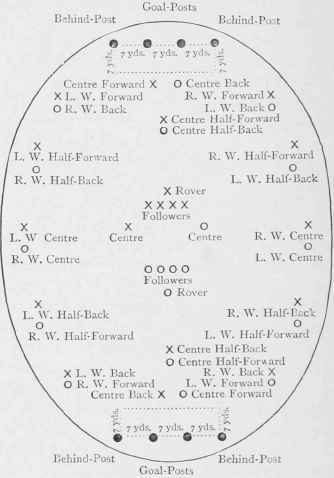
Players marked X kick ↑, while players marked O kick ↓.
In the field as thus disposed there are fifteen men on each side, who have places to which they must in the main adhere. The four who are called 'followers' stand up to the field umpire when he bounces the ball, and follow it in its wanderings over the field. They ought never to be very far from it. The rover is an individual chosen for his quickness and readiness to go wherever he is wanted. He observes the turn of the game, and follows when he sees his own followers being over-weighted by their adversaries, leaves them if he finds they can hold their own, and stations himself wherever he thinks that extra work may be required.
The best and straightest kicker of the team is made centre forward. It is the duty of all the rest to 'feed' him, and place the ball in his hands, giving him the chance to 'mark' it if possible. Then, when the ball has been 'marked,' comes his chance to kick the goal. Other players must on no account take risky shots at the goal; a difficult kick adroitly managed yields individual glory, but in the long run a taste for such display ruins the team that exhibits it. All such temptation has to be shunned, and the ball worked steadily up the field, 'middled' if necessary, until it reaches the hands of 'central forward,' who ought to put it through. The next best kickers are placed as right and left wing forwards.
Continue to:


My Books

