


Chapter IV. The Association Game
Description
This section is from the book "Athletics And Football", by Montague Shearman. Also available from Amazon: Athletics and Football.
Chapter IV. The Association Game
The Association game, though it may bear less resemblance than the Rugby Union game to the original sport, certainly finds a more appropriate name in Football, as it is with the foot alone that the ball is urged to victory. Certainly, of late years, men play with their heads in more senses than one, and a goal may be lost or won by ' heading,' but the main outline of the game is simplicity itself, being to propel the ball by kicking with the feet between the posts and under the cross-bar of the opponents' goal, and to prevent the opponents from doing the like; no player but the goal-keeper being at liberty to use his hands or arms throughout the game. Such is the simple game which has now been brought to such an extraordinary pitch of skill that none but those who have seen can well appreciate, and which is so well appreciated by those who have seen that it is no rare thing for ten or twelve thousand spectators to watch and follow a match with interest.
The dribbling game, if the theory we have given above be correct, grew up entirely at the schools where running with the ball and tackling the runners was dangerous to clothes and limbs. Each of the old schools had, as we have seen, its own game, differing in almost every point except in the essential feature of the prohibition of tackling and running with the ball, and it was not until the old public-school boys felt drawn to form clubs to play the game again when their school-days were over, that the necessity for assimilation of rules arose. Then the dribblers associated themselves in 1863, more than seven years before the Rugby Unionists, so that nearly a quarter of a century has already passed over the Association rules, which have varied but little, much as the style of play has altered during that time. Almost from its earliest days the Association has provided that ' a goal shall be won when the ball passes between the goal-posts under the tape, not being thrown, knocked on, or carried,' and that 'no player shall carry, or knock on the ball, and handling the ball under any pretence whatever shall be prohibited, except in the case of the goalkeeper,' and further that 'no player shall use his hands to hold or push his adversary;' and so, without any substantial variation, has the game remained, and is likely to remain, as long as it is played.
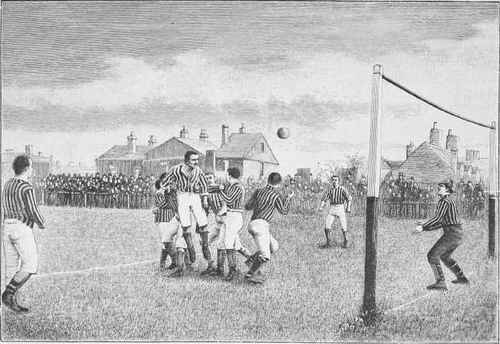
THE ASSOCIATION GAME.
So few have been the changes of rules and of tactics in the dribbling game that the task of describing the phases of Association play is simpler than to follow the changes of Rugby Unionism. From first to last the 'off-side' rule has been a trouble, and it can scarcely be said that the present rule (by which a player can have the ball passed forward to him if there are at least three players between him and the opponents' goal-line) even now gives universal satisfaction, although it has been the rule of the Association for twenty years. The question of throwing in from touch has also from time to time divided Association players, and not long since the whole Association world was convulsed with the agitation that led to the recognition of professionalism. On the whole, however, save for one thorough and important change - the abandonment of individual dribbling skill for combined passing from foot to foot amongst the forwards - the game has remained substantially the same, although in our opinion the amount of skill exhibited to-day has quite surpassed the best efforts of the crack players of a dozen years ago.
The one change, however, the introduction of a combination of passing tactics from forward to forward to the discouragement of brilliant dribbling by individual players, so far revolutionised the game that we may fairly say that there have been two ages of Association play, the dribbling and the passing. The difference of play, however, in these periods belongs almost wholly to the forward field, and, although the practice of passing-forward has so far weakened the defence of the goal that a larger number of back players has become a necessity, the tactics and tricks of back play have always been the same. But before we come to describe the modern game and its players something must be said of the game of older days.
When it was founded in 1863, the Association followed the same rule of 'off-side' which was recognised at Rugby, no player being allowed to take the ball on from one of his own side who kicked on to him from behind; and under such a rule it is obvious that individual dribbling was the only thing that could pay. In 1867, however, the adhesion of the Westminster and Charterhouse players was secured by the introduction of the present rule, and from that time both passing and dribbling became possible as a means to success. Neither the Association nor the Rugby game took a strong hold upon the public until the growing popularity of football led to the establishment of the international matches and the Association Cup Ties in 1872. Sheffield had early taken up the Association game, and had formed a powerful association of its own in 1867, playing its own rules, one of which, declaring no man to be 'off-side' if the opposing goal-keeper was between him and the goal, was widely different from the Association rule. In spite of the difference of rules, however, the Sheffielders joined the Association in 1870, with special freedom to play their own code, which they continued to do until 1877. But before the institution of a London v.
Sheffield match as an annual fixture in 1871, it may almost be said that football, until that date, was rather a recreation and a means of exercise for a few old public-school boys than a really national sport, and it was not until 'the seventies' that football began to be an attraction to the general sporting and athletic public. Nor was it until some years later still that captains and teams had discovered that the way to win a match was not to dribble cleverly and to 'back up' the dribblers, but to pass and to trust to combination alone.
Continue to:


My Books

