


The Rugby Union Game. Part 12
Description
This section is from the book "Athletics And Football", by Montague Shearman. Also available from Amazon: Athletics and Football.
The Rugby Union Game. Part 12
South matches has been won by the South. The Southern system of selectional matches is not many years old, and the working out of the idea has owed much to Mr. G. Rowland Hill, the hon. sec. of the English Rugby Union, who is one of the rare examples of a sporting enthusiast who does not allow his enthusiasm to give any bias to his views. Footballers throughout the kingdom owe more to his energy and discretion than they are aware of. The North v. South match takes place early in December, and it is from the form they show in this match that players gain or lose the coveted honour of the international cap. The international matches all take place in the three months after Christmas; the match between England and Scotland, which is the great event of the season, is played alternately in England and Scotland in March, and with this the season is brought to a close.
A word may perhaps be said about the strong prejudice which prevails with most Rugby Unionists against the system of cup ties. The objections to these contests are weighty even with respect to the Association game, as there is no doubt that they interfere with the ordinary and pleasant routine of club fixtures, and lead to great expense and trouble, besides exciting partisanship to a high degree. But of this we shall have more to say anon, when we come to discuss the Association game. It is something more than this, however, which makes the Rugby Union so strongly discourage cup ties. It is strongly felt that the Rugby Union game, with its collaring and throwing to the ground, its scrummaging and its collisions, is naturally so rough that not the least occasion should be given for allowing warm partisanship to lead to ill-temper, and ill-temper to brutality. Experience has conclusively shown that, whatever be the class of the players, Rugby cup ties give an opening for ill-feeling and the exhibition of unnecessary roughness. The present writer has seen various Rugby Union cup ties, and never left such a match without feeling strongly that they are an abomination.
The hospitals have their annual Rugby cup tie in London, and that the roughness is greater than that of any other match in which hospital fifteens engage seems apparent. As long ago as 1876, the Oxford Rugby Union decided to have a College championship, and the competition was abandoned after two years' trial on account of the roughness of the game. The writer still has a vivid recollection of playing in the final tie in 1877, and can well recollect what a battered appearance was presented by his side when they met to celebrate the occasion in the evening. There seems to be little doubt that in the excitement of a cup tie the old Adam in the breast of the footballer will have its way, and probably nothing but a team of Neoplatonists could play a Rugby Union cup tie without roughness.
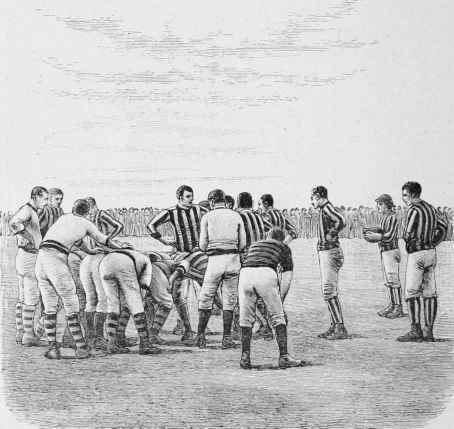
Partisanship.
The Committee of the Yorkshire Union can hardly be ignorant of the way in which cup-tie play is liable to degeneration. Their book of rules is significant evidence upon the point:
15. In case of wilful breach of the rules of the game or any foul play, the referee may caution the offending player, or order him to retire from the game, and no substitute shall be allowed to take his place.
16. In order to prevent a rough style of play in Cup contests, the committee shall have the power (on a unanimous report of the referee and umpires) to disqualify a team for rough play, even if that team win their round.
No wonder the Captain of the Northern fifteen in 1880 alluded with his well-known homely eloquence to 'those beastly cup ties.' Association players should understand that we only endorse this sentiment in its Pickwickian sense, and confine its application exclusively to the Rugby Union game.
The system of county matches which is the essential basis of antagonism at cricket seems hitherto to have failed, more or less, at football, and most especially so in the South of England. In the North there has certainly never been any lack of interest over the match between Lancashire and Yorkshire; but a few years ago county football had entirely ceased to raise any interest outside of the North of England. The authorities of the Rugby Union tried to remedy this state of affairs by instituting a competition for the county championship, and there can be no question that this competition has intensified the interest in county matches in the North, and has done something to quicken the interest in county fixtures in other parts of the country. The counties are divided into four groups, the North-Western (Lancashire, Cheshire, Cumberland, and Westmoreland), North-Eastern (Yorkshire, Durham, and Northumberland), South-Eastern (Kent, Middlesex, Surrey, and Midland Counties), and Western (Somerset, Devon, Cornwall, and Gloucestershire). The winners of the respective groups each play one match during the season with the winners of the other groups, and in this way the champion county is picked.
The new system has certainly been of some use to the authorities in bringing out new talent for the international matches, but can hardly be said to have had the desired effect of stimulating the South to take interest in county matches. The great county of Yorkshire is almost invariably too strong for the other counties, and save in 1890, when Lancashire managed to beat her old opponent, Yorkshire has always been, and seems likely at present to continue, the 'cock county.' At the end of the season it is usual for the champion county to play the 'Rest of England,' and Yorkshire has twice succeeded in beating the Rest. The matches in London between Surrey, Kent and Middlesex excite but a very languid interest.
We have said enough of the time-honoured and boisterous game of Rugby football in the past and in the present. It is perhaps idle to speculate whether it will take any altered shape or be subject to any altered conditions in the future. During the quarter of a century that it has reappeared as a popular sport for gentle and simple, it has gone through several phases. The first movement was to reduce scrummaging to its due proportion in the game; the second movement, to give increased importance to systematic passing. Whether either or both movements will continue and will lead to fresh developments, it would be rash to prophesy. Certainly many of the lay public who do not know the genuine delight nor understand the science of scrummaging, think there is still too much pushing in the game. What such a game as Rugby football without scrummaging would be like is hard to conjecture; the very suggestion would seem a heresy to most players; but one thing may be said with tolerable certainty, that if any future change is to be made, it will certainly not be in the way of a return to the old scrummaging order of things.
From year to year the Rugby Union game has become faster and more skilful, and yet has shown no signs of being less manly than of yore.
Continue to:


My Books

