


Chapter III. The Rugby Union Game
Description
This section is from the book "Athletics And Football", by Montague Shearman. Also available from Amazon: Athletics and Football.
Chapter III. The Rugby Union Game
Although the forms of the dribbling game were many and various, as we have seen, the running and tackling game has always been played, since it first became an organised sport, substantially in one way, that in which it came from Rugby school to the country at large. That form, it will have been perceived, is historically an adaptation of the original scrummaging game to a field of play when there was plenty of room for a number of boys to overthrow each other 'without hazard (or any great hazard) to their limbs.' The ground not being unlimited, like the field of play of 'hurling across country,' boundaries at the end and sides, or 'goal lines' and 'touch lines,' were established, and the ball when beyond these was considered out of play as soon as 'touched down.' Save for this the original features of the game remained only just altered so far as to prevent any actually dangerous violence. As soon as the game came from boys to men, however, further modifications became necessary, as the adult shin and neck could not stand the amount of 'hacking' or 'scragging' which used to be seen in matches at the Rugby game before the rules were definitely settled and promulgated by the Rugby Football Union. Now we do not intend in the present work to describe in minute detail the rules either of the Rugby Union or Association games, taking it for granted that those who do not know the games, by actual acquaintance as players or spectators, will care nothing for what we have to say about them; while those who do so know them will not require to be enlightened about the ABC of the sport.
We may also at once say that we do not propose in any of our criticisms of the past or present games under either set of rules, to take sides in the old and threadbare controversy as to which is the better game - Rugby or Association football. To start at once with a piece of advice, we recommend both players and spectators to pay their money and take their choice, and for preference to try both, not together but 'singly in quick succession.' At the outset, therefore, we may begin by saying, we hope, without offence, that the early matches at the Rugby game were very dull affairs, and that it is only very slowly and tentatively that the Rugby Union rules and style of play have been altered so as to render skill of more avail than force in the settlement of matches. Rather more than a dozen years ago we saw a shoving match between rival teams of Scotchmen and Englishmen which was dignified by the name of an 'international match.' A quarter of a hundred of heavyweights appeared to be leaning up against each other for periods of five minutes or thereabouts, while occasionally the ball became accidentally disentangled from the solid globe of scrummagers, and the remaining players then had some interesting bursts of play between themselves while the globular mass gradually dissolved.
The plain truth of the matter was that the Rugbeian traditions of ' big-sides' still remained an article of faith with players, and that the main thing which kept big-sides from becoming shoving matches was first the small-ness of many of the boys who could thus move about in the scrummage, and secondly the hacking which kept the scrummage open and the ball moving. For the dozen years or so during which the Rugby game was played before the foundation of the Rugby Union the shoving was the great hindrance to its popularity. True it is that the matches as a rule were only between fifteens and not twenties, but the grounds used were often very small, and were described as 'large enough for fifteens' by the players, who still thought that twenty was the minimum for a model side. So far also did the notion go that scrummaging was the essence of the game, that some clubs played the rule that no man who was tackled was obliged to call 'down' unless he liked; and in one match in which the present writer played, the heavier side, when one of their own men was collared, used the tactics of never calling 'down,' but of shoving the whole of the opposite forwards down the ground until the accidental or intentional 'tripping up' of the whole scrummage by the side losing ground necessarily caused a halt, and the ball was then at last put clown.
The Rugby Union, immediately after its establishment in 1871, determined to put a stop to this 'mauling,' before the ball was down, and the 18th law was especially framed to deal with this abuse. This law has since been altered, as we shall see later, but as originally framed it ran as follows: 'In the event of any player, holding, or running with the ball being tackled, and the ball fair/y held, he must at once cry "down" and there put it down.'

THE ROGBY UNION GAME.
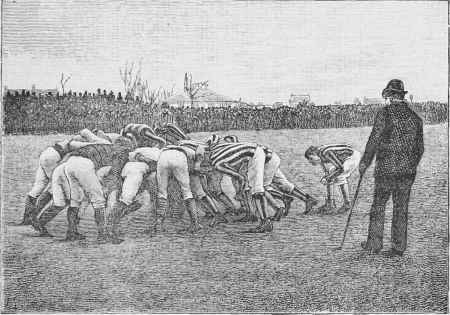
Rugby football.
A few words might perhaps here be said with reference to the Union code of laws, which are too long to discuss seriatim, and will therefore, in their present form, be placed in the Appendix to this work. By reading them, one can perhaps obtain as good an idea of what the game is as can be given by any bald scientific description of a moving scene of life. The original laws have naturally been altered from time to time as the character of the game changed, and as abuses arose which it became necessary to prevent, but there can be no doubt that they were very admirably and carefully drafted.
The original code of laws was the work of three old Rugbeians - L. J. Maton, A. Rutter, and E. C. Holmes, and it is doubtless due to this fact that those who now play the running and tackling game are substantially playing the same game which the founders of the Union played at Rugby School. After twenty years' use the original laws became so overlaid with a mass of amendments and additions that the Union decided upon a new codification. The present code, which is printed in the Appendix, was mainly the work of W. Cail, of Northumberland County. It came into force at the commencement of the season 1892-3, and has stood the test of practice well, as very few amendments or explanations have been necessary since the game has been played under this set of laws.
Continue to:


My Books

