


Paper-Chasing And Cross-Country Running. Part 3
Description
This section is from the book "Athletics And Football", by Montague Shearman. Also available from Amazon: Athletics and Football.
Paper-Chasing And Cross-Country Running. Part 3
Hares are very seldom caught by the hounds, and never if they know the rudiments of 'false' laying, for a hound must be lucky indeed if he has not to go a mile or so more than the hares in a moderately long run.
The distance run varies much, and usually consists of a ring of eight to ten miles from the club-house, which is generally an old-fashioned suburban inn. Some clubs go much less, and there is a standing joke that no member of one well-known club had ever been seen off an equally well-known common of about two miles square, till one of them was found roaming about disconsolately quite lost three miles from home. The longest run we remember was round Ewell and Epsom and half-a-dozen other villages, about twenty-four miles. J. Scott finished first in a little over three hours.
Hares and hound alike should run in the colours of their club. Canvas shoes with india-rubber soles, worsted socks, flannel knickerbockers, and white or dark blue watermen's sweaters are the best things to wear in the winter, for if a brook has to be forded or a river swum the warm wet wool prevents any chill being taken in the coldest weather, and those who have tried it are aware that it is cold after sunset running over two miles of heath, fagged out, in wet things. On no account, however tired, should the runner walk more than a few yards at a time, but go on home at a jog-trot, however slow. We remember a narrow escape from very serious results when a runner, far from home, sat down in a dry ditch to rest. Had he not been picked up and dosed with hot drink, and rubbed till his skin came off, the consequences might have been grave indeed, for his hands and arms were 'dead' up to the armpits. We can, however, speak from an experience now covering nearly twenty years, and can positively say that we know of no man of the hundreds with whom we have been acquainted who has been injured by distance running, and the rate of mortality among running men is singularly small.
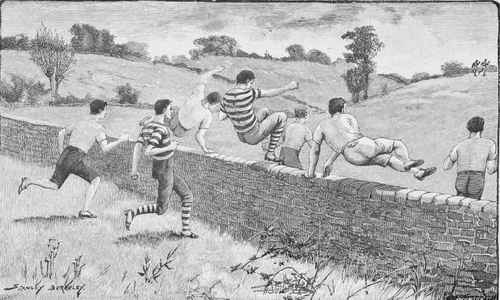
THE HOUNDS.
Hounds should be strongly cautioned against 'larking' over unnecessary jumps or doing the least avoidable damage. Farmers are mortal, and are therefore generally fond of sport, and if no great damage is done and if what is done is cheerfully and voluntarily paid for, will generally let a moderately sized pack cross their land; but near London monster packs of thirty or forty runners become a nuisance. Like hunting the scent, jumping for the sake of jumping is dying out a great deal. We have no fine jumpers nowadays, like the two Burts who learnt the art at Wellington and would take every gate through a long run, or A. P. Smith who would jump at anything, or tricky jumpers like Bentley, who used to land with both feet on the top of a five-barred gate with a clatter and a rattle, and jump off the top far into the next field.
In fact, jumping does not pay in the cross-country racing which has to a great extent supplanted the old paper-chasing proper, for it takes too much out of a man. The new class of men get over the ground wonderfully fast and can scramble and 'jump up anywhere,' but do not aspire to jump over obstacles. Still they are so handy in a very cramped grass country with plenty of difficult wood-grown banks and thick hedges, that a picked team of runners would take the conceit out of most riders to hounds.
When the run is over, the tub - lukewarm if it can be had - is in universal request, followed, if possible, by a cold douche by means of a bucketful of water from the hands of a stable-helper. If the run has been extra wet or cold, a steaming glass of port negus may be wisely taken as a precaution; but it is a singular thing that both before and after the meal which terminates the evening, 'ginger beer and gin' is the favourite drink, having probably been found by long experience to best carry off the extra heat of the body caused by a long run. While on the subject, we may say that though many of our best short-distance runners were actually teetotallers, e.g. J. C. Clegg, J. Shearman, and others, we have only known one abstainer (Coad) who was anywhere in the first flight of cross-country runners. The tea, which is usually followed by a formal meeting l and a 'sing-song,' used to close the evening very pleasantly. Too often, nowadays, however, the card-playing which has spoiled and ruined so many a young athlete is introduced by a selfish few, who are not satisfied with simple sociability.
The round game of spelling-bee, in which the sport is to close a word as soon as possible against your left-hand neighbour, is, however, very popular, and may be said to have originated at Roehampton. With a room full of athletes, friendly chaff often leads to matches, and two or three times we remember offhand races coming off late at night, one especially of sixteen miles (twice round the Thames long course), which resulted in the scratch man coming to the front about 300 yards only from home, and both men reaching the goal smothered with mud and bleeding from innumerable scratches.
Of the use of paper-chasing and, in moderation, of crosscountry steeplechasing and team racing, there can be no doubt. To be a good runner over country, a man must be abstemious, patient, and good-tempered. A sprinter may indulge up to a certain point both in smoke and drink, but woe betide the ordinary long-distance runner who takes too much of one or the other before a hard race. Stenning was an example to the contrary, for he seldom had a pipe out of his mouth when he finished first for four consecutive years, but he was an exception that proved the rule, and nobody knows what he might have done had he not smoked. He was also very fond of all sorts of pastry, which cannot be recommended to runners as a rule. That cross-country work has heightened the standard of long-distance running immensely is certain, for not only are all times from two miles up much faster than of yore, but they have all been made by men who are notoriously cross-country runners; in fact, it would be hard to find a man in the first flight who is not a member of some paper-chase club or another.
Of late years Gibb, George, Rogers, and Coad are brilliant examples of the truth of this statement.
1 For the election of new members, and other business.
It is probably no exaggeration to say, that a hundred men could now be found in paper-chase clubs who could run ten miles in the hour, and a score who could run eleven. How valuable such a body of men would be in time of war for scouts or messengers need hardly be explained, and even when war is not imminent they have their uses.
The future of paper-chasing is doubtful. The evils of importing members solely to run in match teams, of running matches round enclosed courses for gate-money, and of winking at, if not tolerating, regular betting by lists, have taken firm root, and have injured it greatly as a sport. The mechanic, artisan, or labourer, who used to be barred from competition with gentlemen, is now not only allowed to run, but, if fast, is a welcome member of all country, and many London, clubs, there being only one which insists on all its members being gentlemen by profession and education. If cricket recognises class distinction, why should not paper-chasing? The bricklayer or carpenter who can do 'thirty under' for a mile, and to whom 20/. is a mine of wealth, is too apt to accept that sum from a bookmaker not to try at the 'Championship.' Roping is too often overlooked, and treated more as a joke than anything else. Another feature which has tended to lower the sport, is the ridiculous number of prizes given in steeplechases, and the 'pewters' and medals presented to the first men in, or first bicyclist in, and so on, in ordinary runs. Men ought to take enough interest in the sport, for the sport's sake, to come down and run without these paltry bribes.
If they do not care for sport only, let them stop away. The explanation of all this is, that the management of many of the clubs has got into the hands of men who have had no practical experience of the sport, and who simply run them as athletic rather than cross-country clubs, for the sake of the popularity or prestige which is supposed to attach to the officials of an athletic club, though they may have been outsiders or duffers and be in no way in touch with the real wants and feelings of genuine athletes. The snobbery, too, of touting for the use of the names of local celebrities, M.P's. and so on (who neither know anything of, nor care anything for, the sport), as presidents, vice-presidents, and so on, and the degradation of accepting challenge cups from the publicans at whose houses the clubs meet, have greatly tended to bring the sport into disrepute.
Continue to:


My Books

