


Running And Runners. Part 16
Description
This section is from the book "Athletics And Football", by Montague Shearman. Also available from Amazon: Athletics and Football.
Running And Runners. Part 16
A steeplechase of two miles was one of the events in the first Inter-'Varsity gathering on the Christ Church cricket-ground at Oxford in 1864, when R. C. Garnett, of Cambridge, proved himself too good by six yards for the present Attorney-General, of whom, as a runner, we have already spoken. In the following year, however, the event was changed to a two-mile flat race; and there have been no more steeplechases at Inter-'Varsity gatherings. For the four or five years before 1875 the few steeplechases that were included in meetings round London were nearly all won by C. J. Michod, a Civil Service runner, who was very clever over the obstacles and water-jumps, and would have been a fine distance-runner had he been gifted with a little more pace for a spurt. We can recollect on one occasion Slade starting at scratch with Michod in a steeplechase at the Richmond Cricket Club Sports; but the crack miler blundered so much over the hurdles, banging his shins, and occasionally falling prostrate, that Michod before long sailed away from him, and eventually won the race outright, Slade giving up.
In the summer championship of 1879 a two-mile steeplechase was included in the programme, and was won by H. M. Oliver, an old London paperchaser, who for some years previous to that date had settled in Birmingham and become the leader of the athletic movement in the midlands, and founder of the famous Moseley Harriers Club. Oliver was only a moderate performer on the flat, but was certainly a very clever jumper, never wasting an ounce of his strength, and he beat, in 1879, C. L. O'Malley and the other Londoners by the clever way in which he got upon the top of the hurdles and jumped from them clean over the water-jump without an effort. Of late years the best steeplechasers have nearly always been the bestpaperchasers of the day, the ordinary flat-race runners having little opportunity to practise jumping without taking part in crosscountry runs. The best Londoners have been C. L. O'Malley, who, however, never, we believe, figured as a paperchaser, and J. T. Wills, an old Oxonian, who was good on the flat also.
Strangely enough, as the sport is a very genuine and interesting one, steeplechasing is quite unknown at athletic meetings at the Universities; and what makes this still more strange is that in hurdle-racing - a kindred sport - the 'Varsities uniformly produce some of the best men in every year; indeed, of the twenty-nine hurdle-racing champions up to the date of writing, seventeen have hailed from Oxford or Cambridge.
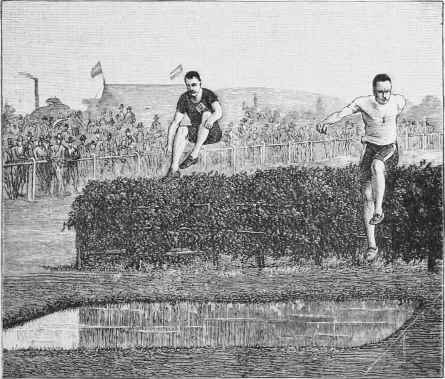
Steeplechase - Water-jump.
Hurdle-racing. - In the early days of amateur athletics hurdling and steeplechasing were considered as kindred sports, the former being a test of short-distance running plus jumping, the latter of long-distance running plus jumping. So much was thought of this judicious combination that the first Inter-University meeting at Oxford, in 1864, had two hurdle races and a steeplechase out of eight events, the remaining items being three flat races and two jumps. The two hurdle races were at 120 yards and 200 yards, each having ten flights of hurdles. The former distance, however, soon became the more popular; and the committee who drew up the programme for the first championship meeting settled the future of hurdle-racing by fixing upon 120 yards race with ten flights, the hurdles being 3 ft. 6 in. high, at even distances of ten yards, with fifteen yards between the start and the first hurdle, and a similar distance between the last hurdle and the finish. As soon, however, as the distance between the hurdles became stereotyped the runners were not long in finding out that in the race invented to test running and jumping powers in combination the more running there was, and the less jumping, the faster the time over the distance would be.
Experience soon taught that three strides would take a man from hurdle to hurdle, and that he could spring off one leg and alight on the other, taking the hurdle in his stride. The result was that hurdle-racing over the recognised distance soon became a very difficult and pretty but highly artificial performance. The 'crack' hurdler takes every stride of exactly the same length, rises exactly the same height at every jump, and moves with the regularity and precision of clockwork. Some jump off the right, some off the left, foot; in either case, when the spring is taken the front leg is jerked up enough to enable the runner to get his shin or knee over the bar; that leg then is dropped again, so as to enable him to alight on the ball of his toe; meanwhile the hind leg is lifted in similar style over the bar and straightened at once as soon as the bar is cleared, and directly the other toe has alighted the next stride is taken almost without a pause. It will be obvious how slight a delay is caused by clearing the hurdles when it is considered that men who are equal to little better than 12 3/4 seconds over 120 yards on the flat have covered 120 yards over ten hurdles of 3 ft. 6 in. high in 16 seconds.
The sport is a pretty one, requiring great skill, speed and agility, and a 'light foot,' but we cannot help expressing a wish that in addition there might be seen other short hurdle races at meetings where the runners should not know the exact distance between each hurdle, and the exact height of the jump, and so would be unable to calculate the precise length of the stride and the precise amount, to the smallest fraction, of the power required to lift them over the hurdle. Running is nothing if not natural, and graceful as hurdling is, in our opinion it has been brought to too high a pitch of artificiality. We have seen H. K. Upcher, one of the best of the Oxford hurdlers, take two spins over hurdles, when in each spin his feet fell in exactly the same track (and we may add the same part of his shin scraped the top of the hurdle in exactly the same spot), so that a Red Indian following him by his tracks would hardly have seen that he had been twice over the same ground.
Continue to:


My Books

