


Running And Runners. Part 5
Description
This section is from the book "Athletics And Football", by Montague Shearman. Also available from Amazon: Athletics and Football.
Running And Runners. Part 5
Lockton was, we think, the most beautifully-proportioned runner we ever saw on the path, and would probably have been first class at any distance he chose to take up. Unfortunately he left behind him, as some others have done, the reputation of being a 'fine runner but a poor racer.' In practice his trainer timed him to do level time over a hundred yards day after day, but on more than one occasion he succumbed to his inferiors, notably in the championship of 1880, when he was beaten by a few inches by W. P. Phillips and Massey. Lockton both sprinted and hurdled in a very graceful and taking style, and the contrast between him and Phillips when they ran together was most marked, Lockton running low and Phillips perfectly erect. For the next three years (1880, 1881 and 1882) the Championship Hundred Yards was won by W. P. Phillips, the best English amateur at a quarter-mile before Tindall's day, whose untimely death from heart disease in 1883 came as a shock to the athletic world. Phillips, who was over six feet, was, like Lockton, a model of manly strength, and was a splendid oar as well as runner. From 220 yards to a quarter-mile he was unrivalled, but a hundred yards was hardly long enough for him.
His three championships were each won by a few inches, and in each case a lucky start had something to do with his victory. His runner up in 1881 and 1882 was J. M. Cowie, who afterwards took the championship at this distance for three years, and was possibly superior, and certainly not inferior, to Lockton and Junker and the older cracks. Although only of medium height and calibre, he, like the other celebrities, was very strong in the back and thighs, and his superlative form was in a great measure due to years of persistent and careful training; for though he was of first-rate ability as long ago as 1880, it was not until 1884 or 1885 that he showed his very best form. The other celebrities of the day at sprinting, Wharton, Ritchie, and Wood, have been previously described. Wharton was undoubtedly the speediest at 100 yards, but Wood excelled him at the longer sprints, and in 1887 'cut' all the old records from 150 to 300 yards. Wharton has recently joined the professional ranks. It is always an unsatisfactory task to attempt to compare the athletes of past and present days in any branch of sport, and, although in longer races the time test can be applied satisfactorily, the conditions of wind, weather, and ability of timekeeper prevent timing in short sprints from being an absolutely certain guide.
As far, however, as any line can be taken through times, there seems to be but very little difference between the merits in sprinting of the chief cracks during the last fifteen years.1
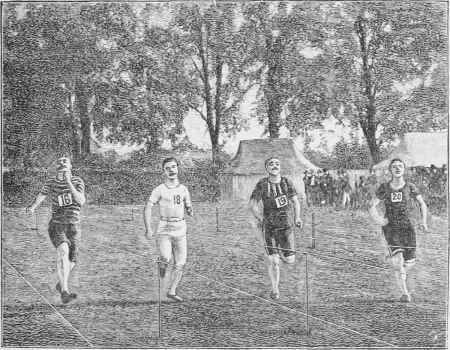
Sprinting of to-day.
The next distance beyond the 300 yards sprint which is regularly run is the quarter of a mile, although managers of athletic meetings who desire a novelty, or ambitious competitors who flatter themselves that they will obtain some credit by making a record over a distance which no one has ever tried before, occasionally promote a race at some intermediate distance. As a general rule, however, it may safely be said that the experience which decided what distances should be regularly run was not at fault, for of the distances of 220 yards, a quarter-mile, half-mile, and mile, each brings forth a totally distinct class of runner, who may excel at his own single distance and at that alone. Generally the quarter of a mile is a most interesting race, as it gives an opportunity both to the man who has real sprinting pace and to the man who has stay and strength. As an example of how much reliance can be placed upon the popular manuals of sport, of which so many are published, we may perhaps quote with advantage the sapient remarks contained in one of these publications which is now before us. ' The quarter-mile race,' says our author,' is about the severest course that can be run; it requires both pace and stamina.' So far he is doubtless right, for runners have been known to 'run themselves blind' before reaching the tape in this race; that is, have been so exhausted that they could finish and feel the tape, and yet were unable to see anything.
After stating, however, how severe the 'course' is, the practical directions given for preparation for the race are that the athlete 'should run the racing distance only once a day.' A moment's reflection should show even the uninitiated how absurd this advice is; for it practically amounts to this: 'To make a man fresh and strong, to give him both spurt and reserve of energy upon an approaching day, you should make him thoroughly
1 C. A. Bradley of Huddersfield was the amateur champion of 1892 and 1893. He was a strong thick-set man of moderate height, who ran erect and straight as an arrow. In the championship race of 1893 he ran slightly up-hill and against a slight wind and reached home in 10 seconds, a record which speaks for itself, exhaust himself at least once a day.' It is advice of this sort which sends athletes into the hospitals or to an early grave, while, if they had passed their youth in a sensible and rational course of training and practice, they would have laid in a stock of health and strength which would have rendered them independent of a doctor's advice for the rest of their lives.
It may seem a paradox, but it is, we think, true, nevertheless, that there are two entirely different ways of preparing for a quarter-mile race. The reason is this, that the distance is a common ground for two entirely different classes of runners. On the one hand, the best quarter-miler of the day is often the man who is the best sprinter as well, and has found that this distance is not beyond his sprinting powers when he is very fit. On the other hand, the sprinting quarter-milers sometimes find themselves outclassed by a runner who is of nothing more than second-class sprinting ability, but whose stay and strength enable him to keep his stride from shortening up to the very end of a quarter-mile or even farther. To take some examples from the present day. To Cowie and Wood the quarter is really a sprint, and nothing else. But a pair of Cambridge runners, W. H. Churchill and R. H. Macaulay, occur to our mind who were indifferent sprinters, and yet could beat 51 seconds for a quarter-mile, and could probably have reached 50 seconds if pressed; while H. R. Ball is another example of the same class. Even Myers, the best quarter-miler by a very long way who ever appeared in the amateur world, was of no particular account at any distance shorter than 200 or 220 yards.
Continue to:


My Books

