


Running And Runners. Part 8
Description
This section is from the book "Athletics And Football", by Montague Shearman. Also available from Amazon: Athletics and Football.
Running And Runners. Part 8
He was of medium height and weight, but ran with his body low, and with the smallest possible appearance of effort, although his stride was very long for his height, indeed the length of stride seemed in no way due to length of leg. He took long and easy bounds over the ground, and both in build and style of running was not unlike Cowie, although the latter had not that peculiar ease and lightfooted-ness which distinguished Clague. Unfortunately Clague never met Elborough, who was the leading figure amongst amateur runners of short distances, during the three seasons of 1875, 1876, and 1877, and who during that time divided with Walter Slade, the miler, the reputation of being the most famous amateur upon the path.
1 In the championship meeting of 1889, H. C. L. Tindall ran the quarter in 48 1/2 secs, beating Myers' English record, but we never saw any quarter-miler so good as Myers at his best.
Elborough was well above the medium height, being quite 5 ft. 10 in., and weighing, we believe, about 11 st. in training. Although not so strong physically as Colbeck, who must have been a couple of inches taller and a stone heavier, in his capacities he was a second Colbeck, as his long stride made him a sprinter hard to beat at 100 or 150 yards, and invincible at 220 or 300 yards. As a quarter-miler he had no one to extend him, and as, although he trained assiduously, he was somewhat fitful and fanciful in his appearance on the path, he did no performance at this distance at all worthy of his reputation. A line, however, can perhaps be drawn by collateral form which would show his powers. In two quarter-mile races in two successive years at the Civil Service Sports a handicap of seven yards brought Elborough and J. Shearman together. The latter was doubtless an improved man when in 1877, in a match with H. H. Sturt, he covered the quarter at Lillie Bridge in 505 seconds, but at any time Elborough at his best could, we think, have given five yards to the elder Shearman. Indeed, his trainers and the public never doubted that Elborough, had he been wound up for a quarter, could have got well inside 50 seconds.
In those days, however, the feverish desire for making records (which we think the athletes have caught from their cycling brethren) was not raging, and runners like Elborough liked to win their races and their championships without troubling to scamper over so many yards of cinder a shade faster than some predecessor. In style Elborough ran very erect, shooting his legs out in front of him. He was cleanly but not strongly built, and his excellence as a runner must be set down to his perfect proportions. Up to the spring of 1876 we believe he never attempted more than 600 yards, and was in training for the Hundred Yards and Quarter Championships of 1876, but being dissatisfied with his speed, altered his mind at the last moment, and started for the Half Mile and the Quarter, winning both with great ease. Ultimately he proposed to extend his practice to mile running, but being beaten in the provinces in the summer of 1877 at 1,000 yards by C. Hazenwood, he never afterwards made a show upon the path.
In 1880, W. P. Phillips, who had been doing some fine performances at 220 yards, turned his attention to quarters, and had he run with a little more judgment in his initial attempt in the championship of that year might have earned the title upon the first occasion he ran a quarter in public. Phillips, however, who was a very fast sprinter, seemed by some fatality bound to make a fiasco of all his attempts to win the Quarter-Mile Championship, and, although undoubtedly capable of a better performance at this distance than any Englishman since Elborough, either from nervousness or bad judgment, invariably spoilt his chances by running too slowly in the early part of the race. Thus he was beaten in 1880 by M. Shearman, in 1882 by H. R. Ball, and in 1883 by Cowie, although he was undoubtedly a better man than any of the three over this distance. In 1880, after racing off fast, he slowed in the middle until he had allowed the winner to get seven or eight yards away from him, and then was only beaten by two yards at the finish. In 1881, when he met Myers, who was undoubtedly too good for him, he pushed the American crack along the whole way, was not shaken off until 100 yards from home, and then only finished three yards behind the winner in 48 3/5 seconds.
The Aston track, upon which this race was run, is certainly very fast for a quarter, the last 300 yards being downhill; but whatever the time was, Phillips showed his extraordinary excellence by being the only man who could ever make a race with Myers at this distance. In 1882, therefore, with Myers out of England the Quarter Championship seemed a moral for Phillips; but, to the intense astonishment of everybody, he started as if he were going for a mile race, and never had the least chance of catching H. R. Ball, who sprinted throughout, and won in the fine time of 50 1/5 seconds. Probably Phillips, who was certainly not deficient in pluck, as his race with Myers showed, suffered all along from the ' weak heart' from which he suddenly died in the next year, and to this must be ascribed the disappointing form he displayed on some occasions.
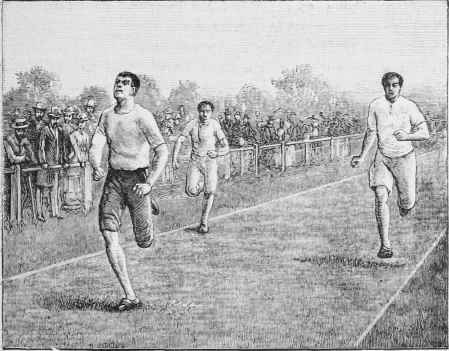
A very fast sprinter.
During the last few years, Cowie, Wood, Ball, and Tindall, the old Cambridge 'blue,' have all done performances equal to or better than 50 seconds for a quarter. Probably, however, the improvement in quarter times since Myers appeared in England is due to the lesson taught by that runner, that to run a good quarter one must be prepared to 'spin' all the way, and there will very likely yet be seen some further developments in the way of fast quarters in the next few years.l
Our survey of famous quarter-milers may aptly be concluded with some notice of Myers. There is very little doubt that this runner, while in his best form, some years ago, could have approached very near to 48 seconds in his quarters, a performance which it is improbable that any other runner, amateur or professional, could have compassed. Myers, in more senses than one, was a phenomenon; his physical conformity was somewhat marvellous, and of a kind not likely to be soon met again. Although about 5 ft. 8 in. in height, his weight was only just 8 stone, and from a glance at a photograph which we have before us of the American in running costume one fact strikes the eye at once: that his legs are disproportionately long as compared with his body. According to his own account his mother died young of consumption, and Myers himself, although not appearing in the least consumptive, certainly was not troubled with an ounce of superfluous flesh. Being, then, little more than a long pair of wiry legs, with a very small and light body upon the top of them, it is hardly surprising that he should have made a very good running machine.
Continue to:


My Books

