


Running And Runners. Part 9
Description
This section is from the book "Athletics And Football", by Montague Shearman. Also available from Amazon: Athletics and Football.
Running And Runners. Part 9
Certain it is that Myers' extraordinary times over a quarter and a half mile arise from the fact that, as he begins to tire and labour in his running, his stride appears to lengthen instead of shortening. Those who have noticed him running quarters have seen that about the middle of the race, when the English heavy-weight sprinters take their first breather, Myers is enabled to shoot away and place a gap of half-a-dozen yards between himself and the second man without an apparent effort. Having, in fact, no weight to carry, no distance under a mile can tire him, and this it is, we think, which enables him to run right away from any opponent at any distance where staying power is a necessity as well as speed. Certainly Myers is unlike any of his predecessors at this distance; whether another will ever appear like unto him it is hard to say.
1 Since tins was written II. C. L. Tindall has run a quarter in 48 1/2 sec. at Stamford Bridge.
A very favourite distance at athletic meetings is 600 yards; but, although the race is so common, it can hardly be considered a distance in itself, as it is very rarely that the winner who can manage 600 yards is not capable of doing a half-mile as well. The fine sprinter, who may be able, by a certain amount of staying power, to make a first-class quarter-miler, cannot, as far as ordinary experience goes, manage 600 yards. In fact, at any distance over the quarter, one may say that staying powers are more important than speed. The man who can run 600 yards comfortably can probably do any distance whatever creditably, while many sprinters could hardly cover a mile as fast as a schoolboy. In a 600 yards race, therefore, the sprinting quarter-milers are found conspicuous by their absence. It is a race which cannot be won by the winner rushing off fast and making use of his pace while he has it. In a word, the man who can run 600 yards comfortably may safely train for a half-mile as well, and it is not necessary to consider the runner of 600 yards apart from the half-miler.
The medium distances, however (600 yards, half-mile, 1,000 yards), produce a distinct type of runner, who must be trained in a distinct way. Many men, like the Hon. A. L. Pelham, H. W. Hill, of the L.A.C., and T. E. Wells, the Oxonian, were half-milers pure and simple. The half-miler is sure to be good at a quarter and good at a mile, for he must have speed and stride, and must have as well good wind and staying powers; but many and many a runner can only find his true distance at half a mile or 1,000 yards, and until he trains for these distances misses his real vocation upon the cinder-path. The system of taking exercise for races changes completely as soon as sprinting distances are left behind. The man training for medium distances will, of course, do himself all good and no harm by sprinting to improve his speed, but his sprinting is only an accessory, and not the essential, to success. He has got to improve his legs, wind, and all the muscles of his body in strength, and the way to do this is not gradually to lengthen the distances of practice so much as gradually to increase the pace over those distances. As we have said before, the man who is training for half a mile will do enough to take his trials over 600 yards, or thereabouts.
As he gets fitter he should accustom himself to go faster over his spin. Once or twice befure the race he may have 'a full-dress rehearsal' - a veritable trial over the whole distance, that he may know exactly what he has to do in the race, and the more walking he can get in the day the better, as there is nothing so healthy, and so little exhausting, to a man in training as brisk walking in fresh air.
Suppose, then, the half-miler has got himself into the state of preliminary fitness, and is going to give himself three weeks of training for a race. On the first day he will do with a steady equable 600 yards. On the second day a brisk 600 yards, which will stretch his limbs a bit, and remind him that running is not all pure enjoyment. On the third day he may take it easy again, and do a very slow, steady half-mile, without making any attempt to spurt, or quicken, or push himself along at any part of the course. On the fourth day he can do the brisk 600 yards again; on the fifth a steady and slower 600; on the sixth a rather brisker 600 yards than he has done before; and then, if he takes a good walk on the intervening Sunday, he will feel himself at the end of his week a good deal more like a runner than he was at the beginning. A similar programme will do for the remaining three weeks of training, but his full trial should be at least a week before the race, and for the last few days before the event he should take no spin at all that can possibly exhaust him. Indeed, on the day before the race a sprint or two will be quite sufficient to maintain him in the state of fitness to which he has arrived.
Above all, if on commencing practice any day he feels that he has not got over his yesterday's exertions, he should make a point of having a light day's work upon that occasion, as it is always better to do too little work than too much. But the runner, while practising, should never forget that the main object of all his practice is to improve the even pace which he can accomplish over the distance. In medium and long-distance races the runner must accustom himself to run at an even pace, and at as fast an even pace as he can command over the distance, keeping his spurts for when they are wanted, either to pass an antagonist or to get in front at the finish; so that, in training for these distances, it is of importance to know how fast one is going. It is wise, therefore, to be timed from day to day by a trainer, who will tell the man what pace he ought to go for the distance he is running for the day, and whether in the actual spin he has got inside it or not.
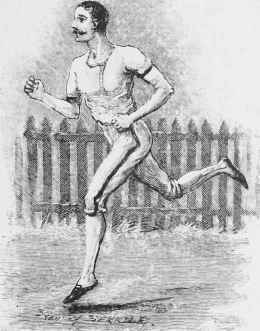
In condition.
Continue to:


My Books

