


The Rugby Union Game. Part 10
Description
This section is from the book "Athletics And Football", by Montague Shearman. Also available from Amazon: Athletics and Football.
The Rugby Union Game. Part 10
The steadiest defensive player who is a good drop-kick and safe in stopping forward rushes should be in the centre, and he must be always on the look-out for passing to whichever of the two outside three-quarters has the clearest field in front of him. But very often, and especially when the game is getting near his own goal, the middle three-quarter should neither pass nor run himself, but take a long drop or punt into touch, and when on the contrary the game is near the opponents' goal, he should be continually on the alert to drop a goal from the field of play.
It will thus be seen that, in the writer's opinion, the centre three-quarter should cultivate drop-kicking as the first and most important thing of all, and provided he be a safe and smart drop, and steady at stopping forward rushes by snapping up the ball or falling upon it, it does not matter so much whether he has any brilliant pace, great as is the advantage of pace upon any quarter of the field.
Each and all the three-quarters must be good tacklers, and must always tackle low, and hold the ball at all costs, for as only one back is played and passing is understood nowadays, it is not safe to rely upon the single back. The outside three-quarters must do the bulk of the running, and get most of the tries, for when a pass is once well begun the outside three-quarter who is on the open side of the play (i.e. where there is the widest portion of field between the scrummage and the touch line) is sure to get the ball either from the half-back or from the centre three-quarter, who will pass after he has made a start himself and given his outside a chance of getting into the right position. It is therefore in the position of outside three-quarters that the very fastest runners should be placed, and many men have made a brilliant show in this position simply and solely owing to their pace.
However, though fast running alone can never make a footballer, the really fast runner has a great pull at three-quarters, for the best tackier in the world cannot stop a man whom he cannot reach, and there have been many fast runners, especially in the earlier days, who have gained tries simply through their fleetness of foot. Useful therefore as drop-kicking is to every three-quarter, the feature of outside three-quarter play is running, and in selecting the three men for the place in every team different qualities are required for centre and side. Lastly, all the three-quarters must recollect that they have only one back behind them, and if they miss a man or if from any cause a runner has passed them, they must be on his track at full speed without delay. They must in one word recollect that their business is defence as well as attack, and must continually see that they are covering the field between them and are not all massed together in their greediness to get the ball for a showy run.
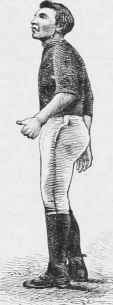
Three-quarter back: 'An anxious moment.'.
Undoubtedly the best three-quarter of his day was L. Stokes, the Blackheath captain. There have been both before and since more brilliant runners and safer tacklers, but probably no better drop-kick, and none with more judgment and knowledge of the game. His command over the ball in drop-kicking was marvellous, and his drops at goal and long drops into touch were masterpieces. One great element in his success was the careful eye he kept on his halves and backs to ensure a safe defence of the field. In his time, first one, and then two three-quarters were played, but in the present game his style of play would have fitted him for centre three-quarter. We are rather inclined to think, however, that Wade, the Oxonian, was the best three-quarter we have seen. He and W. N. Bolton, of Blackheath, were great rivals and contemporaries, both being strong, fast men, and very hard to stop, and one day one, on another day the other, pleased their critics best; Bolton, however, though perhaps faster, occasionally played clumsily and made mistakes, although always a very dangerous player to have on the other side.
Lately, Stoddart of Blackheath has eclipsed both in reputation, being a very fast clever runner and a capital drop, and on his day marvellously good; but as a defensive player he was not in our opinion the equal of Bolton or Wade, and was more uncertain in his play than either of them. For all-round excellence at three-quarters few have ever surpassed R. E. Lockwood, a little Yorkshire-man who was both sturdy and speedy.
Last but not least comes the full back, and of him it may be said that it is easy to describe him but difficult to find him. Two things only are required of him, that he should be an admirable and accurate drop, and a safe and strong tackier, who neither lets his man pass him nor can be knocked over or brushed aside by a rush. To find those who can answer to this description would not seem to be difficult, but the fact remains that backs are not to be found. The reason after all is plain enough, that most footballers play for the fun and the fun alone, and there is no pleasure at all in playing back unless one's own side is getting much the worst of the game. The goal-keeper in the Association game is sure to have something to do even in a winning game, but the Rugby back when his side is winning often has nothing but one or two drop-kicks throughout the game. The better the side the less work and the less practice the back is likely to have, and that is why even the backs of the best clubs often cannot be depended on simply through lack of practice.
The work of the back requires but a short description; he must on no account come far enough forward to make it possible for a drop-kick of the enemy to go over his head, for otherwise he will have to run back and the rush will be on him before he can take his drop. When he gets the ball he must 'drop' into touch, as far up the field as he can reach the touch line, but still into touch the ball should go, for if it do not his own men will be off-side, and the drop will simply be returned. The back then must be he who never muffs a catch, and never misses a tackle, and can so far control his natural desire for emulation as to refrain from indulging in a run when he thinks he can see an opportunity. Above all things, he must not pass nor attempt to, and if collared with the ball should be glued to it and cry down. One other thing might be said, and that is, that it is often safer to 'punt' than to drop for a back; indeed, some of the best backs we have seen have continually punted instead of dropping, both in dry and wet weather. In wet weather a dropped bait rises very slowly, and if perchance the opposing forward can charge it down before it rises all may be lost, and that is why the old hand punts in wet weather.
Continue to:


My Books

