


Walking And Walkers. Part 3
Description
This section is from the book "Athletics And Football", by Montague Shearman. Also available from Amazon: Athletics and Football.
Walking And Walkers. Part 3
At present the one satisfactory thing about the championship walking event is that some of the shifty goers find it impossible to conceal the true secret of their mode of progression after the first few miles. The longer the distance is the more likelihood is there that a real walker will prove the winner, for besides the chances of detection we believe it is really very hard to run on the heels for more than a mile or two. The first walking champion was J. G. Chambers, a gentleman who was one of the pioneers of the athletic movement both at the Universities and in London, and whose name will always be remembered in connection with the Amateur Athletic Club, now extinct. Chambers was not what we should call now a first-class walker, and his only opponents in the championship of 1866 were three other University men, the time being only 28 seconds within the hour; but as regards Chambers' reputation as an athlete, it must be recollected that he could not only walk his seven miles within the hour, but was, if not the very best oarsman and sculler of his day, at least one of the best.
It is, perhaps, worthy of note that the work from which we have studied the account of Chambers' championship defines 'fair walking' as 'having one leg on the ground at the time,' and adds, ' the straightness of the legs does not prove or alter fair walking.' It is scarcely any wonder, therefore, that walking should have begun very early to be open to abuse. The account we have seen of the championship of 1867 is rather curious. The three men who were really in the hunt were Chambers, T. H. Farnworth, the Northern celebrity, and R. M, Williams, of the Civil Service, a fine walker, who travelled perfectly upright, but with a very short niggling stride. Williams and Farnworth disputed the lead for nearly five miles, when Chambers, who was well in the rear, began to gain. Half a mile from home Chambers caught the leaders, and the three began to race together. At the end of the last lap but one Williams retired, finding himself unable to keep pace with the others, and Farnworth and Chambers began to have a 'ding dong' race. 'At the last corner,' says our reporter, 'the two were level: the shouts were tremendous: each of the two became very suspicious in their style (sic); neck and neck they came down the straight, Farnworth winning by a foot.' Eyewitnesses have declared that the style of both first and second men was by no means suspicious, being an open undisguised run for the last lap and a half, and that if the judges had been up to their work both would have been disqualified, and Williams, who was walking fairly, would have become champion of the year.
After this year we hear nothing more of walkers from the Universities, and from that day to this it is a curious fact that no walker of any merit whatever has appeared on the path from Oxford or Cambridge. Indeed, some ten years ago walking races were dropped out of the programme at both the Universities, owing to the paucity and inferiority of the performers, and, we believe, the only walking race in which undergraduates now figure is that for the valuable silver cup given yearly by Sir Edward Joddrell, Bart., to the students of Queen's College, Oxford. This prize usually brings out a performer who can do his three miles well inside half an hour, and the utmost that can be said for the performers is that they all walk with strict fairness if not with speed. It appears that at the Universities no competition which does not give the athlete a chance of winning his 'blue' will be followed with much zest.
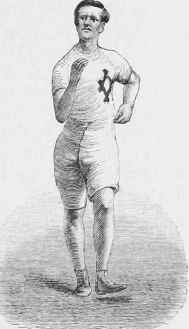
Short stride.
About the time that Chambers retired from the path, some new walkers began to appear on the scene in the metropolis, the best of these being Walter Rye, S. P. Smith, and T. Griffith. All of these were tall men, Smith, however, being the tallest of the three, and, if we recollect rightly, over six feet. Rye walked with a perfectly straight leg, very erect, and was certainly a better walker than any who had preceded him. He held the L.A.C. Challenge Cup for the seven-mile walking race through the year 1867. Towards the end of that year, however, Smith and Griffith had begun to make their mark, and in the last L.A.C. meeting of that year Smith, Griffith, Rye, and Williams all met in a two-mile handicap, the two last named being at scratch and Smith and Griffith with 25 sec. start. In the result Smith astonished the spectators, gaining 2 sec. upon Rye, and finishing in 15 min. 15 sec, the best time on record at that period. Smith, though then only a lad of nineteen or thereabouts, is said to have walked in splendid style and with great fairness, and would probably have done something notable had he persevered on the path; but in the spring of the next year he abandoned the pursuit as suddenly as he had taken it up.
In the race to which we are alluding Griffith finished second, after being once cautioned, his time being 15 min. 32 sec.; Rye third, in the time of 15 min. 17 sec.; and Williams fourth, in 15 min. 35 sec. In the succeeding year Rye won the championship easily enough; but in the two following years Griffith was the winner, Rye not being a competitor. Griffith, who has long been a familiar figure as the representative of 'Bell's Life,' certainly disputed with Rye the reputation of being the best walker of his time, but although, in 1870, he beat his rival's times when he won the championship from R. H. Nunn in 55 min. 30 sec, we believe he never beat Rye when the pair met in a race. R. H. Nunn, who made so fine a race with Griffith in 1870, was beaten by Rye, who took the L.A.C. Cup again in the autumn of 1869, this being the last time he competed for it. Rye, Griffith, Nunn, and Williams retired about the same time, and their places were taken by inferior men. The next celebrity in the walking line was W. J. Morgan of the Atalanta R. C, who was champion for the three years from 1873-75 inclusive. Morgan was a short man, hard and thick-set, and was, we believe, about five-and-twenty when he took to the path.
Continue to:


My Books

