


Walking And Walkers. Part 4
Description
This section is from the book "Athletics And Football", by Montague Shearman. Also available from Amazon: Athletics and Football.
Walking And Walkers. Part 4
His first appearance was at the spring sports on the Richmond cricket ground in 1872, when he was immediately spotted by the connoisseurs as the coming man. He walked perfectly erect and with a fair heel and toe action, but with a springy stride, and we always used to think that when he spurted his style was by no means irreproachable. Undoubtedly he could and often did walk with great fairness, but his springy style and quick stride rendered the passage from walking into trotting very easy for the walker and very puzzling for the judges. Morgan, in his third championship win, covered his seven miles in 53 min. 47 sec, then a record, and was also the maker of athletic history in another sense. It was about this time that the ring-fence of gentleman-amateurism was being broken down in London. Morgan, who was an employe in Shoolbred's establishment, had his entry accepted at many meetings, and finally the officers of the London Athletic Club accepted his entry for a London Athletic Club meeting. The result was a strong cabal amongst some of the older members of the club, who threatened to resign if the entry were not refused.
Eventually, when the meeting came off, about half the entrants declined to run on finding Morgan's name in the programme, but eventually the malcontents yielded to a compromise and returned to the club, most of them following the lead of Walter Slade, who declined to persevere in his opposition. The point, however, was practically settled, and in a year or two both the club and its entries gained in number what they had lost in social standing. Before leaving the subject it is only fair to state that no personal objection to Morgan was ever expressed, the opposition to him being simply to the representative of a class. The incident, though apparently trivial, had important results, as after this one protest no further objection was ever raised to the system of popularisation of the London Athletic Club meetings, which was carried out by the managers of the L.A.C. in a most thorough manner.
While Morgan was unrivalled in his career of success in the South, another celebrity was arising in the North, H. Webster of Knotty Ash, a representative of yet another class of the athletic community. Webster, like the greater part of the Northern amateurs of the past and present day, was of the artisan class, and before he was seen in the South, rumours of his fame as a walker reached the metropolitan athletes; but in those days Southerners who ran on carefully measured cinder-tracks used to be very sceptical of the fast times alleged to have been done by provincial runners upon grass tracks, or at unimportant meetings. However, in the summer of 1874, Morgan had practical proof of the ability of the Northern walkers at the meeting held at Lurgan in the North of Ireland. Lurgan then had one of the most interesting meetings of the year, as the Northerners, Southerners, and Irishmen often met there for the first time. In the walking race in 1874 Morgan only finished third, Webster being the winner, and Hughes of Liverpool second, and an acrimonious controversy followed as to whether the judge had not been too lenient.
Webster, however, made no appearance in the South till after Morgan had retired and his place as champion had been taken by H. Venn, jun., who was the best walker that the L.A.C. had produced since Rye's retirement. Venn first appeared on the path in 1875, and, although quite young, walked in irreproachable style, and with a fine free stride. Although slightly built and only of medium height, his staying powers seemed very great, and he walked very erect, and without a suspicion of a 'lift' when he first came out. He won the championship very early in 1876, and whenever he was in training was indulged with a walk over for the L.A.C.
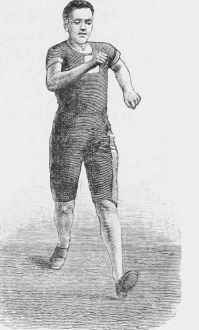
A fine free stride.
Challenge Cups, no opponent being able to hold him. In 1877, however, he met Webster in the championship and suffered defeat; Webster finishing the seven miles in 53 min. 59 3/5 sec. Both men certainly walked fairly enough at the start, but Webster, who could undoubtedly walk both fast and fairly upon occasions, was in the habit when tiring of getting into a very jumpy action, although it was hard to say at any time that he had both feet off the ground at once. On this occasion, when he beat Venn, he was in our opinion by no means walking fairly; but, on the other hand, Venn, who was making great efforts not to be outpaced, was also not going in the best of styles; indeed, Venn's style was by this time rapidly deterio-rati ng, and we have already stated our opinion that in the succeeding year, when he turned the tables on his opponent, both men were running under the nose of the referee of walking. The succeeding year (1879) did not see the pair meet, the L.A.C. men showing their opposition to a spring fixture by refraining from entering at Lillie Bridge, and Webster, who came up for the event, finished the full distance in 52 min. 34 sec, only 9 seconds slower than the time in which Venn had won in the preceding year.
At the summer championship at Lillie Bridge Venn walked over, and as he soon afterwards retired from the path the pair never met again. In 1880 Webster again competed for the championship, and finished an easy first, but after passing the post the judges told him he was disqualified for unfair going, and awarded the race to the second man, G. P. Becklcy. The decision naturally gave rise to some unpleasantness, and when the prizes were given away there was a noisy demonstration. A month or so later we saw Webster win unchallenged the Three Mile Championship of the Northern counties at Southport, and took occasion to watch his style narrowly. His gait was certainly not that of a walker, if the upper part of his body and hips only were looked at, as each step was undoubtedly a spring: but as long as walking is to be judged solely by the criterion of there being always one foot on the ground, it must be admitted that when not turning round a sharp corner Webster was within the definition. The present writer, on the occasion in question, upon which Webster completed his three miles in 21 min. 28 sec, lay flat on the ground at different places to watch Webster's feet, and it certainly could not be said that in the straights he had both feet off the ground at once.
Continue to:


My Books

