


The Down-Swing
Description
This section is from the book "The Golf Swing, The Ernest Jones Method", by Daryn Hammond. Also available from Amazon: The golf swing, the Ernest Jones method.
The Down-Swing
One of the most vital moments in the golf swing occurs just before the up-swing is completed. Even the player who has begun to realize the importance of persistently moving the club-head with the hands, is tempted at this point to forget to carry this action out and to let the body go on twisting on its own account. When this tendency is yielded to, it becomes extremely difficult to give the proper start to the club-head at the beginning of the down-swing; for if the hands fail at any moment they are all the more likely to fail at the next moment. And the right shoulder, instead of being pulled round as a result of an impetus set up and kept up by the hands, will turn on its own account (Fig. 4). Consequently, when the club-head strikes the ball, the shoulders will not be in anything like the position they occupied when the ball was addressed, but will be turned toward the hole - they will, in fact, be already more or less in the position they should take at the finish of the shot. This is the normal case of "body in too soon." The player will be told by his caddy that he has cut across the ball or pulled his arms in, and he will be urged to throw his arms out after hitting the ball. Such advice is on a par with the recommendation to lock the door after the horse has gone. The player has not pulled his arms in. His body has turned prematurely and on its own impulse. The arms cannot help coming across the line of intended flight as the ball is struck, and nothing that the player can do as he strikes the ball, or after he has struck it, can be of the least avail. One must get back to the source of the trouble - that point in the swing, possibly in the up-swing, possibly at the beginning of the down-swing, at which the hands and fingers have failed to do their work. (Compare Figs. 22 and 23.)
In most of the books on golf, that vital moment in the swing, the beginning of the down-swing, is passed by in silence, but in one or two of the books greater or less attention is devoted to it. In the Harry Vardon book it is dealt with at some length, and the player is recommended to aim, at the beginning of the down-swing, at an imaginary person behind him. This kind of teaching may conceivably do some good, but it is, in principle, unsound. It does not go to the root of the matter. If in the true swing the club-head passes through certain points, it does not follow that the true swing can be produced by guiding the club-head through those points. In the true swing, the fingers, hands, arms, etc., perform coordinate movements, and if those movements are properly produced, the club-head cannot help following the proper path. To guide the club-head along that path in the hope that the anatomical movements will be sound is to put the cart before the horse, effect before cause. One must begin at the beginning and endeavour to secure the effect desired by mastering the processes of which that effect is the inevitable outcome.
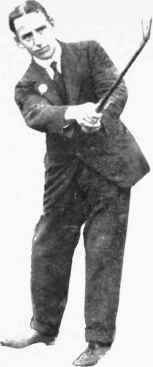
Fig. 32. - Perfect finish of short iron shot. Contrast with Figs. 30 and 31, and note how the club-head has been forced through.
In "Golf Faults Illustrated," Taylor, in speaking of the down-swing, admonishes the reader not to "put on leverage too soon." The meaning here is not too clear, but it may be the same as that conveyed by that golfing commonplace "Don't hit from the top." If it is, then it is diametrically opposed to the injunction of Braid in "Advanced Golf," who directs the player to hit from the top as hard as he can, Taylor is apparently anxious that the player should not force the shot with his body; Braid is apparently anxious that he should take the risk. And so long as the player always applies his power with his hands, letting everything else freely respond to the action so initiated, there can be no doubt that he who hits most vigorously will hit best.
In several other books it is stated that the down-swing is begun by a pull of the left arm. This, at best, is a half-truth, and is misleading. The initiation of the movement is in the hands, and the pull of the left arm is a responsive - an immediately responsive - movement. The operation is simply the operation of hitting - it is instinctive when once the principles of the movement have been mastered; and it is significant that no good golfer who is on his game has ever anything in mind when making a shot other than hitting the ball. He is not trying to hit an imaginary person behind him; he is not trying not to put on leverage too soon, or not to hit from the top; he is not trying to initiate the downswing with a pull of the left arm - he is merely moving the club-head - hitting the ball.
Continue to:


My Books

