


The Problem
Description
This section is from the book "Golf at Gleneagles", by R. J. Maclennan. Also available from Amazon: Golf at Gleneagles.
The Problem
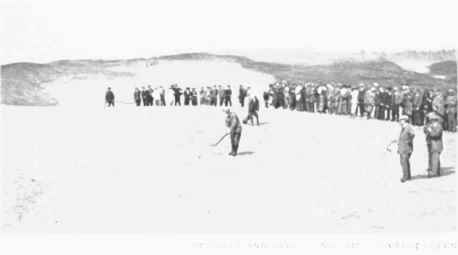
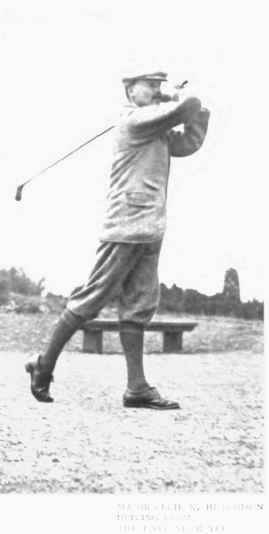
IT is one thing to choose the site of a golf course and another thing to make the golf course. The magnificence of the site set the problem, and it was fully realised that the solution had to be synonymous with perfection. But a good site can be "made or marred." Time was the maker of Gleneagles. Time fashioned with a master hand what has been described as "The Golf Course the Great in Scotland." The wizard touch is everywhere in evidence. Were you to ask the native Scot for an opinion he would probably tell you that Nature was at work here in "the days o' auld lang syne" - Nature and then Jimmy Braid! That sums up the matter in a nutshell. Braid, five times winner of the Open Golf Championship, designed and laid out both courses. Before, and again after, the Great War he had the assistance of Major Cecil K. Hutchison, the accomplished amateur golfer. Together they made a splendid job. Had not Nature, however, taken a first hand in the work the perfect results could not have been obtained.
Initially the Golf Courses demanded of Braid clear vision and concentration of purpose. The work of survey called for full measure of foresight and quick anticipation of the great possibilities. These having been envisaged had to be realised to the utmost. There is no doubt the possibilities were there. As has been indicated, the ground even in its rough state was a natural golf course. Experts in the designing and making of golf courses as well as amateur and professional players were unanimous in that opinion.
Dr. Mackenzie and Mr. H. S. Colt, well known as having laid out many of the most important golf courses of the world, expressed the view that the ground at Gleneagles possessed the natural features which golf imperatively demands - fine resilient turf on gravelly sub-soil readily drained and therefore unaffected by heavy rain. And they further stated that in the infinite variety of the ground for golf, the undulating character of the surface, the bold natural plateaux, the sandy ridges and hillocks, the rough hollows and ravines, the heather, the whin and the broom, the bracing character of the air and the magnificence of the surroundings, Gleneagles could be made to be absolutely unrivalled among countryside courses.
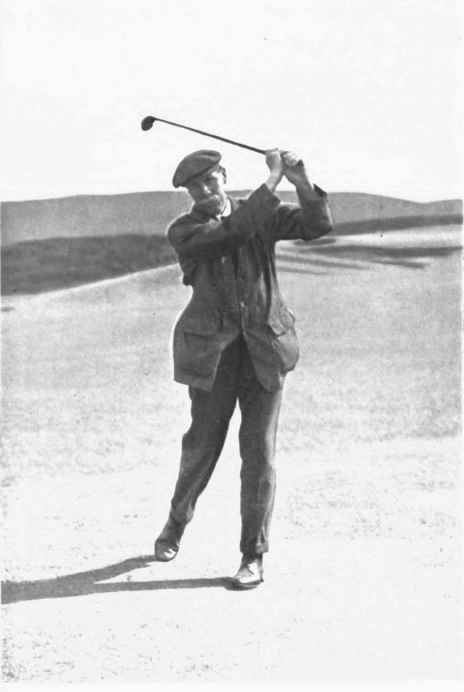
Major Cecil K. Hutchison was delighted with the potentialities of the place and described it as being the finest natural golfing ground that he had ever seen.
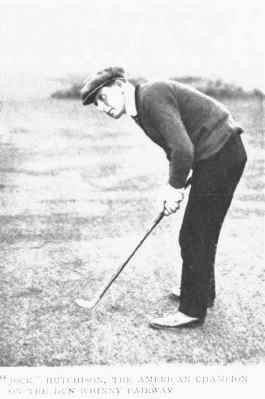
Braid and Ray were equally strong in commendation of the fine natural features, and no less enthusiastic in describing the ground as being such as would allow of the making of a golf course which would not be excelled by any in the United Kingdom. And subsequently Taylor, Vardon and Herd also expressed very favourable opinions, while later "Jock" Hutchison, the American Champion, described Gleneagles as being an absolute revelation, and predicted a delightful surprise to all American golfers, including even those who have tested the qualities of the finest and most famous of the golf courses of America, either seaside or countryside.
On the basis of expert advice initiative was strengthened. The reports by the leading authorities on golf courses were passed so to speak through a fine mesh and, on a well considered scheme, the work of construction commenced early in the first year of the Great War. Owing to the War, however, it took several years to complete. Braid, for months, gave his almost undivided attention to it, confident that it was worthy of the best that was in him. His confidence has been justified. The subsequent chorus of praise is proof of that.
The King's Course possesses the essentials that appertain to excellence. It has varied and wide undulating fairways, a goodly proportion of one-shot and two-shot holes in proper sequence - the one-shot holes are placed at even and odd numbers to give partners in a foursome each a share - numerous teeing grounds that permit of the lengthening or shortening of the holes according to the season of the year, the state of the ground and the vagaries of the wind; spacious and agreeably undulating greens "greens of velvet - varying in shape, size and natural position, some being on high plateaux, others in a moderately raised position and a few in hollows among the typical howes and knowes of "Wee Scotland." Each of the greens is of entirely different character, and to all there is led a water supply from the Ochil I ills. In respect of blindness in the approach shots, so often overdone, there is only one hole that has this feature,a hole that greatly gains, however, from this characteristic. In the disposition of the bunkers there has been strict regard to the necessity of placing them in positions in which good shots will not be punished. They vary in character, but are entirely legitimate. There is a sufficient number of heroic carries from the tee, and the course has so been arranged that the weaker player with the loss of a stroke or" portion of a stroke has always an alternative route open to him. By having achieved the great desideratum of holes of different character - so arranged as to sustain interest throughout - the natural consequence is a call to prove a happy versatility in brassie shots, iron shots, and pitch-and-run-up shots. In a word, the conditions offer all that is desirable for stimulating worthy effort. Yet while the conditions are exacting, as they ought ever to be to make the game worth while, they are not oppressively so, and both the King's Course and the Queen's Course are pleasing alike to the absolute beginner, the moderate exponent, and to the plus man. It is especially noticeable that in the planning there has been particular regard to the necessity of ensuring that there should be little walking between the greens and the tees; the player is always moving in a direct line forward. A surprise to most visitors is the sense of privacy enjoyed, a special and somewhat unusual feature being the splendid isolation of each of the fairways and greens. The natural features of the ground appear to keep them wholly apart, giving each as it were an air of exclusiveness that is particularly acceptable to players. On the busiest days the feeling that the course is crowded - a feeling that affects many players adversely - never obtrudes. While there are all manner of natural hazards on both courses - clumps of whin and broom, margins of heather and bracken, stretches of rushes and, in the case of some of the holes, water - there is always a comforting margin of semi-rough to the fairway, the last mentioned being a gracious concession to those who do not play on the "true line." It will be entirely your own fault if you land in the "rough" and are tempted to complain. Braid justifies the "rough" with the direct blunt and typically Scottish observation, "you shouldna' be there."
Gleneagles Cioil Club House
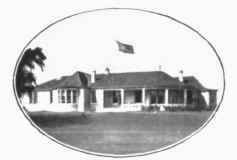
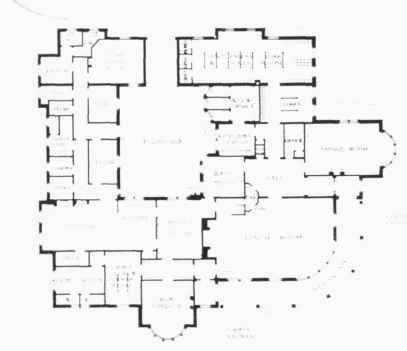
As well as the problem of the lay-out of the Golf Course, a question requiring solution was that attaching to the position of the Club-House. It was recognised that the Club-House should be in the immediate vicinity of the starting tees and the home greens, and that, if possible, it should be slightly elevated. The problem was complicated by the necessity of precluding the possibility of any building being erected that might tend to detract from the picture of the gren as seen from the windows of the hotel. And the magnificent landscape had a further influence in the selection of the site, inasmuch as it was thought that the views from the Club-House windows should also be pleasing. It was, therefore, decided that the Club-House should be built on a site as westerly as possible, a decision which has been justified by the result. A little engineering produced an artificial plateau of such a level as to allow of the home greens being overlooked from the windows of the Club-House, and while it is true that the Club-House is nearer the starting tee of the Queen's Course than the starting tee of the King's Course, the grande place leading to the latter provides the fullest compensation from the promenade point of view. The architecture of the Club-House is simple Georgian in its character, and a look at the picture on page 15 will suggest the pleasing character of the elevation and the convenience of the plan.
Continue to:


My Books

