


X. Some Women Golfers And Their Play
Description
This section is from the book "Golf For Women", by Mabel S. Hoskins. Also available from Amazon: Golf For Women.
X. Some Women Golfers And Their Play
Woman is prone to keep an eye on the fashionable modiste when it comes to style in dress, which causes man (with his stiff collar, temperature regardless) to smile or to ridicule. Woman is as independent as man when it comes to the style of her golfing stroke in which, like man, she employs many different methods to get the desired result. Perhaps, in a collective sense, she has not taken her golf quite so seriously as man, for her social and home duties do not allow her quite the same amount of time to brood or enthuse over the day's play. She does not linger so long about the clubhouse after the round, to dilate upon the three puts that she took on No. 6 green or the misfortune of taking two shots to get out of the footprint in a bunker, and she is not so apt to give the impression that she has lost her last friend because of defeat in a championship round. The woman golfer is a cheerful loser.

Mrs. Lilian Hyde Fettner Getting away a long brassie.
In comparison with the time that she has given to golf from the competitive angle, her progress has been rapid and it would seem as if each year she is drawing gradually nearer to the standard of the sex which, from time immemorial, has devoted itself to athletic pastimes. Whether golf is to be the first athletic pastime in which woman eventually will take her place on a plane with man is problematical, but the possibilities are better than in perhaps any other sport. It might be so in shooting, except that woman's natural tastes hardly will lead her into that field in such numbers as into the field of golf.
Up to the present time, woman's inferiority in the Royal and Ancient game has been • largely a matter of physical strength. She has not had the generations of muscle-building toil or athletic activities to develop along these lines. Even where endowed abnormally in the matter of muscle and strength, she has not had the actual training, or the athletic heritage, to use her strength to best advantage in the pastimes of the field. What she can do, however, without this heritage or long training is being demonstrated more and more in golf, where in certain individual instances she is vieing with man in ability to hit the golf ball for remarkable distances. One reason for this, of course, is that distance in golf maybe in one instance a matter of brute strength and in the other a matter of smoothness of stroke, plus suppleness of muscles and the knack of hitting the ball at just that second when the clubhead is traveling at its maximum pace, - in other words, perfect timing. Few men in the country can drive a ball as far as Mrs. Quentin Feitner (Miss Lillian B. Hyde) of Brooklyn, but many who normally would play the odd with her after the tee shots might leave her far behind in the matter of distance out of a bad lie in heavy grass, where strength of forearm and wrist are an absolute requirement.
Woman is naturally more of a stylist in golf than is man, or to put it another way, a greater percentage of her sex hit the ball with that easy graceful motion of a Vardon than can be said of the rank and file of men. One of the reasons doubtless is that a greater percentage of women than men begin their golfing career by taking lessons of a professional and practice more assiduously. If the professional under whom they study has any real fundamental knowledge of golf for beginners, and can impart that knowledge lucidly, the pupil at least has the advantage of starting on sound principles.
That women golfers come naturally by their fortunate habit of taking an easy swing, gaining their distance on timing, is exampled in the achievements of some of the foremost golfers in the early days of women's competition. Lady Margaret Scott, winner of the first three championships held under the auspices of the Ladies' Golf Union, of the British Isles, in 1893, '94 and '95, is referred to by writers of her day as "possessed of a fine, full, easy swing which won universal admiration. Her play throughout the competition (1893) was almost faultless." Mrs. Ryder Richardson, semi-finalist in the British ladies championship of 1895 at Portrush, when she was 4 up at the turn, only to lose the match by 2 up, also was noted for her "easy, graceful style." As a stylist, there never has been seen on an American course a girl who more closely typified the Vardon grace and ease of stroke, with perfection of timing, than Miss Florence Teacher, who came to the United States in 1909 with Mrs. Dorothy Campbell Hurd, Miss Grace Semple and one or two other British girls, that being the year that Mrs. Hurd (then Dorothy Campbell) won the American title for the first time. While it was Mrs. Hurd who won the title, it was Miss Teacher whose play was watched with profound admiration. This fairly tall, wonderfully lithe and graceful wielder of the golf club, champion of Scotland in 1907, had a full swing which was as smooth-working as a well-oiled piece of machinery. She used a driver with the dread-naught head, so large that it was, first, a cause of constant wonderment that she could swing it at all; second, that she could get the head through after hitting the ball, so as to keep the ball on the line instead of slicing it badly, or getting off the line to the left by meeting the ball too late. The secret was that Miss Teacher was in perfect communion with the club, so to speak. She had her stroke perfected to the point where each time it appeared to follow a long familiar groove both in going back and in coming down, leaving Miss Teacher the sole task of keeping her eye on the ball and her body from swaying. It naturally would seem quite essential that a woman, unless abnormally large and strong, should get a full swing for her distance, but it does not always work out that way. As reference has just been made to Mrs. Dorothy Campbell Hurd, we will take her as an example. Winner of so many championship titles, on both sides of the Atlantic, that she might find it difficult to enumerate them all offhand, she rarely has been consistently and pronouncedly outdriven, though she is of comparatively small stature and played in her days of championship supremacy with a back swing possibly a trifle more than half. Where she held her own with the majority of her competitors in the long game was in the tremendous snap of her downward stroke, in which not one ounce of her strength was wasted. Had Mrs. Hurd lengthened her swing, there is the bare possibility that she could have added distance, but with that short back swing and not exaggerated follow through, she kept the ball as near the middle of the course, and as far from trouble, as Mr. Walter J. Travis in the ranks of the men. The consequence was that in the long run she probably gained as much distance from the tees as the women of longer swing but less control. Her short swing, moreover, was admirably adapted to the firmly hit and accurately placed iron shots of which she and a number of other British women golfers are such masters. She and Mrs. Bruce D. Smith
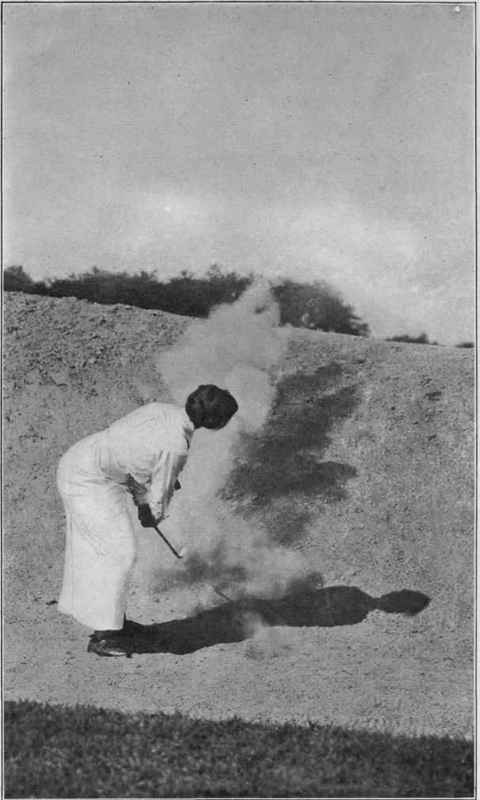
Miss Marion Hollins Bunkered and well out.
(winner of the United States women's championship in 1905, as Miss Pauline Mackay) are two of much the same type, - the short back swing, snappy downstroke, modified follow through, with accuracy and match play courage as much factors in their success as their actual stroke ability.
The reverse of Mrs. Hurd and Mrs. Smith, in a sense, is Mrs. H. A. (Harley) Jackson, winner of the women's national in 1908 and 1914. She is a large woman, with an upright swing of quite fair length and one who might be expected to hit a tremendously long ball. Mrs. Jackson won two championships because, like Mrs. Hurd and Miss Mackay, she preferred to sacrifice distance for the sake of accuracy. Her stroke from beginning to end is smooth and under supreme control at every point. Could she get more wrist action and snap into her swing as it comes to the horizontal, nearing the ball, she would drive yards ahead of Mrs. Hurd, but her stroke, while so beautifully smooth, is what might be termed "tame." It has none of that fire that comes of calling upon muscles to give, at just the final moment, not only their normal function of sweeping that ball away from the little pile of sand, but also their concentrated force at the moment of attack. There was, from the other point of view, Mrs. C. T. Stout (nee Genevieve Hecker), one of the most brilliant of all the American women golfers, a girl who might well have won the British women's championship had she gone abroad in the heyday of her game. There was a girl who, in spite of her shortness of stature, used almost a regulation St. Andrews swing of the old days of the gutty ball, with all the fire, dash and abandon of a violin virtuoso playing a favorite rhapsody. She swung as if the action typified the joy of living, little caring, as the spectator viewed it, where the ball went and for that matter, playing out of trouble with extraordinary power for one of her size, a distinct reminder, in all the essentials of her game, of Mr. Jerome D. Travers. Miss Rhona Adair, the first of the British women champions who really made a pronounced impression upon American golfing enthusiasts, upon the occasion of her visit a dozen years ago, was another like Mrs. Stout who hit at the ball as if her very heart and soul were in the stroke. She drove with an open stance, with knees a trifle bent at all stages of the stroke; the club was started back with the left hand, for about a three-quarters swing, but, when the head came down on the ball, it was with the force imparted about equally with both hands, for Miss Adair was among the women who believed in letting her right hand know what her left was doing.
While the rank and file of the women golfers are taught (quite wrongly, I believe) to start the club back with the left hand and allow that to be the leading factor in all of their wooden shots, if not pretty much the only factor, there are, in following this practice, a few notable exceptions, of which the greatest in this country probably are Miss Margaret and Miss Harriet S. Curtis, sisters and Boston golfers who have held the national title four times between them, Margaret three times and Harriet once. For years Miss Margaret Curtis held the distinction of being rated as the longest hitter in the women's ranks this side of the water, and it was not until the advent of Mrs. Quentin Feitner with her tremendous distances that Miss Curtis had to grant superiority. Miss Margaret Curtis and her sister are largely self-taught in golf, acquiring knowledge through assiduous practice and perhaps occasional helpful suggestions from their brother James Curtis, himself a fine golfer a few years back. Very likely it was lack of professional teaching that led the Curtis sisters to get the weight of their stroke in with the right hand. They are unusually robust girls, to start with, and their ability at long hitting has been more or less of the downright slugging order, like that of a strong man, than the sweeping, well-timed stroke of the girls of slighter frame who hit a good tee shot. Both Curtis girls take a fairly full swing at the ball and their blow is distinctly a hit, as contrasted with a sweep. The chief trouble with their style of stroke, especially so in the case of Miss Margaret Curtis when she is a little off her game, is the tendency to dip the right shoulder in the act of trying to get just a little more force into the blow. This of course is fatal, for the moment she dips that shoulder, the club is almost certain to hit the ground too soon and result in a badly schlaffed shot, without distance. That was exactly what happened when Miss Curtis met Miss Vera Ramsay in the final of the Boston District women's championship of 1915. The three times national champion simply could not hold herself up on the swing, or else, in noting what was wrong in her game, she involuntarily overdid the part of keeping the right shoulder up on the downward swing and consequently topped the ball.
In playing the irons, Miss Margaret Curtis at her best is about as fine an example of a woman golfer that this country has bred, for it is on the iron play that the American girls have been so deficient as compared to their English cousins in the upper rank. The
Curtises are not afraid of allowing the heads of their irons to hit the turf, for they have the wrist and forearm power to take the turf and yet get the clubhead through. It is a curious fact, and beautifully illustrative of what concentration, determination and practice will do, to note the evolution in Miss Margaret Curtis's short game. As far back as 1902, the year that the national championship was first held at The Country Club, Brookline, Mass., Miss Curtis, then a plump girl in her teens, familiarly known as "Peggy," was touted as a title possibility. Her long game was wonderful, but her short game atrocious, especially mashie shots from distances around fifty yards, also her long approach puts. She did not seem to have the remotest conception of the innate "feeling" of the club on a short shot and on a 30-foot approach put she was just as apt to be thirty feet over as anywhere else. The same trouble pursued her in 1903 and 1904, in each of which years she again was looked upon as a prospective champion, only to discourage her chief admirers by her failure to master that delicacy of stroke so essential to the short game and the putting green. She became the title runner-up in 1905, to Mrs. Bruce D. Smith, and her failure to win the title on that occasion led the critics to break forth into doleful verbiage to the effect that now it was a certainty that Miss Curtis need never again be taken seriously in a national tourney.
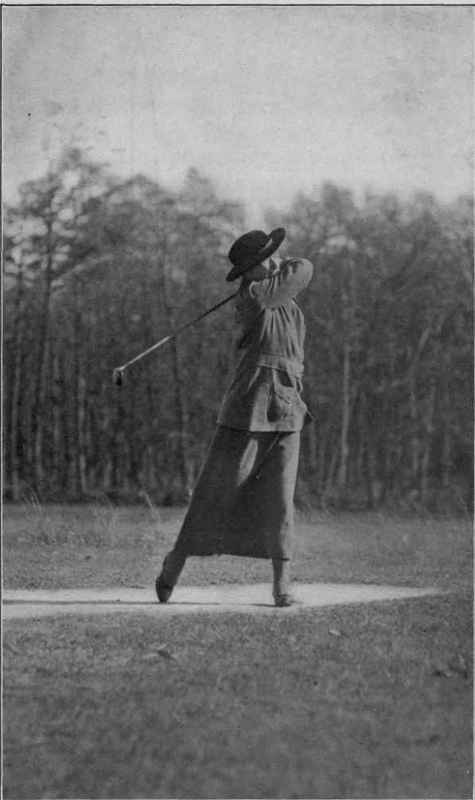
Mrs. Ronald H. Barlow At the end of full swing.
The reverse of the picture was presented in full measure at the women's national of 1911, at the Baltusrol Golf Club, where Miss Curtis and Mrs. Hurd met in the semi-finals. Mrs. Hurd up to that time had swept all before her in this country and was considered unbeatable. What happened was that Miss Margaret Curtis won the match by 4 and 3 and the elements of her success, probably to her own supreme satisfaction, were in the supremacy of her short game. In other words, it was through mastery over Mrs. Hurd in her own stronghold, accurate approaching and good putting, that the Boston girl gave the Briton her first championship defeat this side of the Atlantic. From that time criticisms of Miss Curtis's short game virtually ceased, except in an occasional instance such as every good golfer experiences, when nothing goes right. Application, pure and simple, is what did it.
For fear that the impression might be given that it is downright physical strength that enables the Curtis girls to get so much distance through the "punch" from the right arm, there can be presented as another example of the girl who derives a goodly part of her distance from the right hand, Miss Fanny C. Osgood, another Boston girl of comparatively slight build. Miss Osgood hits one of the longest irons of any woman golfer and while apparently she gets both arms about equally into the stroke, it undoubtedly is by pushing out with her right at the moment of impact, as well as applying extra power with it, that she gets quite a decided hook to the ball and an unusual run when the ground is the least bit hard. She probably learned early in her golfing experience that it was necessary for her to get in the punch with the right arm to hold her own in distance with girls of the Curtis type, but she also learned the equally important lesson that if it is the hook which gives additional distance, it is the same hook which leads to all sorts of difficulties unless under the best of control. That Miss Osgood can control it extraordinarily well has been proved time and again, her record in the Boston District in winning several championships, against fields inclusive of the Curtis girls, the late Mrs. E. C. Wheeler, Jr., Mrs. H. A. Jackson and others of the country's leaders, being proof enough.
This country of course has an especially high opinion of the play of British girls because so many of the best from the other side of the Atlantic have visited the United States, such as Miss Rhona Adair, Miss Lottie Dod, Miss Muriel Dodd, Mrs. Hurd, Miss Florence Teacher, Miss Gladys Ravenscroft, Miss Vera Ramsay and Mrs. W. A. Gavin. An admirable array they are, wonderful golfers all, differing in some of their methods, but alike in their ability to play up to the standard of women's par almost day in and day out. If Miss Teacher might be considered the essence of grace and rhythm in her wooden club stroke, Miss Gladys Ravenscroft might be likened to the "Ted" Ray of the irons. She is a woman of the Amazon mold, a perfect picture of robust health. When she took an iron in her hand, the spectator indubitably felt that something had to go. The top of her swing on a fairly long iron rarely carried the club back further than horizontal with the shoulders, with the left wrist curved sharply inward, ready to come back with a snap at the proper moment. She held her body rigid, her eye on the ball religiously and went into the turf in just the same manner as do the male professionals.
Two notable exponents of the supremacy of British women's golf, of more recent date, are Miss Vera Ramsay, twice holder of the Boston District title, and Mrs. W. A. Gavin, 1916 winner of the women's Eastern championship, a medal play competition. Miss Ramsay, a girl endowed physically along the lines of Miss Ravenscroft, has a touch of the professional male in the way she "hits" the ball, whereas Mrs. Gavin, compact but rather short, is of the type which gets distance through smoothness of stroke, plus perfect timing. Miss Ramsay stands up square to the ball in the most business-like fashion, makes up her mind almost instantly as to what club is best suited for the lie and the distance to be covered, goes back about three-quarters with the upright swing and when she hits the ball she puts into it every ounce of force to be derived from a powerful right shoulder. She has an unusually pronounced follow through, which is the natural result of the way she gets that right shoulder into the stroke. The same characteristic applies to her irons. How the weight of a club can affect the play was illustrated in Miss Ramsay's game in the 1916 Women's Eastern championship. She was trying out a new driver, weighted more heavily in the head than her old one. It was noticeable that with abnormal frequency, for her, the ball was being pushed out to the right, not exactly a slice, but simply off the line. It was due, undoubtedly, to the fact that she did not quite have the feel of the heavier clubhead, which was a fraction of a second late in going through after its contact with the ball, as compared with her old and slightly lighter club. On her short mashie shots, Miss Ramsay stands with her feet just far enough apart to give a firm stance, takes her club back a short distance, compared with the average girl, and puts in the necessary punch almost exclusively with the wrists. She plays to hit the ball first and then have the clubhead take the turf, with resultant backspin.
Mrs. Gavin is of a different type, except that like Miss Ramsay she stands square to the ball, with feet fairly well apart and firmly placed. In fact, Mrs. Gavin is one of the most careful persons in the matter of her stance that the world of women's golf knows. She never attempts to start her swing to hit the ball until she feels absolutely satisfied that her feet are firmly emplaced and that, on the tee, the ball is on a spot least likely to affect the shot adversely. Her backward swing for the drive is the essence of deliberation in a golf stroke. As the club goes back, to quite a full degree, the free elasticity of the body is shown and, when the clubhead comes back on the ball, it is with a smoothness which exemplifies how well Mrs. Gavin has learned the lesson of allowing the club to do the work, supplemented by the power imparted by supple wrists. Watching Mrs. Gavin take her driver back on the swing, so slowly and deliberately to the top of the stroke, is almost to gain the impression that she has a certain set of muscles which click a message of "Everything O. K. at this station" before the club continues its journey. That delibera-tiveness continues as the clubhead starts downward and there is nothing deliberate about it, although nothing jerky, when the blow goes home. Then Mrs. Gavin comes forward on her left foot with no uncertainty as to where her weight has been transferred, to lose none of the power.

Mrs. C. H. Vanderbeck Playing out of the sand.
That there are no hard and fast rules governing women's play as judged from results, is exampled in the styles of those already referred to, but another illustration may be taken from the play of Mrs. R. H. Barlow, the Philadelphia woman. Mrs. Barlow has one peculiarity almost exclusively. Instead of bending the left knee at the beginning of the back swing, she holds it rigid until practically at the top of the swing. Then comes the bend of the knee, with surprising suddenness. A natural impression of this eccentricity, at first glance, would be that it would have a tendency to make the stroke jerky or to sway the body, but the proof of the pudding is in the eating, and no one could criticise this unorthodox movement of the knee after witnessing the regularity with which Mrs. Barlow gets away her tee shots for distances quite the equal of a majority of the leading women golfers, if not beyond most of them.
As regards putting, many close followers of both men's and women's golf are firmly convinced that the leading women golfers, as a class, are quite the equal of their brothers and that, taken right through all classes, the women may even excel. Possibly there is a strictly feminine explanation of this point. Woman is gifted naturally with more delicate fingers than man, and delicacy of touch presumably is an attribute to putting. There is no reason for doubting that woman has as keen an eye as man. The third element in her favor is that she is more apt, than man, to stand fairly upright in her putting, if for no other reason than to stoop far over and assume some of the putting postures found in the male ranks is contrary to her innate sense against appearing awkward. Many experts have written that the golfer who stands fairly straight in putting gets a better line on the hole and that may be the explanation of women's proficiency.
Of course styles differ in women's putting, but not nearly to the same extent as in the men's ranks. There are women who try to put with merely a wrist motion; women who put with the arms close to the body and others with arms extended; some who use the pendulum putting stroke and many who put with no definite idea of any particular method. Two of the finest putters ever known in the women's ranks this side of the water putted with the croquet stroke, so called, with both feet pointed toward the hole and the club out to the right of the body. These two were Mrs. Bruce D. Smith and the late Mrs. E. C. Wheeler, Jr. It is a style which looks as if it might be effective on comparatively short puts, but most uncertain on long ones, yet Mrs. Smith and Mrs. Wheeler won a large share of their links honors through their proficiency on the putting greens. As an exponent of the more natural style, Mrs. H. A. Jackson, twice the national champion, is one of the leading examples. She stands quite upright, except for the bend at the head and shoulders which puts her eyes directly over the ball and on a line with the hole. Her putting stroke is mostly with the wrists and the most pleasing thing about it is the firmness with which she hit the ball. The consequence is that the ball generally is up to the hole, even if it does not go down, but on puts up to eight or ten feet she is notably accurate. Just as "cleanliness is next to godliness," so is firmness essential to successful putting.
Whether courage is as important a factor in women's golf as it is in men's is one of the debatable questions. Both men and women golfers miss ridiculously easy puts at important stages of their matches, yet the writer doubts if this is quite as true of the women as of the men. Taking the two sexes by and large, they go at competitive golf in a rather different spirit. The man, in an important match, is apt to be wrapped up in the result of that match to the exclusion of everything else on earth, so that when he faces the short put at a critical stage the sole thought in his mind is that everything depends upon the success or failure of that put. The thing looms so large that he perhaps begins to fear that even so short a put is missable. Then it is entirely a question of whether he can so control himself that his muscles will not tighten and involuntarily apply too much pressure from one hand or the other or, in his eagerness to see the ball enter the cup, look at the hole instead of the ball and stub the put. The woman, on the other hand, is not quite so likely to look upon either the put or the outcome of the match as so momentous, hence the more natural play of the muscles and the greater percentage of chance that the ball will go to the spot intended.
We must not forget the example as set by one of the most brilliant of all America's lady golfers, Miss Alexa Stirling, of Atlanta, Georgia. Still in her teens, possessed of no such strength as has aided many of the women golfers of past prominence, this youthful golfer acts as a model to all others of tender golfing years. The Southern champion and national semi-finalist combines the graceful rhythm which we would attribute to a feminine Harry Vardon, if there were such a personage, and the snap and dash and lusty vigor in shot making which come only to those who are golfers born and not made.

Miss Marion Hollins Halfway down in approach shot.
It was in the fall of 1914 at the Woman's championship held at the Nassau Country Club, Glen Cove, L. I., that lovers of golfing style - there are many such - noticed a mere slip of a girl swinging a golf club with all that freedom and joy and zest which comes to those whose plastic muscles are attuned by nature to obey satisfactorily the mind's behest. The critics followed round with the young player, delighted with her swing and un-cramped style and prophesying conquered golfing worlds in the years to come. Miss Stirling's lithe body, her auburn locks falling in profusion down her back and her healthy attitude towards the game made her seem the embodiment of the real golfing spirit of the links. Such players are rare.
How, one may ask, does Miss Stirling get her results? Is it all innate ability or does her style command respect from the par of the links? Perhaps if we say that there is an even distribution we shall not be far wrong. Miss Stirling, as do most women, holds to the orthodox or V-shaped grip, she has wooden clubs which weigh 12 1/4 ounces, a splendid weight for most lady players, and she stands much after the fashion of the best male golfers with the right foot advanced slightly. It would seem natural to one filled with the exuberance of youth to take the club-head back quickly. Miss Stirling owes much of her success in driving, iron play and putting to her "slowback" method of stroke making, a feature of every champion's play, and an absolute essential for the prevention of that fatal mistake "overswinging." In the shots from the tee Miss Stirling averages 175 yards; in her drives, like Ray and Braid, she drives for carry plus a run. Her back swing is a full three-quarters at the least, but her power is gained by the absolute timing control and by the shoulder and back force communicated to the clubhead, plus a full carry through which has always seemed the property of a blithesome college golfer. It is, however, in the making of the iron shots that Miss Stirling outclasses her American rivals. As we have noted women golfers have not extra-strong fingers and too many of them believe that they cannot force the clubhead to strike the ball and turf and still get distance. The majority try to take the ball as cleanly snipped from the grass carpet as is possible; and when the lie is favorable the results may be just as good. But when the golf ball is in a cuppy lie, or the push shot against the wind must be played it is the player with the knowledge how and the ability to take turf crisply who wins. This Miss Stirling can do and do well. Her back swing is slow, her left knee is bent slightly, the left arm is only slightly flexed at the elbow, the right elbow is extended and the hands are held fairly high. When the ball is hit the back muscles get into action and the follow through is clean cut with a sane preservation of the circularity of the stroke. The whole swing comes under the upright category. Although there is an abundance of healthy action the stroke is at all times under control. There is no better stylist for feminine youth to copy than Miss Stirling, who some day will be the champion of the land.
Long driving, when straight down the course, as a rule lays the foundation for wonderful golfing possibilities. To force one's rival to play the odd, from a distance back of forty or fifty yards, hole after hole, usually brings discouragement and ultimate defeat. It seems strange, therefore, when we speak of Mrs. Quentin Feitner (Miss Lillian Hyde) as averaging over two hundred yards on her drives, not to announce her as the former or present champion of the land. But, although many sectional titles have come her way, her habit of taking an extra put at inopportune times has kept her in the list of keen contenders. Mrs. Feitner hits the longest tee shot of any woman in America and perhaps is surpassed by no lady golfer in the world. She has played eighteen holes in 75 and has averaged on all but the short holes two hundred and twenty-five yards, while some of her drives have measured well over two hundred and fifty. Now this inordinate length is yards more than ninety per cent. of the country's golfers, men and women, average. It is interesting to note how such splendid results are obtained.
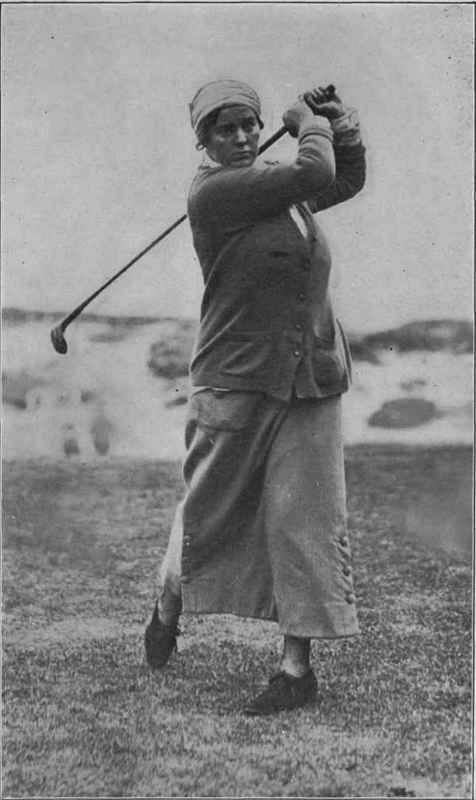
Miss Gladys Ravenscroft A firm, straight brassie shot.
One of the necessities to gain extra yardage is extra strength, and this Mrs. Feitner has in abundance. Her shoulders are broad, her arm muscles pliant, supple and strong, while her wrists are eminently powerful. Yet these attributes would be as nought if it were not for the perfect cohesion of parts, the rhythmic timing and that delicious snappy "hit" which assures a drive of lengthy proportions. With that essential adherence to golfing success Mrs. Feitner takes the club-head back with deliberation, but as the club-head nears the horizontal there is detected a gathering of the forces which make for a true "hit" at the ball and with that blow there goes a body follow through which must add to the distance many yards. Lady golfers, as a rule, are content to let the arm and a quarter body swing account for driving success; to the player who will pivot more, as does Mrs. Feitner, will come added yardage. This is seen in the roll of the rubber core after it lights. In her iron shots Mrs. Feitner does not hesitate to take turf and she often gets 200 yards from an unfavorable lie. Here is where her wrist and forearm strength mean so much. And, as happens so many times, there are deficiencies in her game to make up for the excellences. The pretty touch when chip shots are needed is absent, and so, also, is a sure putting stroke. Mrs. Feitner has the unhappy fault of turning over the right wrist just at the moment of impact when putting the ball and this fault has cost her dearly in many a contest. It has always been remarked that when she has won her big events she has been putting well and has not been over-long on her drives, which is still one more of the many proofs which we have that a player rarely receives from the goddess of golfing fortune at one time or in any one round all the attributes of muscle freedom and delicate touch which are essential for the playing of a near perfect round. Still, the 1916 Metropolitan champion has a great advantage over thousands of her sex golfers in that one may by assiduous practice become a good player at the approach and the put while all the practice in the world may not suffice to add ten yards to the drive. That is why there is so much praise and credit given to those ladies who are the longest hitters in the world.
If we were to take a hasty composite picture of the best lady golfers in the land it is quite likely that we would select the drive of Mrs. Feitner, the brassie shot which Mrs. Clarence Vanderbeck can get, the iron shots up to the chip shot, of Miss Stirling, the chip shots of Mrs. Dorothy Campbell Hurd and Mrs. H. A. Jackson and the putting stroke of Miss Rosenthal. And if we wished to see a player who gained the results which the best strokes of these mentioned golfers attained our journey would bring us to Great Britain and to the home course of Miss Cecilia Leitch, the winner of the last ladies' championship of the British Isles. Miss Leitch drives about as far as Mrs. Feitner, her iron shots are a bit better than those of Miss Stirling, her chip shots are wonderful and her putting is well above the average. Possessed of a perfect constitution and great strength, the "Amazon" golfer, as she has been termed, bangs away with all the freedom imaginable. Her stance is open and a bit exaggerated, her full swing brings the clubhead to the horizontal, while her finish brings the clubhead down almost to the level of her waist. Miss Leitch uses a modified flat swing wherein the club is swung more around the shoulder which gives her a long run to the ball; she is a bit different in her manner of swinging, it might be noted, for nine-tenths of women golfers use the upright style of driving. In her iron play Miss Leitch finishes as does James H. Taylor, five times champion of the British Isles, and when that is said we know why she excels through the green. Perhaps no other lady golfer in the world other than Miss Leitch can play a push shot brassie into the wind and this ability alone is worth more than one hole a round on British courses where the wind is so often strong. When the war is over the champion will visit the States and show to the golfers in this land how she accomplishes her rounds of seventy-four and seventy-five over good links. But, meanwhile there are more and more golfers of the female persuasion taking to the game. All the golf widows are not women.
Continue to:


My Books

