


Summary Of Both Strokes
Description
This section is from the book "Hints To Golfers", by O. K. Niblick. Also available from Amazon: Hints To Golfers.
Summary Of Both Strokes
The Stance
For the quarter iron and wrist shot, one should stand well over the ball, the distance one stands from the ball increasing as one plays a half, three quarter or a full iron stroke. For the full swing, the right foot is back of the left; for the three-quarter swing it is parallel with the left; for the half swing it is in front of the left; for the quarter and wrist swings it moves still closer to the ball; for the wrist swing pointing towards it. For the full swing, the weight of the body is almost wholly on the left foot; for the three-quarter swing it is equally on both feet; for the half swing it is largely on the right foot; and for the quarter and wrist swings it is wholly on the right foot.
The Grip
Hold the shaft more and more down the leather in playing from the full iron to the wrist shot, so that with these different strokes less momentum of the body will go into the stroke with the swing.
The Arms
In playing from the full iron to the wrist shot, as the right foot moves nearer the ball, the backward swing gradually becomes shorter. There is, therefore, less movement of the arms and less bending of the elbows. For all stiff' and bent arm strokes, the left elbow should always point well out, but in the stiff arm strokes the right elbow is held closer to the body as one plays from the full iron to the wrist shot and in the bent arm strokes it should always be held close to the body.
The Swing
In moving the right foot towards the ball, the weight of the body is transferred more and more to the right leg, there being less pivoting on the feet and less momentum of the body in the swing.
The Flight of the Ball
The momentum which goes into the ball is lessened
(1) By a gradual shortening of the swing.
(2) By a gradual shortening of the grip on the shaft.
(3) By a gradual moving of the right foot towards the ball.
(4) By a gradual bringing of the feet closer together.
(5) By a gradual facing towards the hole.
The amount of run given the ball is determined
(1) By the amount of forward spin.
(2) By the amount of backward spin.
(3) By the amount of right to left spin.
(4) By the amount of left to right spin.
The Jerk or Chop Stroke
When there is a ridge so close behind the ball that the club head has to come down perpendicularly to get between the obstruction and the ball, or when the obstruction is so close in front of the ball that the club head has to dig into the ground under the ball to get it over the obstruction, an up and down stroke, similar to the bent arm stroke, is necessary. With this stroke, the downward swing is so perpendicular that the whole body feels the concussion of the club head with the ground, and it is therefore called the jerk or chop stroke. In making the stroke the impact of the club head with the ground adds so much elasticity to the iron that extra impetus is given the ball which makes it fly from the club head as if shot from a catapult, and while not a difficult stroke to make, it is always a mystery to a novice to know how a ball can fly from an unpromising lie, almost, if not quite as far as if lying clear. In making the stroke only a half swing should be used, but it should be as true a swing and as absolutely free from any jerk as any other stroke. Because of the extra impetus given the ball and because there is no follow through to affect its flight, many professionals use a jerk stroke in preference to any other and play into the ground with a full swing with a brassy, cleek or iron, when the ball has a good lie, the ball going further than if struck squarely. When, however, such a stroke is used, the ball should have a grassy lie so that the club can get well under it.

Coop!

1 - the half swing, bent arm stroke. 2 - the half swing, jerk stroke. a b - the sweep of the club head.
In making the stroke
(1) If the obstruction is behind the ball, stand well in front of the ball and nearly facing the hole so that, with the perpendicular downward swing, the club head can easily get between the ball and the obstruction, the left foot pointing towards the hole, and the right foot with the heel on a line which, if drawn at a right angle to the line of flight, will pass through the ball.


(2) If the obstruction is in front of the ball, stand well back of the ball and nearly facing the hole, the right foot pointing towards the ball, the left foot pointing towards the hole with the toes on a line which, if drawn at a right angle to the line of flight, will pass through the ball.
(3) If the obstruction is both behind and in front of the ball, namely, when the bail is in a cup, stand the same as when playing with the obstruction behind the ball.
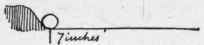

In making the swing, whether one stands in front of the ball or behind it, keep the left shoulder squared more to the front than for the stiff arm or bent arm stroke; and, to prevent the club turning in the hands as it digs into the ground, grasp the shaft with as firm a grip as possible.
When the obstruction is close behind the ball, hold the club so that the face of the iron will be nearly perpendicular as the club descends. When the obstruction is close in front of the ball hold the club with the face of the iron well back so that the club head can get well under it, and play to slice the ball. With the backward swing, bring the club up more perpendicularly than when playing a bent arm stroke and down more perpendicularly with the forward swing. In other respects, the stroke only differs from the bent arm stroke in not having to loosen the left hand with the forward swing.
Because with the forward swing the club head comes down vertically more or less turf is dug up with the stroke, but it is not turf behind the ball but turf under and in front of the ball, the divot cut out, if the stroke is properly made, being the width of the iron.

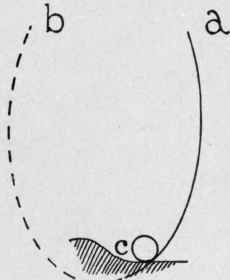
a b - the sweep of the iron. c - the divot cut out.
Suggestions
Use a mashie as less turf is taken and there is less liability of the face of the club glancing off as it strikes the ground.
Although the essence of the stroke is digging the club head into the ground, remember that if it digs into the ground before it gets under the ball the stroke is bafFed and the ball goes only a short distance.
When the obstruction is behind the ball do not see how straight you can bring the club down, but how far you can keep the club head from the ball without its hitting the obstruction.
Do not think of the turf to be dug up or conscientiously try to cut out a divot or you will do it too soon and the effect of the stroke will be lost.
Remember that the worse the lie, the more slowly and deliberately the stroke should be made, for accuracy and not distance is the thing desired.
Because one has in mind that he is to dig into the turf he is apt to bend too much over the ball. Remember, therefore, to swing the shoulders well around with the back bone a pivot and not to lean forward.
Because one has in mind the jerk, he is apt to shrink from the ball. Be careful, therefore, not to draw away from the ball with the downward swing.
As the club head comes down perpendicularly, great accuracy is necessary to prevent topping the ball. Keep the eye, therefore, not on the ball but on the ground behind it.
If the ball has such a bad lie that one can only expect to get the ball on to better ground, use a quarter stroke because, with a short swing, one is more sure of swinging the face of the club between the obstruction and the ball.
If the ball is on soft ground, the stroke should never be used with the thought of getting distance, as the impetus of the stroke expends itself in the ground without much of it going into the ball.
When the ball has such a lie that there is a fronting face, the stroke is often made with a brassy or cleek and, if struck properly, will fly as far as if played from a tee.
The stroke is also made with a full swing when the ball is on the edge of a ridge or knob, or cocked up, as it is called. With such a lie any club may be used and the more the swing is up and down the further the ball will be driven.
As frequently happens, the obstruction is so close behind the ball that it is impossible to get the face of the iron between it and the ball. In such a case, as the club head has to sweep through the obstruction to get under the ball, there must be an especially firm grip on the shaft.

a b - the sweep of the iron. c - the divot cut out.
Continue to:


My Books

