


The Distinction Between Courses
Description
This section is from the book "How To Play Golf", by H. J. Whigham. Also available from Amazon: How to play golf.
The Distinction Between Courses
Great latitude, as may be observed, is permissible in the choice of clubs for use on the putting green. There is this much to be said, however: On courses in Scotland and England it would be perfectly safe to recommend the wooden putter in preference to all others, since the best links are all by the sea. In America, so many of the courses are inland, or rather, so few are near the sea, that a strong distinction has to be drawn between seaside and inland putting greens. Unless the soil is of a sandy nature, it is wrong to begin life with a wooden putter. After a great many years it may be possible to get the same fine grass inland as is found on seaside courses; but even that is very doubtful. For the present at least, the coarser and more stubbly nature of the best lawn grass debars the effective use of the wooden putter. And yet you will find it very difficult to play your long puts with the ordinary iron putter, especially if the greens are at all heavy. The ball stays too near the ground, and its strength is affected by any unevenness, and especially by long grass. The best club for inland greens is therefore the genuine cleek with a driving shaft, cut short if necessary for convenience' sake; it enables you to get the necessary distance without any great exertion, and it also allows the ball to travel more evenly over strong grass.
It must be remembered, of course, that in recommending any particular club for putting purposes, nothing more is intended than an expression of opinion. I know numbers of excellent players who disagree with me and who support their judgment by an irritating display of accuracy on the green. Still, since beginners have no prejudice in favor of one club or the other, it is just as well that they should choose that one whose use has been sanctioned by the majority. Now, on sandy soil the wooden putter probably has the preference among first-class players, and the cleek or some similar iron weapon is a good second. The regular iron putter, with its straight face and upright shaft, is not patronized to any great extent by the faculty. If you are going to use an iron putter at all, it is better to get what is known as a putting cleek, a sort of cross between a driving cleek and an iron putter, or else one of Park's patent clubs, with the crooked neck.
The Line Of The Put
And finally, remember to look at the ball. Too much care over the line of your put is a dangerous thing. Make up your mind as to your direction first, and then when you address the ball, look once at the hole and once at some intervening point of the line which you have chosen, and then devote yourself entirely to hitting the ball clean. Many players examine their puts from both ends. But I hardly think that this is a good plan unless you cannot decide easily upon the line by looking at it behind the ball. In ordinary cases it is only confusing to examine it from both points of view. Be very careful to place the head of your club evenly on the ground, and hit your ball with confidence, and you will be surprised to find how many times it will find the hole.
Summary
To sum up, then: Choose the club that suits you best, but do not use a wooden putter on inland greens unless they are in perfect condition.
Do not rest your right elbow on your hip. In using a regular putter stand erect and swing the club more or less like a pendulum; in using a cleek, or any driving club, get rather more over the ball with the shoulders and push the arms toward the hole.
Do not put entirely with the wrists. The arms and even the shoulders should enter into the stroke.
Do not study the line of your put too long.
Think more of hitting your ball clean than of anything else. Keep your eye on the ball.
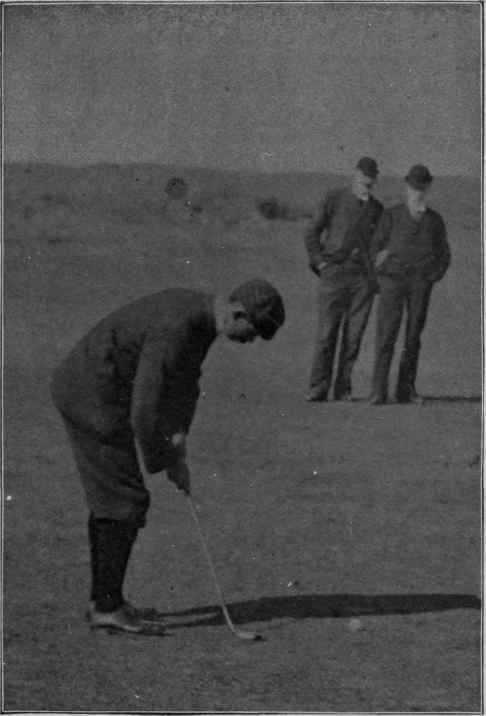
Photographed by R. W. Hawks, Edinburgh.
Mr. John Ball, Putting.
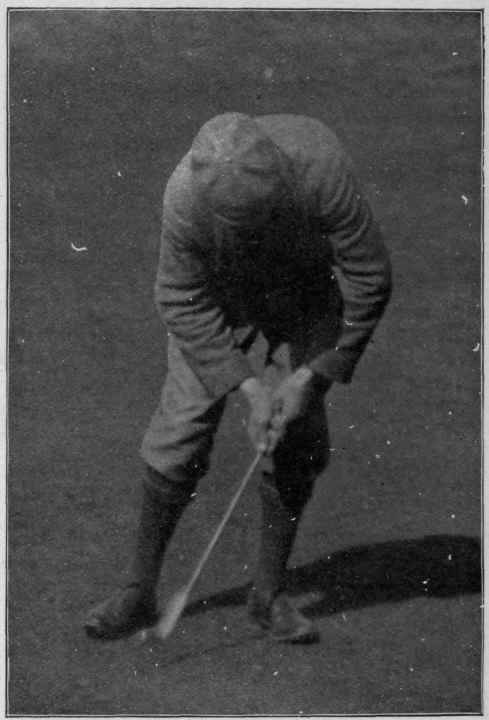
Photographed by R. W. Hawks, Edinburgh.
Mr. F. G. Tait, Putting.

Photographed by R. W. Hawks, Edinburgh.
Mr. F. G. Tait, After The Put.
Continue to:


My Books

