


Cleek And Iron Shots. Continued
Description
This section is from the book "How To Play Golf", by Harry Vardon. Also available from Amazon: How To Play Golf.
Cleek And Iron Shots. Continued

Stance. The player is distinctly nearer to the ball than for the drives.

THE CLEEK SHOT.
Top of the swing.
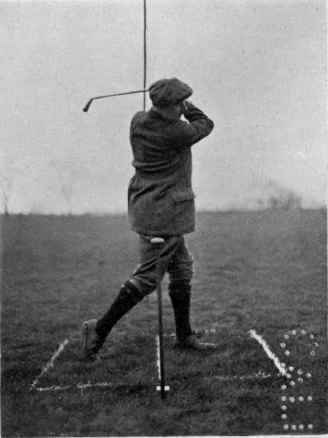
Finish.
The nearer the player is to the ball, the more upright will be the swing. That is inevitable. For the iron clubs, the swing ought to be more upright than for the driver or brassie. It should be a more compact action altogether. Generally speaking, the position of the left foot should alter less than that of the right - taking the drive as the basis for the stance. For a cleek or iron shot, as for a stroke with a wooden club, the ball should be on a line with a point a few inches inside the left heel; but the right foot should be brought nearer to the left so as to allow for the introduction of that element of uprightness into the swing. The left may be an inch or so forward, but the distance between the two feet should be lessened, mainly as a result of the right's advance. When the player takes the iron he should turn his body slightly towards the hole. That change will place the right foot even closer to the ball than the left.
The learner likes to hit hard, and he should begin his course of education with the iron by making full shots. He should aim from half an inch to an inch behind the ball. He will find the shots comparatively easy and - when he executes them properly - soul-satisfying. Except for that degree of uprightness, which is enforced by the fact of the feet being closer together, the swing should be the same as for the wooden clubs. It should consist of just the same old operation of winding up the body from the hips as the arms go back, pivoting on the inside of the left foot from the big joint to the big toe, and unwinding the body as the arms return. If the feet are too far apart, it is impossible to pivot properly. When the left heel turns outwards, it is certain that the player is lurching his body.
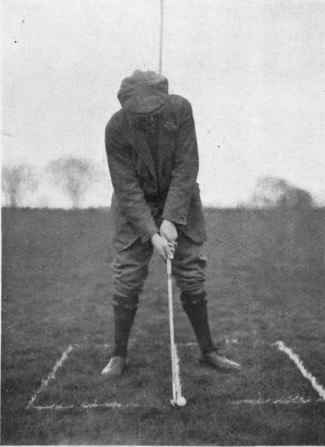
Statue. The player has drawn nearer to the ball than for the cleek, and the body is turned a little more towards the hole.

THE IRON SHOT.
Top of the swing.

finish.
Do not forget to aim at a spot half an inch or even an inch behind the ball. This applies to the cleek as well as to the iron. The place on which you need to fix the eye is the small gap between the ball and the club when the latter is grounded preparatory to the making of the shot. If you recollect at this moment of the completion of the address to direct the vision at that little gap, you will see the side of the ball, which is the part you want to hit. It is desirable to remember not to have the arms tucked right into the body. This is a fairly common fault; the player, having drawn nearer to the ball, seems to be possessed by an impulse to keep his arms so close in that they touch his body. They should be clear.
The distance of the shot should be governed by the length of the back swing. It is a great thing to always hit the ball unfalteringly. When only a half shot is needed, it is bad to take the club right back, and then try to check it at the moment of impact so as to prevent the ball going too far. One often sees this done, and the result is nearly always a foozle. Judgment in the execution of approaches depends not upon deciding how hard to strike the ball. The real judgment consists of knowing just how far to take the club back. Every player must find out for himself how far he can hit with various lengths of back swings; the only warning I offer is against the fairly common habit of paying no attention at all to the back swing, and trying to apply a certain strength just as the club meets the ball. I fear nobody could do that with much success. When a man goes back a long way for a half shot, he realizes at the critical moment that he must slow up a little or he will overshoot the mark. Then it is that the whole swing flounders, and the shot with it.
Don't stoop unduly when using the cleek or iron. Many people do this, more particularly when they take up a stance for the iron. If you desire to get up to the top of the swing, and you start in a squatting attitude, you will simply bob up and down. And absolute steadiness of stance is even more important with iron clubs than with the driver. An inclination to lift the body, which is born of a crouching posture during the address, is fatal.
As alternative clubs to the cleek, there are the driving-mashie and the spoon. Each has its virtues. A passing fancy sometimes makes the driving-mashie a highly effective instrument, while the spoon is the favourite implement of many golfers. By reason of its loft, it is easier to use than the cleek, but the latter, when mastered, is by far the more likely, I think, to place the ball near the hole. It is the more complaisant in the matter of guiding the ball. Still, much splendid work can be done with the spoon, as George Duncan and Sandy Herd have shown us, and I would merely advise golfers who conceive a liking for the club not to allow it to turn the cleek out of the bag. They doubtless wish to advance; and certain shots can be made with the cleek which are practically outside the range of possibility with the spoon. There is, for instance, the "push," which can be described later. If the driving-mashie or spoon exercise a sudden fascination over the player, by all means let him succumb, and see how he likes it. The stance for either of these alternative weapons is the same as for the cleek, which, in due course, he will doubtless reinstate as a friend capable of helping him in times of need.
Of late there has come into vogue a club called the wooden cleek, which is helpful to the bad golfer because it has a deeper and broader face than the iron-headed cleek. The loft is the same as in the case of the latter instrument, but the big face of the wooden cleek inspires confidence. There is such a large area with which to hit the ball that the doubter becomes trusting; he feels that some part of the club, anyhow, will realize his hopes. It requires a good lie; but if the player is convinced that it is easier to use than the ordinary cleek, let him use it. It is surprising what a conviction of this kind will do. A case came under my notice not long ago. It was that of a man who vowed that he could always hit a good shot with his iron, but that he was sure to miss the ball with his cleek. One day he decided to take a risk. "Give me the cleek," he said to the caddie. "I'll chance it." Sure enough, he missed the globe three times. "It's no use," he declared, "I must have the iron."The caddie rummaged in the bag, and then glanced at his employer. "Why," he said, "you've got it." Truly enough, the player thought he had been using the cleek, and had simply frightened himself into failure. Directly he realized that he had the iron in his hands, he hit the ball. This story may sound exaggerated, but it is the truth; nothing but the truth.
Continue to:


My Books

