


Golf In A Wind. Part 3
Description
This section is from the book "How To Play Golf", by Harry Vardon. Also available from Amazon: How To Play Golf.
Golf In A Wind. Part 3
I never in my life felt less like doing those things. We duly reached the teeing ground. The first hole was a short one. The green could be reached with a cleek. Far away to the left (it looked too far off for anybody to get near to it) was a pond. I played, and pulled my ball what seemed to be miles off the course - plump into the middle of the pond. What the spectators could have thought just then of the man who was " confident of winning and beating record," as the paper had inconsiderately said of me, I have no idea. Perhaps, however, the incident roused me. At any rate, I really did play well after it, and accomplished what the imaginative writer had evidently expected me to do. But if you would like to know the worst shot I ever played, that start at Boston would be a good answer.
From the foregoing remarks, it may be gathered that the way to impart intentional draw to the ball is to turn the right hand over at the instant of striking - or, at least, turn it half over. It is the easiest thing in the world to overdo the movement; that is why, in a high wind, the shot is so hazardous. If you turn the right hand over only a fraction of an inch too much, the effect of the excess is apt to be prodigious; the ball curls round like a boomerang, and tears across to the other side of the course, assisted by the wind. The stance is, to all intents and purposes, the exact antithesis of that for the slice. In the address, the ball should be just about opposite to the middle of the right foot. The left foot should be well forward so that the player finds himself distinctly in front of the ball and standing for a shot to the right of the line. Now, more than at any other time, is the occasion for remembering to hold tightly with the thumb and forefinger of the right hand. The face of the club must turn delicately on to the ball as the instrument comes down, and if you grip a little tighter with the right hand than with the left, you have a considerable chance of securing this effect without worrying unduly about it. It is, perhaps, an instinct in the matter of the grip, combined with the correct stance, that makes a player what is called "a natural puller." This shot is much safer on a calm day than in a wind, because, in the absence of atmospheric disturbance, there is a considerable chance of finishing on the course even if the turn-over of the right hand be executed to excess.


INTENTIONAL SLICING AND PULLING.
Stance/or the slice. The feet have moved completely behind the ball.
Stance for the pull. The opposite of that for the slice. The fee have moved to the front of the ball.
Naturally on a tranquil day, it is not necessary to aim so far to the right as when a wind is ready to exert its influence, but the principles of the stroke hold good for all occasions. It is by a good deal the longest driving shot "on the market," and as it does not entail great risk when the elements are at peace, it is rapidly becoming an obsession. Good golfers and excellent fellows are becoming intoxicated with the passion for length, and they are playing all their shots with draw. Having got into the way of doing it, they cannot get out of it. They are mechanical pullers. That is where they are handicapped, for the shot is not often useful except for full drives. With this subject I have dealt, however, at the beginning of the book. Sufficient let it be if I suggest to the aspirant to fame that he should not neglect the other strokes in the game, strokes of inestimable importance, in his efforts to master this shot that gratifies the eminently human desire to make the ball go a very long way. Let him be as determined to practise the slice, the length of which shot can be judged with accuracy since it is nearly all carry, as the pull, which produces a flat carry and a long canter. He will be all the better for the diversity of his methods. . I suppose that, for the indifferent performer, there is no experience more trying than that of playing a hole in the teeth of a strong wind. The ball never seems to go any distance, and it has an aggravating way of being caught in the gale and coming back towards its owner just when it might reasonably have rewarded his clean hit by travelling a bit farther than usual. He often discovers that a topped shot which goes straight serves him as well as a properly struck ball. That is because the former dodges the wind, but as topping is not the proper game, it is obviously his duty to keep the ball as low as possible while making sure of raising it from the ground. First of all the tee should be low. The stance should be forward - not quite so forward as for the push-shot, but with the hands the smallest distance conceivable in front of the ball during the address. That is the most important principle of the shot; for then, given a true swing, the club will come down on the ball in such a way as to keep it down throughout its flight. As the implement descends most of the weight should be transferred to the left leg, so that the body may go forward slightly with the club. Obviously the whole tendency of the stance and action is to beat the ball down, as it were, while hitting it so cleanly as to lift it from the tee. The iron shot against the wind should be a push-shot pure and simple. Nothing else is quite so good, for an adverse wind provides the ideal circumstances in which to make the most of the "push."
Golf down wind is a simple business, 15 so long as you pay sufficient prospective attention to the hazards ahead. The drive is easy; the chief danger is that of getting into a bunker which is meant to catch a bad second shot. In the absence of such peril, tee high (but not so high as to introduce the possibility of hitting under the ball), stand rather behind the ball, swing truly, and at the time of impact throw most of the weight on to the right leg so as to lift the ball into the air, and give it the full benefit of the wind. In approaching, it is not bad to remember what I have already written as to the preferableness, on hard ground, of hugging the bunkers on the wings at the risk of making their acquaintance. This, however, must be left to the player's judgment, and to the situation that is offered on the other side of the green, whither the ball may make its ungovernable way.
Personally, the worst wind I ever experienced was that which prevailed during the open championship at Hoylake in 1907, when Arnaud Massy plugged his way so gallantly to victory. It was terrific. The fourth hole, a short one, which can often be played with a mashie, required a full driver shot, and even that had to be kept low in order to escape the full force of the gale that was raging overhead. I like Hoylake, and one of the few faults I have ever seen in it was the bank which had been raised for that occasion a few yards in front of the fourth teeing ground. In order to reach the green, it was necessary to drive very low, and a lot of men who played the only shot for the occasion (Mr John Ball, I believe, among the number) were caught by that bank about five yards in front of the place from which the ball had started. One player had a most exciting experience; he went from the bank into the shelter hard by, and dodged all round the teeing ground until at length he reached the green in, I think, 7, and holed out in 9. At the sixth hole, it was impossible to get even up to the corner of the garden with the drive. Massy played some great golf during that trying week.

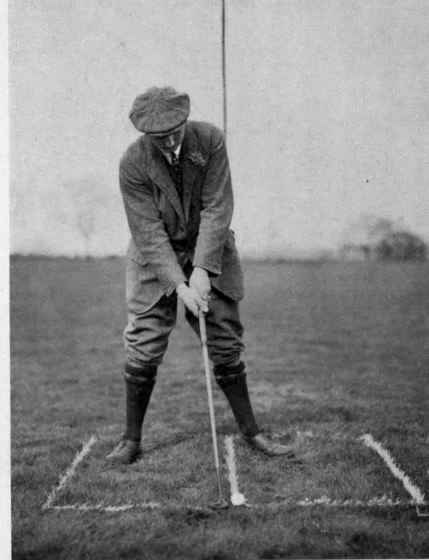
IN THE WIND.
Stance for a drive, against the wind, the hands are very slightly in front of the ball.
A drive down wind. The body is more behind the ball than for an ordinary shot.
The next worst wind I remember was that which prevailed during the tournament at Newcastle, Co. Down, in 1898. There was rain, too, in bucketsful. I know that, in the qualifying competition, we positively ran round; those who did not sprint round the links ran into the clubhouse. Many players retired at the third hole, and the course was bestrewn with the remains of umbrellas. On the night before the final, in which I met Taylor, I asked the attendant at the place in which I was staying to see that my golf boots were dry by the morning. He saw to it most effectually. I do not know whether he put them on the fire or in the oven; at any rate, as I made my first tee-shot in the morning, they both split right across the sole. The best game I ever played in my life with the gutta-percha ball was played in that ruined foot-gear. I have since wondered in times of adversity whether it would be a good thing to split my boots.
The wind is a fine educator; I recommend the golfer to lose no opportunity to coquet with it. For the present, however, he must have had enough of it. I only hope that he has not been involved in it so long as to leave him tired and struggling for his breath.
Continue to:


My Books

