


Some Common Faults. Part 3
Description
This section is from the book "How To Play Golf", by Harry Vardon. Also available from Amazon: How To Play Golf.
Some Common Faults. Part 3
Another provocation of the pull is the fault of holding tighter with one hand than the other, and a third is turning the right hand over at the moment of impact. The first and last of these causes are practically synonymous. As the implement goes back the face of it should be turning away from the ball, so that it may resume only at the instant of hitting the position which it occupied when it was grounded behind the ball. If you do not turn the club-face away by gently screwing the left wrist at the start, the chances are that the right hand will have control coming down, and be in the same position as if that hand had been turned over quickly at the critical moment. Holding tighter with one hand than the other produces much the same effect. There are people who say that you should grip tighter with the left hand than with the right. Personally, I think there ought to be no distinction. The tight hold with left hand is apt to drag the right hand over, and the result is a pull. I am sure all good golfers grip as firmly with one hand as with the other. I know that for an ordinary swing my own right hand is no more relaxed than the left at any stage of the movement. If the left hand were really the master hand, if one hand did all the hard work and the other merely acted as a guide, surely it would be possible, with a true swing, to drive as far with one hand as with two. I have tried single-handed driving. I have hit the ball correctly and made it go straight, and have never succeeded in inducing it to travel anything like so far as with two hands. The one helps as much as the other to secure distance; of that I am certain after submitting the idea of a "master hand" to exhaustive trials. In no circumstances should the right hand be the predominant partner. By his wooden clubs shall ye know what may be called " the right-hand hitter." He wears away the wood at the back of the sole, and reaches the inset of lead in a very short time. That is because he is constantly coming down on the back of the sole. Neither is it, however, correct to be a "left hand hitter," that is to say, to make the left do most of the work. I feel convinced that every first-class player uses his two hands without giving them distinctive duties to perform. Too much left is as bad as too much right; either is apt to produce the hooked shot. The simplest remedy for this error is to make sure of turning the face of the club away from the ball at the beginning of the upward swing so that the tendency of the right to assume command may be checked. When that turn of the left wrist has been completed early in the swing, the golfer should not be conscious that one hand is trying to do more than the other.
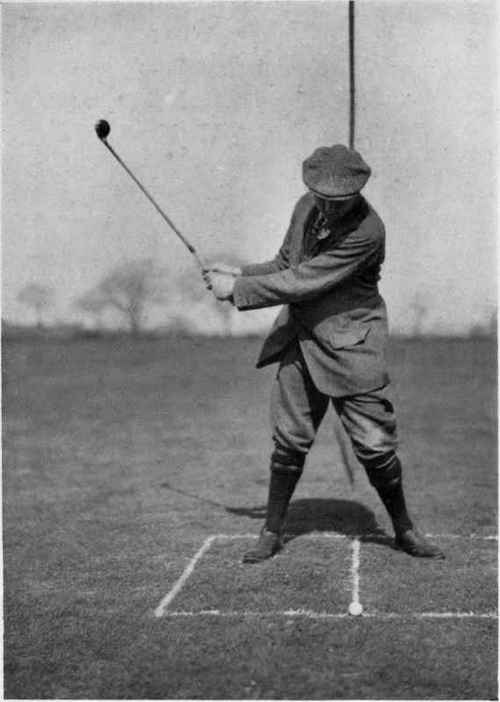
IN THE BEGINNING.
The wrong back swing. The left wrist has not turned sufficiently, and therefore the club face has not turned away from the ball.
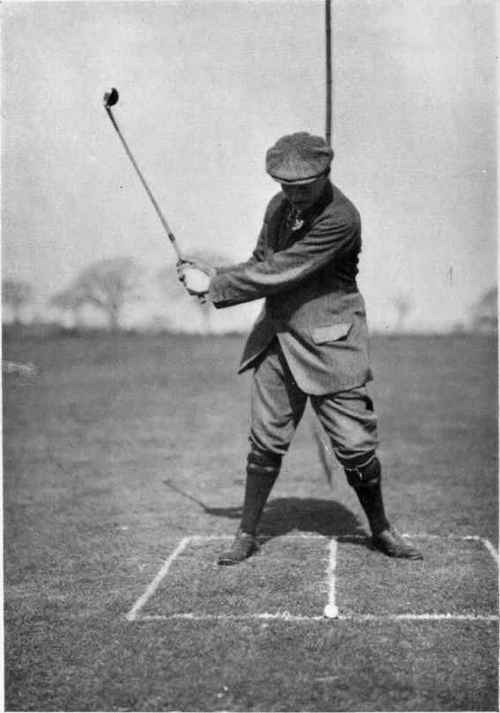
The correct up-swing.
In all these matters, it is essential to remember to screw your hips properly and keep your head steady. Very many golfers do everything correctly when taking the club to the top of the swing, and cut off a segment, so to speak, in coming down. They throw their arms forward immediately; they miss that section just behind them - the section which they had to form in order to get the club up after having turned the left wrist inwards. Instead of following the same track for the return journey, they take a short cut across the corner. Out goes the club, and then anything may happen.
There must be no sudden movement of this description. If in the middle of the task of winding up a clock you were to give the key a sudden and desperately violent twist, you would very likely realize in the course of a minute or so that the works had gone wrong. So will the golf swing go wrong if you try to come down by making a quick dash across the track which the club occupied in its upward course. This throwing out of the arms is a frequent cause of distress in connexion with iron shots. Players imagine that they are farther from the ball than is actually the case. The idea seizes them at the top of the swing, they reach forward directly they start to come down in order to make sure of getting to the ball, and the whole operation is ruined. In the case of a mashie stroke, the face of the club knocks the ball on to the socket and sends it to perdition. The best cure for socket-ting is to determine that the left arm shall graze the coat both going up and coming down. If the left arm can be induced to caress the jacket all the way, the right arm cannot stray, and the action is correct.
Schlaffing is caused by throwing the weight on to the right leg at the moment of hitting, and therefore dropping the right shoulder too quickly. The right shoulder has to come down in order to produce the proper effect, but it must not drop suddenly.
There are some players who, while they nearly always strike the ball accurately and make it travel in a straight line, never succeed in driving far. The reason is that they are not making sufficient use of their arms. They are executing the stroke purely by the twist of the body, and not putting their arms into it. It is the fact that the arms have to be used in order to obtain distance that makes the golfing swing partly a hit. The idea of " sweeping the ball off the tee " is very well in its way, but the arms, kept in decorous position by the trueness of the swing, have to hit, or the shot will be of very modest length.
I think that we have considered most of the common ailments of the golfer, but there are a few points of a general character that may be mentioned before we leave the sick-chamber. In the first place, the player who aspires to real success should never capitulate to the idea of trying to cure a slice that is habitual by playing for a pull, or vice versa. At first blush, such a scheme may seem to have much to recommend it, but if he decide to adopt it, he will be reduced, sooner or later, to a state of despair. He will never know quite where he is going; he will be all hope and fear. As a rule, the corrective influence will be either too weak or too strong; if it be too strong, he will find himself endeavouring to remedy his new fault by cultivating the action which he set out to eradicate. I know many golfers who have practised this plan of existing on antidotes, but I have never met one who has made a success of the conspiracy. Another important point is to make sure that you really are slicing or pulling before you attempt to cure the assumed defect. You may be standing in such a way that a straight shot is sure to go to either the left or the right of the fairway. During the address, the face of the club should be square to the line which you propose to follow. And beware of altering your intentions at the top of the swing. I must confess that this is a counsel of perfection up to which I do not always act in my own golf. It is one of the trials of the game that, just before the club starts to come down, the player suddenly conceives a fancy for executing the shot in a manner quite different from that which had fixed itself in his mind during the upward swing. Such a change is not often for the best.
Continue to:


My Books

