


Chapter V. Championships I Have Played In
Description
This section is from the book "Taylor On Golf Impressions, Comments And Hints", by J. H. Taylor. Also available from Amazon: Taylor on Golf: Impressions Comments and Hints.
Chapter V. Championships I Have Played In
THE mere fact of a man being attached to a club either as a member or local professional does not necessarily mean he is able to play more than an ordinarily good game. The hall-mark of excellence is admittedly placed upon a player's reputation, be he amateur or professional, by his performances in the Championships held annually. Very real tests, too, are these struggles for supremacy. Nerve, stamina, and readiness of resource arc each and all required, and occasional flashes of brilliance do not mean that a competitor will succeed in heading the field.
In a far greater degree than match play a Championship game is calculated to test the all-round excellence of a golfer's form. A far from ordinary or club game has to be played, nothing must be left to chance, fortune must not be tempted, and, in fact, every stroke and its probable bearing upon the result has to be thought out carefully as the rounds are being played.
When a golfer is participating in a match, the playing of one bad stroke will probably give his opponent an advantage sufficient to win the one hole, that is to say, supposing the opponents are upon anything like an equality as regards excellence of play.
But in the Open Championship it is the aggregate of strokes upon the full number of rounds that gives a competitor his position, good or bad, at the finish.
If it be considered for a moment what the playing of a bad stroke, and the attendant results, mean in these circumstances, my line of reasoning may be understood at once.
The mere fact of the enhanced value of every stroke is sufficient to make such a contest a terribly trying ordeal for the young player of either grade; it is the one real test of his capabilities. He is playing at top pressure during the whole of the time ; he cannot relax his vigilance or allow his attention to be distracted from the business in hand for a moment; and it cannot be wondered at that but comparatively few come out of the struggle successfully.
Even the seasoned player, the veteran who has taken part in many a hard struggle, feek the strain severely. How much worse, then, must it be for one who is new to the conditions governing the play!
Even now I do not feel entirely free from the tremor of excitement attending such a contest, although my first Championship game dates back as far as 1893. In that year it was played at Prestwick, and I tied for seventh place, after returning the lowest round that was made in the competition. The Championship was an entirely new experience for me, yet the curious thing was that I did not feel at all nervous-certainly not as nervous as I have felt in subsequent matches of these series, while my best score was made the first round I played.
This performance of mine naturally drew the greater portion of the crowd after me when I went out again, and I think I had better admit I lost my head, perhaps not an extraordinary thing to happen when the circumstances under which I was playing are considered. Be that as it may, the presence of the people affected my form ; I broke down badly, and so was finally put out of the first flight.
In 1894 the Championship was decided at Sandwich, and there I succeeded in securing the title of Open Champion fur the first time. During the twelve months preceding this contest I had played far more professional matches, and so I suppose had schooled myself, and had secured additional nerve for the big event. I had become inured to the presence of a crowd, and so played right up to the very top of my form.
A similar experience awaited me a twelvemonth later, in 1895, when for the second time I won the Championship, on this occasion decided at St. Andrews. Tuned, fortunately, up to the hour, I found myself accustomed to the crowd, and the strain made no appreciable difference to me, although it looked at one time, after the third round had been finished, as though A. Herd was likely to become the ultimate champion.
The Championship of 1896, at Muirfield, provided one of the most exciting finishes upon record, for on that occasion I tied with Harry Vardon for first place, but he defeated me by four strokes when we played it off. In connection with this failure upon my part, though, there was nothing of an astounding nature. The best man on the day's play won, but what might have had an effect upon the result, I think, was an incident that occurred a month or so previously.
This was what happened. The Hampshire County Golf Association had arranged a team match against the Yorkshire Union, to be decided at Ganton, the links to which Vardon was attached. At that time I was in residence at Winchester, and was invited to accompany our local team. I agreed to do so, but unfortunately for me, I did not reach the scene of operations until late in the evening preceding the clay upon which it had been mutually arranged to decide the match.
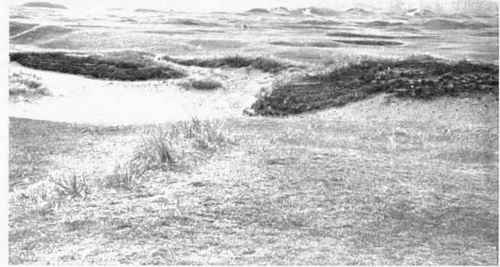
"Hell" Bunker, St. Andrew's p. 24
In consequence of this belated arrival on my part, I had no opportunity of securing a practice round or of forming an acquaintance with the course I had, later on, to play over. The sequel to this misfortune was that Vardon literally made mincemeat of me when we met on the following day, and I was badly beaten.
In the Championship a little later in the year he played a good game. That is beyond question, and I should be the first to admit it was the case ; but (a troublesome thing, these "buts") had he not met me previously I should have been somewhat of an unknown quantity to him, and it may have possibly had some effect upon the result. As it was, he had beaten me once, and this fact gave him additional confidence.
I recollect Mr. Hilton, as we were walking down the road together after the tie had been played off, remarking, "You weren't beaten to-day, Taylor; it was done six weeks ago"; and I sometimes think myself there was a lot of truth in what he said. At all events, these things cannot be helped, and a man is not a sportsman who cannot smile under defeat.
My experience at Hoylake, in 1897, was one of the worst I had had during the whole of my Championship career. I really could not play, try as I might. My condition of health I might plead as a partial excuse. I had had too much golf during the preceding seasons, and was indeed much below my proper form right through the year.
In 1898, at Prestwick, I managed to secure fourth place, and in 1899, when we played at Sandwich, I had regained some, at least, of my lost form. Vardon, who eventually won the Championship of this year, only led me by a single stroke at the end of the first day, but I am sorry to say I was not so successful during the further progress of the play.
In 1900 I again won the Championship, this time at St. Andrews, being then in robust health and at the top of my form again. As for the play itself, the contest was of so recent a date that I think I may be excused from attempting comment of any kind. Last season, 1901, James Braid took the title back to bonnie Scotland, and a special chapter must be devoted to his achievement.
Continue to:


My Books

