


Chapter XXII. The Acceptance Of Risks
Description
This section is from the book "Taylor On Golf Impressions, Comments And Hints", by J. H. Taylor. Also available from Amazon: Taylor on Golf: Impressions Comments and Hints.
Chapter XXII. The Acceptance Of Risks
N EVER despair, no matter what kind of an opponent you may find yourself pitted against. If he should be a longer driver than you are, don't let that fact upset you in the slightest. Neither must you attempt to equal his extra carry when you are fully aware that it is beyond your ordinary power. Should you fall into the error of trying to do this, you will undoubtedly fail more or less miserably, and the whole of your game will suffer in consequence.
It is seldom that a hole is won by a ten or fifteen yards longer drive from the tee, so do not worry about this advantage to your opponent in the slightest. Just continue to play your usual game, and don't sacrifice your steadiness to the, after all very natural, desire to accomplish something out of the common.
As regards taking risks in anything, you cannot afford to do that even when you are leading. On the contrary, you should concentrate your thoughts upon an endeavour to maintain your advantage, and to keep your opponent down, once you get him there. It is a far better plan to risk something when you are being led, and I am quite ready to admit matches have been, and will continue to be, pulled out of the fire at the last moment by a man prepared to accept chances. The thing to be feared is that after playing a risky shot you may discover that you are at a greater disadvantage than you were before. Still, that's the fortune of war, in golf as in everything else.
You must, of course, know when to take these chances, and if you are far behind - well, you must take big ones. A steady, plodding game is useless then, and the only thing remaining is to go at your work in a determined style.
Misfortunes are apt to occur even to the best of players, and if you discover your ball has found an absolutely impossible situation, 1 should strongly advise, as the best course to pursue, the giving up of the hole without further effort. Yet a player should not develop a tendency to give up things too easily. If there is any possibility of playing out, and there generally is, of a bad lie, he should be prepared to accept that chance. In advocating the giving up of the hole should the absolute necessity arise, it is best to take matters as they come, and not attempt impossibilities.
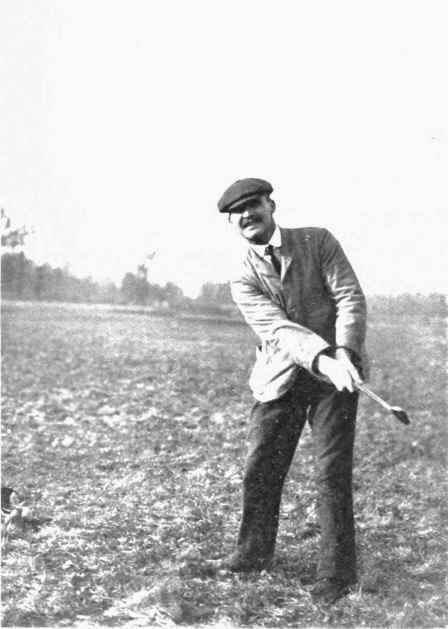
HIGH LOFTING STROKE JUST AFTER STRIKING BALL.

Floundering around and thumping away at a ball when it is in a really impossible position is a proceeding just calculated to weary your muscles and upset your nerves. Once such a thing as this happens your game suffers, so - go gently whenever you can.
One of the very best match players who ever handled a club was the late Lieutenant F. G. Tait. He made some remarkably poor shots, but, and this is where he was continually scoring, he made some marvellously fine recoveries.
Under these circumstances it was a difficult task trying to beat him, for no matter how or where he might be situated, his skill and nerve combined were so great that you never knew when you had him fairly and squarely down. He was capable of performing extraordinary feats, and curiously enough he could perform them just at the exact moment when they were most required.
I recollect once, in the final of the Amateur Championship, decided at Sandwich I think, he was playing Mr. S. Mure-Fergusson. The match was a terribly exciting one, for the pair were all square with one to play. Now the last hole, I may explain, at Sandwich is what may be best described as being a drive and a pitch, with the hole situated just over a nasty deep bunker that runs directly across the course.
Both players hit good drives and then Mr. Mure-
Fergusson played a second, the ball being carried ten or fifteen yards past the hole. Mr. Tait, on the other hand, in playing his second, duffed his approach shot, and laid himself under the face of the bunker. He appeared to be in a perfectly hopeless position, but he just managed to get out of the bunker with his third shot. Playing the like, Mr. Mure-Fergusson laid his ball a yard or so from the edge of the hole. Mr. Tait then had a putt of twelve yards to negotiate, and he managed to accomplish the feat. This must have put Mr. Fergusson off his balance, for he actually missed holing his putt, and Mr. Tait had thus pulled the match out of the fire at the very last moment. Now what did I say about no game being lost before it was won?
Something of a very similar character also occurred at Hoylake in the Amateur Championship of 1894. Mr. John Ball and Mr. Mure-Fergusson were the contestants, and this is how the struggle is described by the Golfing Annual: -
"Despite heavy rain supervening on a brief thunderstorm, there was a crowd of several thousands to see the final in the afternoon between Mr. Ball and Mr. Mure-Fergusson. Mr. Ball opened in a way that pleased the natives, for he won the first four holes by faultless golf. The fifth was halved, but Mr. Mure-Fergusson got the next, and with three successive halves, the turn was reached with the local man three up.
"Such a lead would have daunted many men, but it had the opposite effect upon Mr. Mure-Fergusson. He stuck pluckily to his work, and by winning three out of the next five holes, squared the match with four to go. Two steadily played halves intensified the excitement, and the feelings of the large crowd were with difficulty restrained.
"To the second last hole Mr. Ball got away the longer ball, and Mr. Mure-Fergusson played his second for safety short of the bunker guarding the green. With his brassie Mr. Ball, on the other hand, essayed the long and difficult carry. Straight as an arrow the ball sped for the hole, cleared the bunker, and landed at the hole-side. This grand shot, of course, gave Mr. Ball the hole and the Championship also, for the last was halved."
This feat of Mr. Ball's was indeed a grand one, and it goes to prove my contention that it perhaps pays to take risks occasionally. Certainly Mr. Ball was not afraid to take them at critical moments, and when a big effort was required on his part.
Since the death of Lieutenant Tait, perhaps the best match player amongst us is Mr. John Ball. He rapidly regained his form after his return from the front, threw off his weakness from an injured wrist, and jumped again into the front rank of contemporary players. He is a player of the real bulldog order, never knowing what it is to be beaten, and capable of extricating himself from the tightest of tight places. He is also able to go a full round without uttering a word, but I am unable to say what effect that may have upon his play.
Of the professionals I should say that Harry Vardon is the most dangerous match player you could wish to meet anywhere or at any time. One of the most remarkable features of his play is the manner in which he is prepared to accept big risks. He, too, has a penchant for bringing big things off, so that he is possessed of plenty of confidence in his ability to score where another player would be almost certain to fail. This. I think, is the real secret of his success.
A few years back, too, Vardon could get much farther than any of the other professionals in the playing of two strokes, and that alone is a great advantage in a long hole. For two years - in 1898 and 1899 - he also developed a truly remarkable facility in holing long putts.
I speak feelingly of this, for during the time I have just mentioned Vardon inflicted two almost unique defeats upon me. We met in a 36-hole match, and on the first occasion he defeated me by 11 up, and on the second by 12. Little wonder, then, that I possess very distinct recollections of these encounters!
I might say, however, that in these matches Vardon played the very finest games a man could possibly play. He accomplished something marvellous in the way of scores, and when you catch a man in a mood like that it is a matter of sheer impossibility for you to keep steady and play your usual game. I am not attempting to excuse or explain away my defeat; all I say is that in these instances I found the task of keeping up to my ordinary form very difficult of accomplishment.
Continue to:


My Books

