


Chapter XXVIII. Golf-Clubs And Their Manufacture
Description
This section is from the book "Taylor On Golf Impressions, Comments And Hints", by J. H. Taylor. Also available from Amazon: Taylor on Golf: Impressions Comments and Hints.
Chapter XXVIII. Golf-Clubs And Their Manufacture
AS marking the rapid advance made in all departments of the game, it is only necessary for me to remark that but a few years ago the art of manufacturing the various kinds of golf-clubs was confined simply to a few of the older golfing families in Scotland. Theirs was the right by usage and custom; the art had been passed from father to son; none enjoyed a less-disputed claim to control an industry than they, for it was seldom indeed that an ambitious outsider summoned up sufficient courage to enter the lists against them.
The oldsters had established their reputation when the game was young, and as teachers and manufacturers they had been acknowledged to be preeminent. Their prestige could not be dimmed, for a while at least, so they were allowed to hold well-nigh undisputed sway.
But this condition of affairs could not last for ever. Whispers of the approaching boom were heard throughout the land, and at last the flood tide of golf enthusiasm swept across the country. Players came out, not in their scores or hundreds, but in their thousands; they required the requisites of the game, and there was a difficulty experienced in meeting the demand.
Here, then, was the opportunity, an opportunity that was not missed, for the youth of England at once saw there was money to be made at the game, and recruits flowed in in ever-increasing numbers. Business men on both sides of the Atlantic recognised the fact that money and brains, coupled with the work of skilful hands, were required, and the result is that whereas at one time only scores were engaged in the manufacturing department of the game, at the present time there are thousands so employed.
This was one step forward, but in its wake followed other matters. The rivalry in the output led to the introduction of what were considered to be necessary alterations in the kinds and styles of playing-clubs.
These changes were often radical ones, too, for the old style of club, used when golf was but beginning to make its presence felt, with its narrow head and long, thin face, has now well-nigh passed into oblivion. There are places, of course, where it is treasured up as a relic of what once existed, but with new men came new ideas and new methods, and the old order of things had to go.
Spoons and baffles, which at one time in the history of the game held pride of place in the set of every golfer, have scarcely been heard of by at least one half of those who are at present participating in the game, excepting possibly in the rare cases when they have been reintroduced in the way of aluminiums.
To prove the vast difference existing between the clubs of to-day and those in use a few years back, all that is necessary is for anyone interested in the question to pay a visit to the nearest manufactory or to some spot where players are wont to gather. A glance over the various sets is amply sufficient for anyone to see that there are very few which include more than a couple of wooden clubs in their number. These are the driver and the brassie.
But how different are the drivers and brassies of to-day from those used by the earlier performers! In place of their heads being long and narrow, they have become much shorter and broader, and possess faces with a decided inclination toward the convex. Formerly the reverse was the case, for faces were concave.
The heads, however, are not the only things that have been affected by the shortening process, for the shafts, in a more or less universal manner, have been similarly treated. The tendency to-day is to play with clubs that have the dual advantage of being short and light, and although there are those who maintain that a longer drive is possible and probable from the use of a longer and heavier club, the fact still remains that with the other variety many fine performances are being accomplished day by day.
Prejudice or theory cannot be allowed to stand in the way of progress, and men who have used their brains to the best advantage where the manufacturing side of the pastime is concerned are not likely to allow anything to interfere with their lines of reasoning. They are not bound by red tape or tradition in any way; they do not mind following an idea out to its more or less natural finish, and in consequence we secure the clubs which are best adapted for their particular uses in the game.
I am perfectly willing to admit that there have been occasions when weird and fearsome articles have been attempted to be foisted upon the public. Great advantages, so it has been claimed, would be secured by their being adopted, but unless these claims could be substantiated in actual practice the products of a too-eager brain have been left very severely alone.
These experiences are to be met with in every path of life; it is not in golf alone. Neither does it prove the fallacy of any of the arguments advanced by the bond-fide manufacturer of tried and tested merit. It is to the advantage of the manufacturer that he should provide requisites that will assure him of a continued and increasing return for his outlay; and it is equally certain that every article offered to the golfing public must prove that it fulfils the whole of the required conditions, or it is shelved immediately.
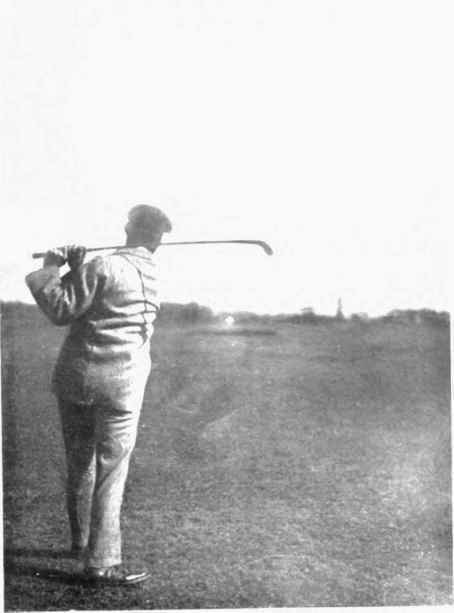
FINISH OF SWING.FULL DRIVE BACK VIEW.
We may therefore safely conclude that the kinds of clubs in use to-day have superseded the clubs of former days because they are proven to be better, and are capable of producing greater results than any others that may have been brought forward.
That the bulger is a superior club to the old-fashioned straight-faced driver there can be little doubt, and although the actual bulge may possess a little more virtue in theory than in practice, yet the reason for its existence is fully justified by its shorter, broader head, and its face, which has small danger, at all events, of ever becoming concave.
Given a long head with a straight face, and the golfer will soon discover to his cost that he is capable of pulling or slicing to a far greater extent than if his club possessed a short head; but when, in addition, the long head has a face which is also somewhat concave, then indeed is the trouble doubly intensified.
That the various iron clubs of to-day are better adapted for the work required of them than baffies or spoons, it seems to me, requires very little explanation or argument, though there may be some of the many thousands of players who, discovering that the facile use of the irons takes a long time to learn, are inclined to pin their faith to the old-fashioned clubs.
If it is a fact that baffles possess the merits that are being claimed for them in these latter days, I am brought face to face with a difficult problem. Supposing, but not admitting, that they do possess these claims to consideration, what is the explanation of their being first in the field, and yet occupying such a considerable time in proving their advantages? Again, why were they so completely ousted from favour by the iron clubs? But I will not argue the question further. That the gutta ball superseded the old feather ball provides no cause for wonderment, but that the latter should now supplant the former would be a phenomenon indeed.
My opinion is this: that every club which has secured popular use has done so because its merit was its recommendation. This being so, it will maintain its popularity until something better is produced and then it must necessarily drop out of the running, as far as the great public is concerned.
Considerable alterations have also been effected in the methods of manufacture. When the game was in its infancy, and up to a comparatively recent date, the manufacturer found it necessary to arm himself with frame-saws and rasps and hew the clubs into the requisite shape. Now, however, with his hand upon a lever, he stands and watches the machine as it accomplishes its task with automatic regularity and well-nigh human skill.
Continue to:


My Books

