


Chapter XXXI. Driving: The One Thing Necessary
Description
This section is from the book "Taylor On Golf Impressions, Comments And Hints", by J. H. Taylor. Also available from Amazon: Taylor on Golf: Impressions Comments and Hints.
Chapter XXXI. Driving: The One Thing Necessary
IF a perfectly timed and powerful stroke is the object of the player, he must fix his eye upon the ball, or at least upon the ground exactly behind and beneath it; and once he has concentrated his attention upon that spot he must not allow his gaze to stray until he has completed his stroke and the ball has been swept off the tee.
Many players wonder why they do not succeed in taking the ball off the little cone of sand cleanly. Probably the cause of this failure upon their part would be found in the fact that they remove their eye from the spot just a fraction before the head of the club meets the ball. I acknowledge that it is a difficult matter not to allow your attention to be distracted, and to gaze ahead. It would be better not to remove the eye from the original spot until a second or more has elapsed after the stroke has been played.
The preliminaries having been accomplished, we now arrive at the swing proper. To play this successfully the club must be taken back along and near the turf, trending around the legs as far as can be allowed by the movement of the arms. The right elbow must be kept close into the side, this action coming into operation before the club is allowed to describe a section of a circle in an upward direction, whence it is carried by means of a stead)-, smooth, swinging movement. When the club has about reached half-way up, the wrists must be drawn inward and toward the right side, this being a necessary lead up to the action by which the club is enabled to reach the correct horizontal position lying behind the neck of the player.
This appears to be a delightfully easy proceeding, but too much pains cannot be taken over doing exactly what I have described. The upward passing of the club-and this is absolutely necessary-must be a correct swing in every detail. It is not just the mere action of placing the club there, for the upward swing exercises the predominating influence upon the downward swing, and unless carried out carefully and correctly it fails in its application. As I have said, the swing is a very difficult thing to master, but it is a necessity, and intelligent practice is the only means by which it is to be learnt. The tutor may advise his pupil, describe how a thing has to be done, and illustrate it himself, but the learner cannot hope to follow in the proper way unless he is prepared to devote time and trouble to his task. The upward sweep of the club must be a real swing, and so must the downward sweep. Unless this is the case, dire failure will be the result of the misapplied efforts of the careless or impatient novice.
When the horizontal position at the back of the neck has been attained in the manner I have described, my opinion is that the club should be stayed in its progress, and not allowed to proceed further in that direction or carried below the position I have just mentioned. Should it be allowed to still sweep round it gets more or less beyond the complete control of the player, and he discovers that it becomes necessary to make an effort, more or less severe, to get it back again. This effort cannot have any other effect than the making of a break in the continuation of the swing, a fatal thing under any circumstances. A golfer must have complete control over his club - I cannot emphasise this point too strongly - and this full control is best secured by the what I will call three-quarter swing, where the line of the club is not allowed to drop below a horizontal position.
Only a few years ago it was the almost invariable rule that every golfer, good, bad, and indifferent, should of necessity develop the full swing; but it is instructive to note how matters have been modified in this respect by the passage of time. Golf has not stood still; its progress has been punctuated by fresh ideas, and the three-quarter swing is one of the products of the carefully-thought-out game.
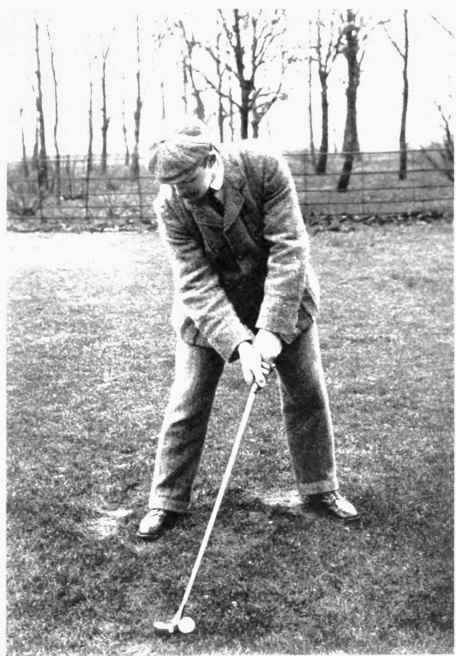
Addressing for drive against wind.
I am not surprised in the slightest that this should have been the case, for it cannot be denied that with such a three-quarter swing the ball can be driven to equally as great a distance from the tee, while, and this is its greatest and most manifold advantage, a far greater degree of accuracy is secured.
That there are always exceptions to the general rule I am willing to concede, and it may occasionally occur that a full swing comes quite naturally to a man who may be taking up golf. The natural golfer must not be spoilt, and if he is capable of swinging his club right round to the full extent, and still to retain full control over it, all I have to say is, allow him to take every advantage of it.
Speaking of the majority of golfers, however, I am decidedly of opinion that they would, as a whole, play a much better game were they to be taught to use the three-quarter swing. It is a far better method, even for those who take up the pastime in the days of their youth, and there is nut the slightest doubt but that a middle-aged player would rapidly discover himself to be beset by all kind of difficulties and dangers were he to attempt anything save what I have advised. Under certain conditions the young man may perhaps accept risks, but the older man, never!
Next it becomes necessary to strike the ball fairly and squarely with the centre of the head. We hear of balls being sliced and pulled, and so on, but such a thing would never occur were they fairly hit But supposing the toe of the club instead of the centre catches the ball, it flies off at a more or less severe tangent to the right, while if struck with the heel of the club the ball curls away in a most exasperating fashion to the left. The best player in the world will occasionally make a slip, but provided the ball is hit fairly it must of necessity fly through the air upon its true course toward its intended destination.
The act of playing the stroke is also as important as any other of the previous features I have touched upon, but an ounce of practice is worth a ton of theory. I have recommended the playing from off the right leg, so without further delay I will proceed to lay down what I consider to be the best and proper method of getting the ball well away on its journey to the hole. To play a stroke off the right leg the latter will need to be advanced some inches nearer the ball than the left, the weight of the body being distributed by the same method as is pursued in boxing, the right leg carrying slightly an excess over the left, although this weight would scarcely be perceptible.
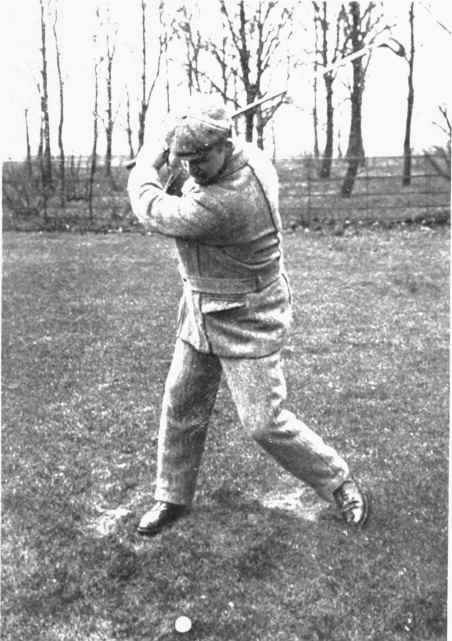
TOP OF SWING FOR DRIVE AGAINST WIND.
Then, as the club comes back in the swing the weight should be shifted by degrees, quietly and gradually, until when the club has reached its topmost point the whole weight of the body is supported by the right leg, the left foot at this time being turned, and the left knee bent in toward the right leg. Next, as the club is taken back to the horizontal position behind the head, the shoulders should be swung round, although the head must be allowed to remain in the same position, with the eyes looking over the left shoulder. The backbone, during the time these operations have been in progress, must have been held perfectly stiff and rigid, the neck and head alone being bent, and the hips being used as the pivot for the swing.
The head is maintained in exactly the same position as the arms are brought down again, and so it remains until the ball has been swept from the tee, the arms and body, for all practical purposes, going through the same action, but in the reverse way, as in the upward swing, the body being held in a similar position, but with the head turned and eyes looking over the right shoulder at the finish of the stroke.
During the progress of this downward movement the weight of the body is again transferred, passing from the right leg to the left until when the finish arrives the whole of the weight has been placed upon the left foot, while the right has assumed the position previously held by its neighbour.
This is how the stroke should be played in order to render it an entire success, but another thing must not be forgotten in connection with it. This is the finish of the stroke, or a possibly better description, the follow through.
After the ball has been struck there must be no semblance of jerking or snatching at the club. The player must not check himself or allow the premonitory symptoms of a check to make themselves felt, even in the slightest degree. He must allow the club head to follow the line of flight of the ball as straight and as far as is possible. The arms must be thrown forward freely and naturally, and as a consequence the right shoulder must be allowed to swing forward too.
By doing this the involuntary checking of the swing is rendered impossible; but if arms and shoulders were to be held tightly under control and as rigid as steel, the stroke would be finished as soon as the head of the club had been brought into contact with the ball. Every stroke in golf must be played freely, every muscle of the body must be allowed to do its full share of the necessary work.
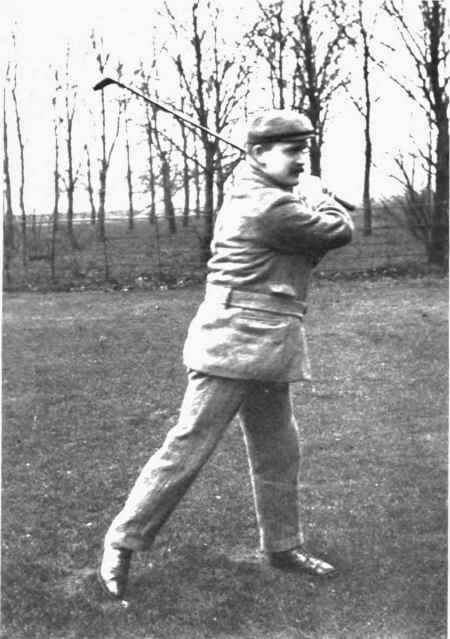
FINISH OF SWING FOR DRIVE AGAINST WIND.
Continue to:


My Books

