


Playing The Approach. Continued
Description
This section is from the book "Modern Golf", by Harold H. Hilton. Also available from Amazon: Modern Golf.
Playing The Approach. Continued
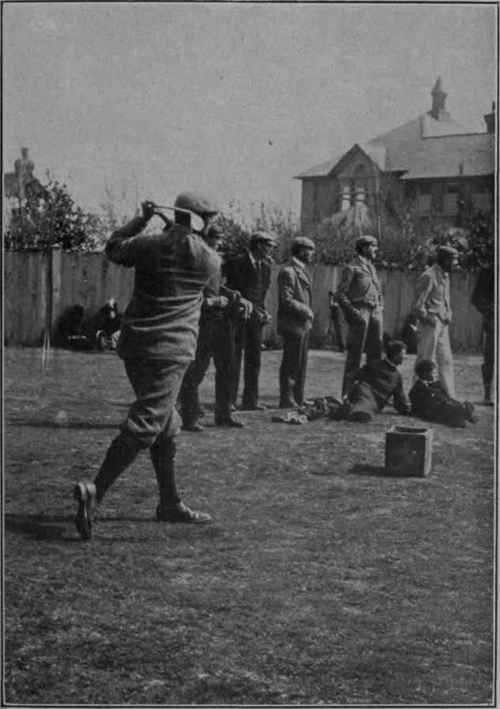
John Ball.
Eight Times British Amateur Champion Rated by Many as the Best Amateur in Great Britain impart a great amount of underspin to the ball. From what I saw of American courses they are peculiarly adapted to this class of shot, as the putting greens, in comparison with the putting greens in England, are on the small side, and it is always a safer procedure to pitch the ball right upon the putting green if possible, and I found the knack of being able to impart spin to the ball extremely useful in the championship meeting at Apawamis.
There is one very simple way of imparting underspin to a ball and that is by using a very lofted club and hitting the ball hard, trusting to the loft on the club, but it is a method which is not always successful when there is any wind blowing, as one cannot control the trajectory of the flight. The true scientific method is to impart the spin by the aid of the fingers of the right hand, bringing the club sharply across the ball from right to left. The club must be held firmly with both hands and the player must remember that it is the right hand which is responsible for imparting the spin. When playing this shot many players have an idea that it is necessary to stand well behind the ball and lay the face of the club well back. This may be a i useful method when it is necessary for the ball to rise quickly over an intervening obstacle, but it is not at all necessary if there is not an obstacle immediately in front of the ball.
The safer method is to stand with the balance of the body forward and swing the club vertically, as it is much easier to bring the club sharply across the ball when the swing is vertical than when it is a horizontal one. As I have before suggested, the true art of playing the lofted approach lies in being able to control the trajectory of the flight of the ball, and the manner in which this is accomplished is by altering the position and balance of the body. If the player wishes to play a high shot he must stand behind the ball, if he wishes to keep the trajectory of the flight comparatively low he must stand forward, with the balance forward. Provided he keeps the face of the club away from him and comes sharply across the ball, he will be surprised at the amount of spin he will impart in a shot which does not rise more than twelve or fifteen feet from the ground. One thing he must remember, however, and that is that he must hit the ball firmly and crisply.
There is probably no more spectacular stroke in the game than the low approach with undercut on the ball. When it leaves the club it appears as if the ball must career past the hole, and when the ball lands upon the green there seems little hope of it staying there, as it invariably takes a shoot forward, the velocity of the stroke precluding the underspin from taking effect immediately. But when it touches the ground for the second time, the spin becomes apparent, as the ball distinctly grips the ground, and on the third time of coming to earth there is no shadow of doubt as to what is going to happen, as the ball suddenly pulls up with a jerk, as if someone had a piece of string attached to it.
The majority of players can make a more or less comparative success of the full shot with an iron club. It is the simplest stroke in the repertoire of iron shots, as all that is required is accurate timing. There is no real question of calculation or control in respect to the swing of the club. The full shot is the natural shot with a golf club, and in consequence it must rank as the most simple. It is the "in between" shots which are the difficult ones with an iron club, the shots which require careful and scientific calculation, both as to the length of the swing of the club and the amount of force to be imparted to the blow.
There are golfers, and extremely successful ones, too, who avoid the playing of these "in between" shots in the correct manner by playing as many strokes as they can with the aid of a lofted club, and taking with that club a more or less full swing. On a day when the distances they have to make with their iron clubs prove peculiarly adaptable to their method of playing the stroke, their lack of knowledge of the true method of playing the half and three-quarter shot may cost them nothing. But, on the other hand, when the majority of the approaches will prove of such a character that they are not really suited to a full shot with any iron club in their bag, that will prove a bad day for them; their lack of knowledge of the command of the club on the backward swing will be severely felt.
I once knew a first-class amateur player who, on account of the fact that he played his full iron shots much more accurately than he played his half and three-quarter shots, made up his mind that in future he would play every approach he possibly could with a full swing of the club. To attain that object, he had a set of eight iron clubs made, with graduating lofts on the face of the respective clubs. At first he found that in principle the theory was quite a correct one, but he did not remain faithful to it for a very long time, as by degrees he found himself exhibiting a strong predilection for various individual members of his set of eight, and in consequence avoiding the less worthy members. Soon he naturally fell back into his old practice of playing with four iron clubs and playing them as they should be played.
To an average handicap player, who has failed to master the half and three-quarter shot, this method of playing a club to its full value is quite a good principle, but all golfers should try to master the half and three-quarter shot. It is admittedly the most difficult stroke in the game to overcome, but the reward for success is very, very great. It is all a matter of being able to control the club on the upward swing, and so control it that this upward swing can be terminated at any time the player wishes. I The whole secret rests in the manipulation of the club with the fingers of the right hand. The left hand naturally has something to do with it, but this hand swings the club naturally and its control is such a simple matter that it can be dismissed. The right hand, however, is a particularly unruly member, as it is so difficult to stop the club on the backward swing and do so without loosening the grip with the fingers and then gripping again. If this happens, it invariably ends in the club face being turned either in or out, with the result that it comes down on the ball at a different angle from that which was originally intended.
The iron play of the present generation of players is infinitely more accurate than it was fifteen or twenty years ago, and this added accuracy must be put down to the command which the leading players have of the half and three-quarter shots. They are probably not better natural players than the players of the past generation, but their task of controlling the backward swing with an iron club has been made comparatively simple by the interlocked grip, by which a certain number of the fingers of the right hand work with, and become more or less a part of, the left hand. In consequence this hand, the simple one to swing with, takes on a greater portion of the responsibility in the upward swing.
In the playing of all iron shots I strongly advocate the use of the overlapping or interlocked method of gripping the club, as it serves to make the task of controlling the upward swing of the club much more simple than when the hands are held in the old-fashioned method, separated from each other. The crux of the situation lies in the player's ability to stop the club on the backward swing and, at the same time, keep continued possession of the club handle with the fingers of the right hand. There must be no sudden loosening with these fingers and then gripping again; there must be an even rhythm in the swing right through, and one help toward the attainment of this even rhythm is a firm grip of the club, as then there is not the same risk of the fingers leaving the club handle.
Nearly all the leading professionals play their iron approaches with a short swing and a hard, firm blow with the club, which is sometimes termed a "push shot" and occasionally by the less euphonious title of "dunch shot," this latter applying to the efforts of the players who come down on the ball vertically and finish the swing with a very restricted follow through. To my way of thinking, this method of playing iron shots is almost entirely due to the introduction of the rubber cored ball, as it would have been almost impossible to do this with the old gutty ball, which required a certain degree of manipulation to cause it to rise from the ground. The "push" shot, as played by many players of the present day, if applied to a solid ball, would result in its keeping very, very close to Mother Earth.
This push shot is in reality a long, firmly played wrist shot. The player must stand with the balance well forward, and right through the stroke must keep firm on his feet, the grip of the club must be firm and tight, and the body must not sway. It is a little difficult to say exactly how long the backward swing of the club should be, but the majority of the professionals seldom take it back beyond the vertical position.
One of the great secrets of successful iron play is to stand firm on the feet when playing the shot, and in particular to keep the heel of the right foot firmly on the ground. There are certain classes of long approaches which have to be played with a comparative degree of body action. For instance, one cannot play a full cleek shot absolutely stock footed, that is, with the heels glued to the ground, but from experience I have found that the best and most accurate iron players are those who stand extremely firm on their feet and trust to the swing of the arms and wrists.
To my mind there seems little object in attempting to hit a long ball with an iron club, as the object of iron clubs is surely in the cause of accuracy, and not in the cause of length, and one can invariably hit the ball just as far as one wants by standing firmly on the feet and employing a three-quarter swing. Personally I always try to avoid playing with an iron club with which I have to force the shot. I infinitely prefer to take a club with which I can comparatively easily reach the hole and play for a spot beyond that hole. If I hit the ball absolutely truly I will probably finish beyond the hole, but I do not mind that, as it is just as easy to putt from beyond as from the near side.
On the other hand, if I fail to hit the ball exactly as I meant to, I am surer to be near the hole than if I had originally played the shot to just reach the pin. The besetting sin of many players is that of underclubbing. They do not seem to mind being short of the pin, but simply loathe seeing their ball go beyond it. Play to be up to the hole with your approaches and chance the probabilities of going too far is advice which I always try to follow myself, as I have reason to know its value, through experience gained in playing against those who invariably follow this principle. I am afraid of the man who plays to be up to the hole at any cost.
Continue to:


My Books

