


(A) The Half-Shot
Description
This section is from the book "The New Book Of Golf", by Horace G. Hutchinson. Also available from Amazon: The new book on golf.
(A) The Half-Shot
We have been talking about the half-shot as if it were played purely with the iron, but the shot can, of course, be played with various other clubs. It can be played very profitably with a cleek, although this is a difficult stroke, only to be acquired, if at all, with much practice and long after the elementary stage is past. It can be played with a mashie, and unless a very abrupt loft or a very dead fall is required, it is the easiest and most obvious shot for an ordinary person to play with a mashie. In short, it is the shot which is the foundation of all approaching, in the usual colloquial sense of that word. Once its main principles have been grasped, the stroke may with comparative ease be regulated to fit the distance. For the moment distance is not particularly to the point; the thing is to grasp the character of the stroke, which, having in some respects the same foundation as has the driving swing, is yet so essentially different from it.
Fortunately there is here no great controversy on the matter of stance. It is generally conceded that the stance should be more open, the right foot further forward than it was in the drive, while the greater part of the weight is on this right foot and the ball is placed comparatively far back. There are the inevitable exceptions. Mr. Laidlay is apt to play his iron shots, as in his most frequent moods he plays all his shots, off his left leg, while Duncan plays all his iron shots with a remarkably square stance. One can only say that these two are unusual, and that a fairly open stance is most likely to suit the average person. At the same time, the knees are rather more bent, and the whole attitude slightly more stooping, the player is decidedly nearer to his ball, and has his arms closer to his side. Also, since straightness and control are to be his particular object, he should almost certainly hold his club fairly low down on the grip. One may hit a full shot very comfortably while holding the club at the extreme end; even if the resultant sensation be that of the tail wagging the dog, it is not in driving wholly to be deprecated, but so undisciplined a state of things will not do with iron clubs.
The term half-shot conveys the impression that the player is to take back his club just half the distance that he would take it back in a full shot. The club is in reality taken considerably further back than this, but if the player keeps a halfway swing before him as an ideal, he will at any rate be likely to keep his club well under control. Now, in making this curtailed movement there is, I believe, a greater risk even than there was in driving of his taking his club up entirely in the wrong way. Just because it may seem to him a simpler and more natural movement, he must be particularly on his guard. He may well return for a moment or two to that backhand exercise with the left hand; at any rate, he must take great care that his wrists and the face of the club are turning away from the ball as they should. Having started the club up on the way it should go, he must stop it when it has only completed part of its course, and this stopping of the club at the right place is one of the hardest achievements in golf. Nearly all bad iron players, which is much the same as saying nearly all golfers, lose control of their club for a fraction of a second. During that infinitesimal moment they do not quite know where the head of the club is and where their own hands are, and it is this momentary loss of control, more than any other one thing, that makes them bad iron players. In order to avoid this pitfall as far as may be, the infant iron player should take up the club distinctly slowly, and make something of a pause before the club begins its return journey. Also, he must keep a very decided grip throughout with the right hand; not a grip so masterful as to cause the right hand to overpower the left, but a thoroughly firm grip, with no trace of that relaxing at the top of the stroke which was allowed him in his full swing. Control, control, and again control; that is the thing to preach about this shot; and all the time the club is being taken back, there should be a feeling of tautness and tension about the wrists as if they were determined not to let the club head run away with them.
Now the player is at the top of this curtailed swing, his wrists bent well under the club, his right elbow close to his side. He has finished the pause at the top, and he wants to come down and hit the ball. As in the drive, the return journey of the club should be made almost automatically if the preliminaries have been correct, but the club must not be allowed to come down and fling itself after the ball with quite the glorious abandon of the driving shot. It must come down more slowly and discreetly: it must not finish so high in the air or so far round the player's left shoulder, and - which is the most teasing and deceitful thing of all - it must not sweep the ball away, but come down on it with something of a snap, with a very palpable hit.
Sir Walter Simpson has said that we must not expect a mental attitude to drive a golf-ball, and it is, on the whole, one of the profoundest remarks of that depressing teacher. At the same time, it is so hard to indicate in words any really tangible difference between a swing and a hit, that one must perforce rely to some extent on the mental attitude of the player. From the very beginning of the stroke, even at the moment when he is turning over his wrists so carefully and conscientiously, he must have it in the back of his mind that this time there is to be a good deal of hit about his swing. This mental attitude will not by itself hit the ball, but combined with much practice it will help in the hitting. At any rate, when once the club has been taken back properly, I have nothing better in the way of positive advice to give. It may perhaps be added that the right hand may be allowed to play a fairly prominent part in bringing the club down, so as to get a little extra snap into the shot, but I have some qualms in this regard, and at any rate the advice must be adopted very circumspectly.
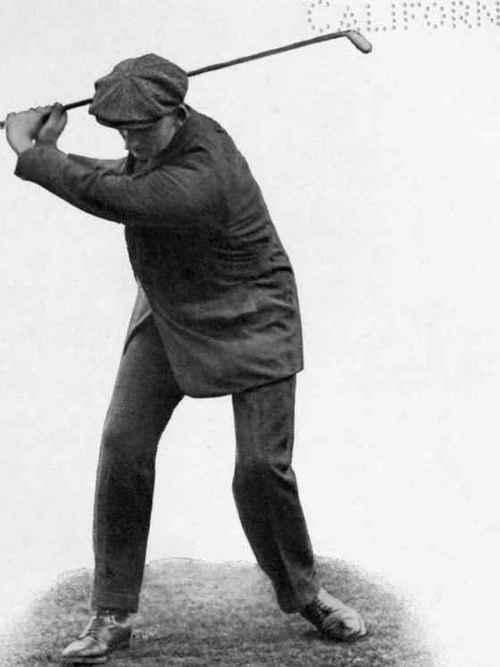
HALF SHOT WITH IRON: TOP OF SWING.
This is a shot that probably a good many people would to-day call a push shot, but half shot seems a simpler and better description.
[To face p. 88.
As regards this stroke, nothing has been said about the pivoting movement of the body, upon which such stress is always laid in regard to driving, and in truth I think the less said about it the better. Of course the body must not be kept wholly rigid and immobile; it must turn to some extent, and so must the left knee and the left foot. But now that the turning movement of the wrist has, let us hope, become in some degree a second nature, the turning of the rest of the anatomy will follow of itself, and, in respect to this stroke, wants restricting rather than encouraging. The steadier and stiller the body and feet, the better for the stroke.
If it is essential not to move the body forward, it is almost equally important not to move it upwards. In other words, the player must never 'unhinge himself at the small of the back,' and so alter the inclination of the body. Also, he cannot possibly be too careful in keeping his eye on the ball. To me, at any rate, the temptation to remove the eye seems greater, and the result of doing so more fatal, in a half-shot than in a full shot. Moreover, it may be added that in playing a half-shot it is very difficult to overdo this business of looking at the ball. In a full shot it is possible to cramp the follow-through by keeping the eye too resolutely glued on the ground after the ball has departed, but in a half-shot there is practically no such risk. The worst that can happen is an occasional hook, and what is that compared with the miseries of topping and socketing?
It only remains to be said, that since the shot will be used at various distances, it is necessary to be able to regulate the strength, and this must be done by regulating the distance that the club is taken back. There is a temptation to do it in quite a different way, by taking back the club a uniform distance, and hitting a more gentle or more vehement blow, as the case may be. Nothing could be more fatal. The gentleness degenerates into flabbiness, so that the club falls feebly on the ball and never gets any further. The vehemence inevitably leads to putting the body into the stroke at the wrong time and in the wrong way; the shot is hopelessly mistimed and the ball struck more often than not upon the socket of the club.
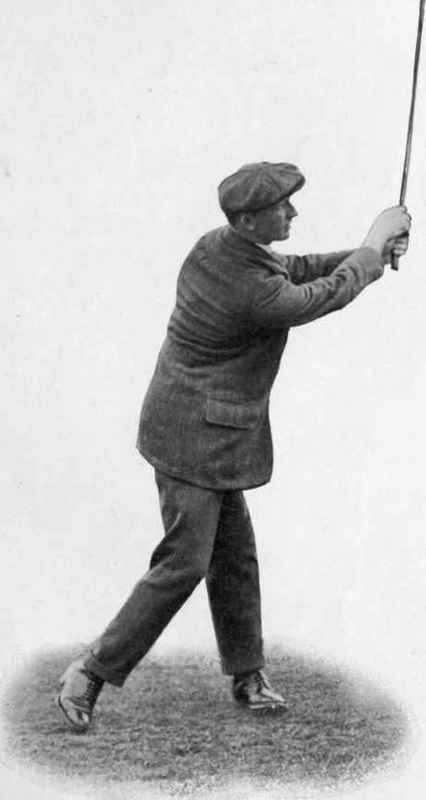
FINISH OF THE HALF SHOT WITH THE IRON.
[To face p. 90.
A propos of the half-shot, it may be thought that something should be said of a stroke that it is now very fashionable to talk about, if not to play, namely the push-shot. I confess to being frightened of this shot. Not only have I grave doubts about its being elementary in character, but I am not at all certain of anything about it; so many different shots, all of them good and useful, are now called by this name. In some cases it is indistinguishable to my eyes from a half-shot. In the case of one player, Mr. Mure Fergusson, it exactly deserves its name. With a driving-mashie or driving-iron Mr. Fergusson plays a shot which is a push and nothing else. He takes the club back a surprisingly short distance with a comparatively rigid wrist, and he pushes the ball a wonderful distance. It is a magnificent shot in a heavy wind, and may well be imitated on a small scale, but it is idle for most people to try to send the ball anything like so far as does Mr. Fergusson.
Mr. de Montmorency has a famous push-shot which he plays with a very short cleek. He stands with his weight well forward, and the hands rather in front: he takes the club up very straight, and seems to punch very hard down on the top of the ball.
The player, however, who has really made the fame of the push-shot is Harry Vardon. He does not look particularly like Mr. de Montmorency when he is playing the stroke, but there is something of the same method about it in that he, too, seems to come rather down on the ball. I cannot do better than quote this master's account of his own shot: 'In playing an ordinary cleek shot the turf is grazed before the ball in the usual manner; but to make this half or push shot perfectly, the sight should be directed to the centre of the ball, and the club should be brought directly on to it. In this way the turf should be grazed for the first time an inch or two on the far side of the ball.' In these words is, I think, compressed the essence of the Vardonian push-shot, and as played by him it is, no doubt, the most beautiful and valuable shot. It is a stroke that does appear to be endued with some uncanny power of making the ball keep an undeviating course, and it may be especially valuable to those who feel a tendency to hook their long iron shots. By all means let the player try to master it in time, but at first he had better attempt fewer and simpler things. When he comes to mastering this push-shot, he will be out of the nursery and likely to despise text-books.
Continue to:


My Books

