


Chapter IV. Through The Green
Description
This section is from the book "The New Book Of Golf", by Horace G. Hutchinson. Also available from Amazon: The new book on golf.
Chapter IV. Through The Green
Although out of a doubtful or bad lie the swing with a brassey varies slightly from that used with a driver, there is practically no difference between a driver and a brassey shot when the ball is lying well through the green. In fact, many people never carry a brassey, but make a driver do all the work. This plan, however, only works well on links where the turf is of a particularly fine quality. On courses where cupped lies and uncertain stances are frequently to be met with, the brassey is the more suitable club to use, and it is practically a necessity for those who wish to get the most out of their game. Some years ago it was invariably thought the right thing to make the shaft of a brassey slightly shorter than that of a driver. Nowadays, opinion seems to be veering round to making both clubs the same length, on the principle that, as the difference in swinging the two is so slight, any variation in length only complicates matters. The brassey shaft is stiffer and the face of the club more laid back. The name is derived from the plate of brass which covers the sole of the club. This plate of brass saves the sole from wear and tear, and it also helps in cutting through the ground or any obstruction when the ball is not lying too well. With these few exceptions the club is made on very much the same lines as the player's driver, the most usual way of getting a suitable brassey being to give the driver used to the clubmaker and to tell him to make the brassey after the same pattern, only with the necessary modifications already specified. Few ladies' links afford much scope for brassey play, but on long links the club can be most useful. It is a very pleasant sensation to hit a really clean long brassey shot, and see the ball soaring away into the dim distance. It pays well to be able to use this club satisfactorily. At many holes a good brassey player will reach the green in two and be able to putt her third, when a weaker player will take three to get within putting distance. Or, again, the brassey will enable one who can use it well to go for some particular hazard and clear it successfully, when another who has not the same skill has to take an iron and play short, at the cost of an extra stroke. Speaking from the woman's point of view, Deal is a links where brassey play is of tremendous importance. Much the same may be said of Walton Heath, where the second shots are far more difficult than the drives. At Newcastle, Co. Down, good brassey shots pay well, and the character of the turf seems to be such as to make it particularly easy to pick them up. The turf makes a great difference. It is much harder to get a brassey shot away well from very bare turf than from that on which the grass grows thickly. A shot made with a brassey will not run as far as one made with a driver, owing to the extra loft on the face of the former club; therefore, when the lie and stance are exceptionally good, it is not only permissible, but very advisable, to take a driver through the green. But the circumstances must be exceptionally favourable, else it is not worth while running the risk of not getting the ball up. With an ordinary good stance and lie the brassey may be used in an exactly similar fashion to a driver. It is important for the beginner to bear in mind when playing this stroke, that, although her ball is lying on the turf instead of being teed up, she need not make any extraordinary effort to lift it. The club will do the work of itself, as the loft on the face is quite sufficient to make the ball rise without any further help. The attempt to force the ball up from the ground only results in dropping the right shoulder, a fault for which no measure of condemnation is too strong. The beginner may find that she cannot play the shot successfully at first, and that the ball is inclined to run along the ground instead of flying through the air, but she must not be discouraged, but must just persevere steadily until some improvement manifests itself. Topping is not nearly such a heinous crime as dropping the right shoulder, and it is much the easier fault of the two to cure. Topping may result from a variety of causes. The player may not be getting down to the ball sufficiently, or she may be taking her eye off too soon, or looking at the top of the ball instead of at the centre of the side nearest the club. She may be standing too close to the ball, or she may be falling forward in the middle of her swing. Any of these faults would be quite sufficient to spoil the stroke. The remedy in each case is obvious and easily tried.
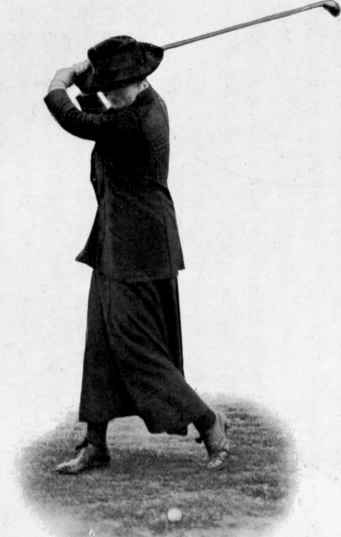
MISS E. GRANT-SUTTIE.
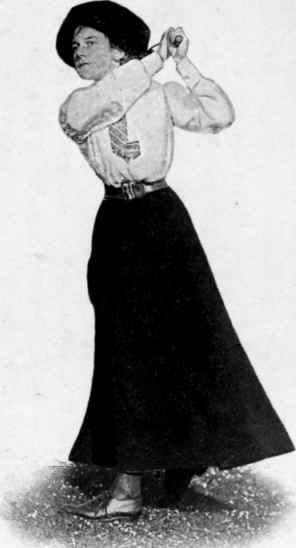
MISS DOROTHY CAMPBELL.
To face p. 308.
Getting down to the ball is the only one that presents any difficulty, and it is a golfing term which is very hard to explain. I have recently asked several first-class golfers how to define it, but they all seem equally hazy on the point. They vaguely aver that it means to stoop, but how much or how little, or what, if anything, must be done besides, they cannot tell. They instinctively do the thing required in actual play, but they cannot describe it in words. I must confess that I find it equally hard to define. I think it must mean a relaxing of the tension of the body, a yielding of the upright position sufficiently to make sure that the ball is comfortably within reach, and that the club will strike it fairly in the even course of the swing without any jerk or straining of the body. A possible point is the hitting of the ball at its lowest extremity, but as to this last I would not be quite sure. A fault to which a beginner is very liable is jerking her body backwards and upwards as she raises her arms for the back swing. This backward jerk dislocates the even motion of the swing dreadfully, and inevitably spoils the shot. The slightly stooped position must be maintained throughout the whole swing, except at the finish of the follow-through, and the body must only be allowed to turn sideways, not upward.
Continue to:


My Books

