


Part III. Men Of Genius. Part 7
Description
This section is from the book "The New Book Of Golf", by Horace G. Hutchinson. Also available from Amazon: The new book on golf.
Part III. Men Of Genius. Part 7
Mr. J. B. Pease is another example of the square stance and ball opposite left foot style. He relies on a pull for his length, but is straighter, though not quite as long, as Mr. de Zoete, the result probably of the three-quarter swing he contents himself with. He can always be relied on to give his opponent a very hard run for his money, as Mr. Ball can testify, when he met him in the last championship at Hoylake. He appears to play nearly all his shots with the same stance and swing.
Of the younger generation there is no more promising player than Mr. L. 0. Munn, who is indubitably the finest golfer that Ireland has yet produced. To win the Irish championship three times running is a great feat, and stamps him as possessing not only the skill, but also the temperament of a great match player. I should say that Mr. Munn is the finest exponent of wooden club play to be found in the amateur ranks. He drives very far and straight with an exceptionally graceful and easy swing, and his second shots are every whit as good as his tee-shots.
Mr. J. Robertson Durham is a very promising young player, who also excels with wooden clubs. His carry is prodigious, but he hits rather too high a ball against a head wind. His run of success at Gullane and Luffness, where he plays most of his golf, has been quite extraordinary. His swing is inclined to be of the 'headsman' type, and is not by any means a long one.

L. O. MUNN.
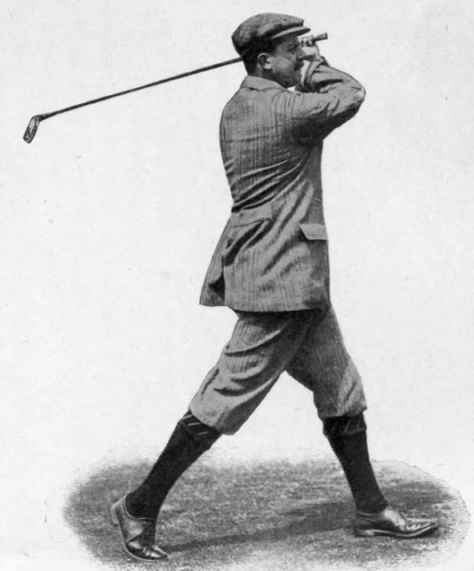
ANGUS V. HAMBRO, M.P..
[To face p. 258. .
Mention of East Lothian courses brings to mind the many fine players who learnt or played most of their golf in this 'holy land of golf.' Twenty years ago Mr. A. M. Ross's name was one to conjure with. A typically correct and orthodox player, he won innumerable medals in the North Berwick-Gullane district. His putting was remarkable as much for its deadliness as for the variety of clubs he employed, varying from the traditional wooden weapon to a long shafted driving-mashie, which he held at the extreme end.
Mr. J. R. Gairdner has a splendid record at North Berwick. He is a very steady, consistent player, with a peculiarly open stance, the ball being nearly opposite the right foot.
The brothers Hunter, too, learnt their golf at North Berwick, and in addition to successes in East Lothian, they have both won the autumn medal of the Royal and Ancient Club, Mr. Norman Hunter's 74 being still the amateur record, though others have succeeded in equalling it. They were very conspicuous in 'Varsity golf, Mr. Mansfield Hunter captaining probably the strongest University team which ever took the field. He is a very pretty player, especially good with the mashie. His brother combines great power with an exceptionally good short game, and has certainly not had his fair share of luck as yet in important events.
The Martin Smith brothers have also played much golf at North Berwick, and have scored many successes there.
Mr. Everard Martin Smith is one of the most brilliant exponents in the amateur ranks. He has twice equalled the record score of 73 in medal play at North Berwick, on one occasion in half a gale of wind, but he capped all previous performances by his marvellous score of 68 in the second round of the St. George's Cup in 1911.
Mr. Martin Smith sets himself a very high standard. He expects to lay approaches dead and to hole long putts, and was only living up to the tenets of his creed on this occasion. He is a very pretty player with a beautiful wrist action, his only fault being a tendency to drop the right shoulder when he is a little off colour.
Like their cousins the Martin Smiths, the Hambro family are very famous in golf. Of all long drivers Mr. Angus Hambro is in my opinion the longest, and it is accomplished with a remarkably easy swing. Although he is very tall and strong, the results which he obtains from such a quiet swing, which is certainly not a long one, are quite wonderful.
Mr. R. H. de Montmorency is another player who accomplishes wonderful results with an even shorter swing. A hard hitter at cricket and racquets, he punches the golf-ball very far and straight, especially with a short, heavy-headed cleek. He finishes with his hands well out and away, though like his back swing the finish is very much under control. He is an adept at the so-called 'push-shot.' Mr. Darwin fails to see much similarity to the stroke as played by Vardon, but I think that this may be explained by the fact that Mr. Montmorency picks the club up very straight, whereas Vardon swings back with a flatter sweep. It is a great pity that his duties at Eton prevent him taking part in more important competitions.
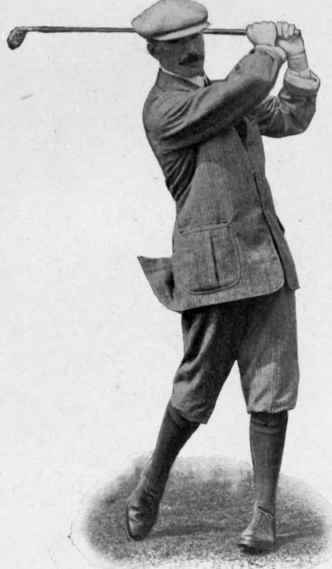
HON. M. SCOTT.
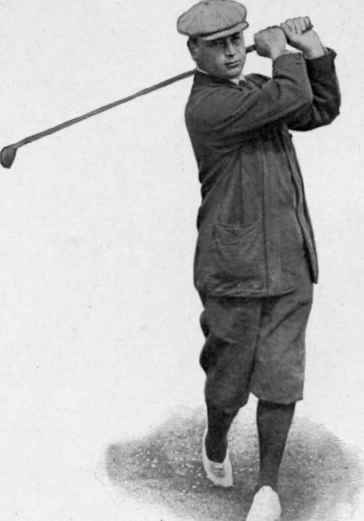
FRED HERRESHOFF (America).
[To face p. 260.
Mr. Gordon Lockhart has been well known for years as one of the best players in the west of Scotland, but he has hardly done himself justice in the championship till 1911, when he reached the semifinal, and with the exception of the winner, probably played the best golf of the meeting. He makes full use of his height and strength, and is a good iron player and putter.
His frequent partner, Mr. R. Andrew, was also a beautiful golfer, with a very finished style. He has recently joined the professional ranks in America, where his many friends will wish him all success. Another prominent west of Scotland player, Mr. A. R. Aitken, has not taken part in the championships the last two years. His best performance was reaching the semi-final in 1905.
To survive many rounds of the amateur championship, it is absolutely necessary to putt well, and Mr. C. C. Aylmer certainly did not lose sight of this fact when he reached the final at Hoylake in 1909. He is a very neat player, and seems to have lengthened his driving considerably of late.
Continue to:


My Books

