


Prologue. How To Learn. Part 2
Description
This section is from the book "The New Book Of Golf", by Horace G. Hutchinson. Also available from Amazon: The new book on golf.
Prologue. How To Learn. Part 2
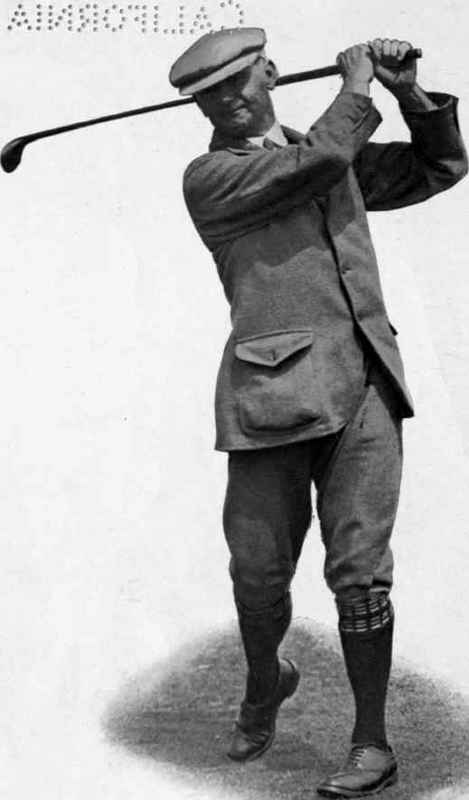
JOHN BALL, Junr. (Eight times Amateur Champion, once Open Champion).
[Frontispiece
The educational value of Sir Walter's recommendation lies in the fact that it is in some sort an appeal to Nature, by whose dXecree each individual differs in countless respects from each and every other.
1 More often spelled 'scare.' - Ed.
Again, in the important matter of stance, the ultimate appeal is to Nature. When a man wishes to deliver the most vigorous blow possible at a fixed point, it is natural for him to place his feet equidistant from that point. This enables him to preserve his balance while hitting, and consequently to time his stroke accurately. It is extremely probable that no golfer exactly follows the guidance of Nature in taking up his position for each and every shot that he plays; and it is quite certain that if a man should satisfy himself by use of a yard measure that he had got his feet equidistant from the ball before striking at it, his shots, owing to lack of spontaneity, would be feeble and inaccurate. The learner need not be particular to an inch or even two. Any greater divergence than this from the normal, in the distance of the two feet from the ball, is a source of danger. Granted that several men play extremely well from a stance which looks as if it had been originally arbitrary rather than methodical; granted, further, that two or three of these men are peculiarly capable of adapting their stance to the inequalities of undulating or hummocky ground; it by no means follows that their example can safely be followed by normal creatures. My experience as an educationalist leads me to believe that a scientific lecture can sometimes be made to produce satisfactory practical results to the learner, if it be summarised in a rule of thumb. Therefore I suggest to the incipient golfer that he train himself to place his feet equidistant from the ball, and to poise his weight so that each of his two legs makes the same angle with the surface of the ground, which for purposes of this rule is presumed to be dead flat. He will be told in subsequent chapters how to make his arrangements for 'hanging' and 'cocked-up' balls. Discussion of accidental difficulties is out of place in a broad dissertation on 'Method.'
There is another point to be dealt with before we come to considering how the club is to be lifted from and brought back to the ball. It is the position of the shoulders during the preliminary address. Let me recapitulate what has already been said: repetition is often helpful. The player is to regard his left arm as part of his club shaft, and his grip as the attachment splicing one part of the shaft to the other; he is to stand with his feet practically equidistant from the ball, and his legs at practically the same angle to the ground. Now, the normal man's arms are, like his legs, of equal length. When he golfs he has to treat his left arm as so much club shaft. It is obvious that in a great majority of cases that left arm will be kept straight, or so nearly straight as makes no matter. It follows that in order to place his right hand below the left on the handle of the club, the normally built man must depress his right shoulder appreciably. A simple experiment will show him well enough the amount of depression which is proper. Let him take hold of his club with the left hand only; let him stand upright and keep his left arm rigidly straight; then let him slowly put his right hand on the handle below the left without stooping forward or shortening his left arm by bending it or by any other trick. He will find that his right shoulder must go down anything from four to six inches below the left. At first, when he addresses the ball, he will very likely feel as if he could not hit as hard as his physique justifies him in expecting to hit. By raising the right shoulder he gains an added sense of power. But what we want is not a feeling of power during the address, but tangible evidence of its presence at the moment of impact. An ounce of fact is proverbially worth a pound of theory, and fact is particularly valuable when it supports theory, as it does in this case. One of the differences between amateur and professional golf is that the professionals, when addressing the ball, keep their right shoulders appreciably lower than the amateurs. Braid, Taylor, and Vardon, though they possess this as every other golfing virtue highly developed, are not thereby singled out from other members of their profession. Mr. Ball and Mr. Maxwell are conspicuous among amateurs for their depressed right shoulders. I have admitted above that the adoption of the position may cause a sensation of comparative feebleness during the address. I will now try to prove that the feeling is illusory, and that full power is exercised in the hitting. In the first place, the five golfers mentioned are all notably long drivers. On the whole, it is true to say that they attain length without appearing to strain after it; their strokes, though full of vigour, are yet restrained and compact. There is every reason why this should be so. The depression of the right shoulder enables them to grip tight with both hands, at least while the club is approaching the end of its downward journey. Even in the days of my novitiate I felt there must be something wrong about the old maxim, 'Tight with the left hand, loose with the right.' Now I am sure. It is seldom wise to argue from the analogy of other games to golf, 'the peculiar pastime of a peculiar people,' but in this connection analogic method of proof is sound. Id all ball-games except lawn-tennis, force and nip are put into hitting by the introduction of the action employed by a good cover-point when he throws in underhand to the stumps. Give a rackets-player a balle a la main, and down goes his right shoulder as he throws his racket underhand at it. The cricketer does the same things when he drives a half-volley straight for four. There is no need to multiply instances; it is sufficient to ask why a golfer should be deprived of a privilege freely accorded to the rest of sane humanity. Many readers will recall countless occasions on which they have heard disappointed players account for a missed shot by saying,' I dropped my right shoulder at it.' I confess that I do not know precisely what this error of style is, unless it be a lifting of the trunk simultaneously with the club and a subsequent lurching of the weight on to the ball. This is an action very different from that which I have endeavoured to describe. But the frequent use of the phrase 'dropping the right shoulder ' frightens many off imitating Braid, Vardon, Mr. Blackwell, and a host of other fine drivers who all depress the right shoulder when addressing the ball, and hit by throwing the club underhand at its mark. There is some danger that he who tries to acquire the recommended action of right-hand arm and shoulder will at first overdo it. He must be warned against allowing his right hand to master the left. In the golfing stroke hit is subservient to swing. So far as either hand or arm is concerned in the production of swing, it is the left. When the right hand introduces the element of hit or 'throw' - call it which you please - it must be kept under such restraint as will prevent it from causing the left wrist to be bent at the moment of impact. When that happens the club head is not presented square to the ball, and a miss of one kind or another ensues. It has been stated above that the left arm must be regarded as part of the club shaft. The right hand must not bend it any more than it can be allowed to bend or break the hickory stick.
Continue to:


My Books

