


Putting #2. Part 2
Description
This section is from the book "The New Book Of Golf", by Horace G. Hutchinson. Also available from Amazon: The new book on golf.
Putting #2. Part 2
Before we come to the actual hitting of the ball in putting, it may be as well to say a few words as to the taking of the line. The success of a putt depends very much upon whether the line has been studied.
Each green is not an exact replica of the last. They nearly all vary in character. Every undulation of the ground, every slight unevenness of the surface, will have its due effect on the course of the ball. Any difference in the character of the turf over which the ball has to pass on its way to the hole, such as is occasioned by a plantain or daisy root, or by the length and nature of the grass, will alter the pace at which the ball runs. Every obstacle, such as a small twig, leaf, wormcast or similar obstruction, will deflect or delay its course. Hence it is necessary that all these points should be taken into account before the putt is actually made. The wind, too, exercises a good deal of influence over the ball; therefore its strength and the direction from which it comes must also be noted. The line can be taken either from the ball to the hole or from the hole to the ball. It is a curious anomaly that, while it is an acknowledged fact that if there is any difference between the two lines, that which is seen from the hole to the ball is the correct one, nine out of ten golfers on ordinary occasions use only the line from ball to hole. The posture in which the line is taken is a matter of choice. Some players simply stand up a few yards behind the ball and view the ground from that position. Others drop on their hands and knees in something of the attitude adopted by their remote ancestors when running along the ground. Others again use a kind of squatting attitude, and meditate profoundly with the right elbow resting on the knee and the chin buried in the palm of the hand. The beginner can select whatever attitude takes her fancy, but when she has taken up her posture may we implore her not to dally too long. The more important the putt, the more consideration has to be given to it, and carefulness and thoroughness in the taking of the line are much to be commended, but there is a reasonable time limit. An exaggeratedly slow putter is a perfect nuisance to every one with whom she has to do. She exasperates her opponent to the last degree, she makes the people behind fume with impatience, and if she at any time attracts a 'gallery' she is responsible for the members of that 'gallery' who contract violent chills, and in fairness should be liable for their doctors' bills.
What may or may not be done to the line of the putt after all this careful investigation of it, is embodied in the following rules:
Rule 28 (1). Any loose impediment may be lifted from the putting-green, irrespective of the position of the player's ball. If the player's ball, when on the putting-green, move after any loose impediment lying within six inches of it has been touched by the player, his partner, or either of their caddies, the player shall be deemed to have caused it to move and the penalty shall be one stroke.
(2) Dung, wormcasts, snow, and ice may be scraped aside with a club, but the club must not be laid with more than its own weight upon the ground, nor must anything be pressed down either with the club or in any other way.
(3) The line of the putt must not be touched except by placing the club immediately in front of the ball in the act of addressing it, and as above authorised. The penalty for a breach of this rule shall be the loss of the hole.
Rule 29 (1). When the player's ball is on the putting-green, the player's caddie, his partner, or his partner's caddie may, before the stroke is played, point out a direction for putting, but in doing this they shall not touch the ground on the proposed line of the putt. No mark shall be placed anywhere on the putting-green.
It is well to remember that the slower the pace at which the ball is rolling, the more easily will it be affected by the irregularities of the ground.
Great latitude can be allowed in the matter of style in putting, as people putt well and badly in all manner of attitudes. But there are extremes of style which should obviously be avoided. One is the exaggerated crouch where the player resembles nothing so much as an old woman bent double with rheumatism. Another is the very upright stance where the club is held at the extreme end of the leather, and the impression is given that very little control is possible. Yet a third is the style in which the player turns both her knees and both her elbows out to an exaggerated extent and holds the club at a peculiarly upright angle. Some players putt off the right foot, some off the left. Some stand squarely at the ball, others adopt the open stance, others again advance the left foot and withdraw the right. Some turn in their toes, some turn out their toes. Some keep their feet wide apart, some put their heels together, some separate them by a medium distance. Miss D. Campbell and Miss Grant-Suttie use rather a square stance. Miss C.
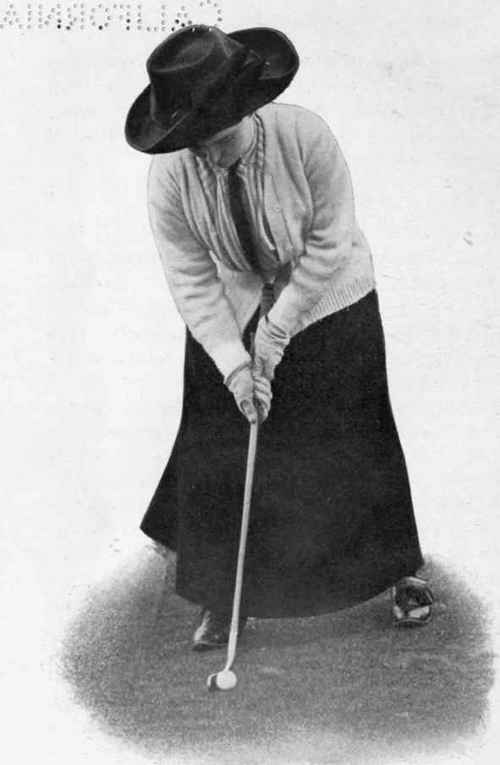
MEDIUM PUTTING STANCE.
[To face p. 301.
Leitch putts off her right foot, her feet being fairly close together. Miss Violet Hezlet, whose putting is one of the strongest points of her game, keeps her heels close together. Mrs. Cuthell, who, at the zenith of her fame, was one of the finest putters I have ever seen, uses a comparatively open stance, with the ball rather nearer her left foot.
The best plan for a beginner as regards stance is to adopt a medium position, and the main thing to be careful of is not to stand too close to the ball, as by so doing the freedom of the wrists is interfered with. The style in part depends on the kind of putter used, a wooden or aluminium putter demanding a more upright stance than an iron putter.
As there is a choice of stance, so there is a choice of grip. The ordinary grip and the interlocked grip are those most generally used. A very large number of people who do not use the interlocked grip through the green, take to it on the green with satisfactory results. But there are good putters and bad putters in plenty who are strong advocates of each style, and the matter is one to be decided by each individual for herself. If the ordinary grip be used, it should be of a more delicate character for putting than for the rest of the game. The club is held principally with the fingers, not with the palm of the hand. Indeed, some people go so far as to make their left-hand grip consist merely of first finger and thumb. To ensure control and straightness the thumbs are better kept down the shaft than round it. There is a great diversity of opinion as to which hand should be the master hand in putting. Indeed, opinions are so divided and there are such good authorities on each side, that it seems to be six to one and half a dozen to the other. But as it is generally easier to use the right hand more than the left, the beginner is advised first to give the right-hand system a fair trial. If she finds it does not work satisfactorily, she can advance the left hand to the place of honour, and then compare results and decide accordingly.
Continue to:


My Books

