


Chapter VI. With Iron Clubs
Description
This section is from the book "Present-Day Golf", by George Duncan, Bernard Darwin. Also available from Amazon: Present-Day Golf.
Chapter VI. With Iron Clubs
In regard to iron play, a great deal has been said and written in the last few years about the push-shot. I must clearly say something about it, and I feel inclined to begin by saying that the push-shot is a myth.
That is rather a startling statement, I know. I don't mean that I do not believe in the shot. It is the shot with iron clubs. I do mean that there is nothing mysterious about it. People talk about it as if it were a mystery. It is, in fact, absolutely simple. It all depends on the distribution of the weight. If you have your weight well forward as you are hitting, you must hit the ball a decidedly descending blow beneath its centre, such as produces under-spin, and that is really all there is to it.
That is the entirely simple explanation of the shot, but I admit that to get the weight properly forward is harder to do than it is to talk about. In writing of the transference of weight I have said how I think it is best done, but I will say it shortly again here. You can either stand well in front of the ball, thus getting your weight on the left foot and keeping it there, or you can start with a certain amount of weight on the right foot and markedly transfer it to the left during the up-swing. I think that the second method is the easier and better, and personally I recommend it. Whichever plan you adopt, the point is that by the time the top of the up-swing is reached you are to have the weight forward on that left foot, and it must not come off it again.
I want to emphasise the last words in that last sentence particularly. I have seen so many of my pupils get their weight on the left foot at the top and then let it come back on to the right foot as they hit. The result is that they finish leaning back on that right foot, sometimes with their left toe actually up in the air, and of course they do not hit the ball the descending blow that they intended. I think what happens is that they get suddenly frightened at the top of the swing when they find themselves leaning over on the left foot, and feel, as it were, on the top of the ball. They forget that the club has got some loft on it which will help them, and feel that they cannot possibly get the ball into the air. So in their terror back they go on to the right foot, and the stroke is ruined.
This management of the weight is much the most important thing that has to be learned in playing the shot, but it is not quite all. The swing has got to be decidedly shorter than the full swing we have been talking about with wooden clubs, and there will consequently be less pivoting. Some golfers find it difficult to shorten their swing. I always tell them to think of keeping the left arm straight, and this acts very well. Sir Walter Simpson very wisely said that the left arm should be regarded as part of the club. Here is a case in which it is particularly well worth remembering.
Given the ground in good condition, I say generally of all shots with iron clubs, except the cleek, 'Push them.' I am not a great believer in pushing cleek shots. If one plays a push-shot with a cleek one is apt by leaning on the left foot to take off the small amount of loft that there is on the face, and so hit the ball too high up and get no under-spin. Vardon is the finest cleek player in the world, and to my eyes he swings his cleek much as he does his wooden club.
The ground must, as I said, be in tolerably good order for the push-shot to be effective. Unfortunately in winter on inland courses this is often not the case. When the turf is soft and muddy, hitting the ball down does not pay. Then is the time to knock them up. Some people find this much easier to do than others, namely, those who are naturally light on the left foot at the top of the swing. A thoroughly-wet, heavy, muddy course-luckily for him he does not have to play on one-would not suit Braid, who is very heavy on his left foot. On such a course I should back Ray or Mitchell or Vardon against him, because it comes easy to them to be light on the left and hit the ball up.
I said that on good ground I recommended all players to play push-shots with their iron clubs, but I do not succeed in teaching all my pupils to do so. I admit that there are a good many players who never can manage it. They cannot master the knack of balancing themselves properly for the stroke. If they can't, they can't, and there is no use in trying beyond a certain point to make them. They had much better be left to swing their iron clubs more or less as they have learned to swing their wooden ones, and make the best of it. With such players I find a general tendency to pull their iron shots. In the first place they are inclined to address the ball with the face of the club not sufficiently open, and then too they let that right hand of theirs come whipping round at the last moment. I always rub it into them as hard as I can that they are to keep the blade of the club open. I also find that I can help them to stop hooking by getting them to stand more in front of the ball. For the man who finds that he must 'swing 'his iron shots and not 'push 'them, I think these two things are the best aids to straightness.
The mashie-niblick has come into almost universal use in the last few years, and is a very useful and important club. No golfer should be without one in his bag. You cannot get enough stop on the modern small heavy ball with the ordinary mashie, especially if the greens are hard ; so there is nothing for it but to get a club that will do it for you. When such a mashie player as J. H. Taylor has had to take to a mashie-niblick, other people can hardly hesitate. They must want one.
There has been a great deal said lately about the ribbed clubs that are being used in America and can stop the ball so wonderfully dead. I heard Lawrence Ayton say the other day that in Jock Hutchison's shots played with his ribbed mashie-niblick the ball never runs forward at all. Perhaps I am too sceptical., I may be wrong, but I do not believe that the ribs have a great deal to do with it. My notion is that it is the loft that does it. It is not so much the spin as the height that makes a ball stop, and I am inclined to think that the Americans, having to pitch on to very hard greens, have been compelled to play with more lofted clubs than we do, so that for example their mid-irons would correspond, as regards loft, with our mashies, and so on down the scale. However, we may know more about this later on.
At any rate here is the mashie-niblick. Let us see how to play with it. The stroke is not different in essentials from that with the mashie, but there are certain points worth remembering. The first is to shove the club back with the left hand-push it back from the left shoulder. And remember particularly here again what I have quoted elsewhere from Sir Walter Simpson, that the left arm is to be regarded as part of the club. Whatever you do, don't pick up the club with the right hand, for that is fatal. I have said this same thing about not letting the right hand take charge over and over again. I said it several times about driving and you may be very tired of it, but I shall say it again nevertheless. I often think, no matter what the shot, what a pity it is we cannot keep the right hand completely off the club to begin with, and start the backward movement of the club solely with the left hand and then switch the right hand on to it. If we could do that we should not get that feeling of tension in the wrong place, and we should miss far fewer shots.
This pushing of the club back with the left hand ought to mean that the club goes back fairly close to the ground. But in any case I recommend you to make a special resolution: 'Hug the ground.' If you do that on the way back you will be able to let the natural loft on the face of the club do the work and get the ball into the air. If you pick up the club sharply with too much right hand you cannot do that.
Remember, too, always to keep the blade of the club open. In the chapter on 'My own Game,'I describe how I often find myself going back unconsciously to my old style in playing pitches and letting the right hand climb over the left. That style came naturally to me, because I began to play on a place where there was very little to pitch over. Wherever they are bred I think this climbing-over movement of the right hand comes naturally to most people, but it is not a good plan with the mashie-niblick because it obviously has a tendency to shut the blade of the club. Therefore keep the blade open, push back with the left, and hug the ground. Those seem to me to be the three main points to remember.
The niblick is next-door neighbour to the mashie-niblick, and I will say just a very little about getting out of bunkers with it. If the ball is lying well in sand and you want to get all the distance you can, you will obviously try to hit it clean. There is normally a face of some height in front of you, and it is essential to make the ball rise quickly. In order to do this you want to get your weight well back on your right foot and hit the ball a quick glancing blow from right to left. In other words, you hit rather across and cut it up and out.
In that which is known as the 'explosive shot'
-where you take a greater or less degree of sand with the ball-the best model is undoubtedly James Braid. Nobody that I know can play it quite as well as he does. The rest of us seem to be lighter on the left foot than he is in playing the shot, and we are a little inclined by comparison to fall away and back at the finish of it. Braid seems to go right through with the shot with a tremendous heave forward, and he can shift more sand than any one else. I believe in being heavy on the left foot at the top of the swing in this stroke. You must not take up your stance with too much weight forward. Get the weight pretty well on the right foot in the address: be heavy on the left at the top and, once at the top, shut your teeth and crash into it.
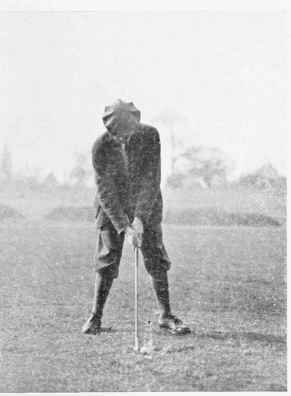
ADDRESS.
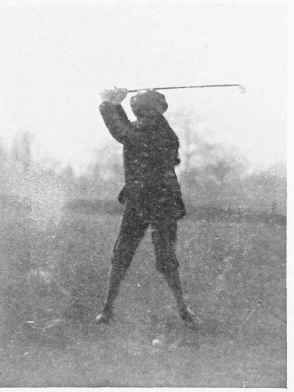
AT THE TOP OF THE SWING.
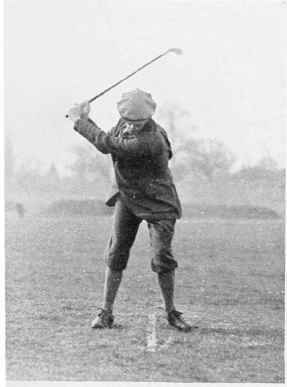
BEGINNING TO COME DOWN.
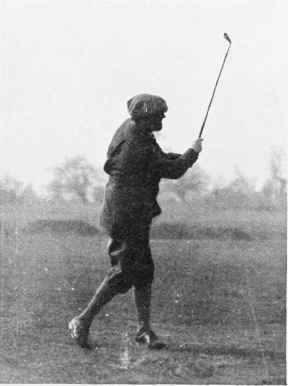
THE FINISH DUNCAN PLAYS A SHOT WITH HIS DRIVING IRON.
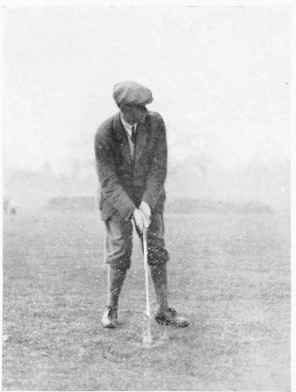
ADDRESS With plenty of weight on the right foot.
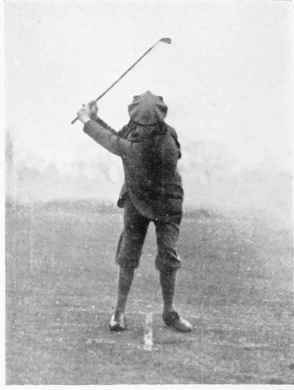
AT THE TOP The weight has come forward on to the left foot.
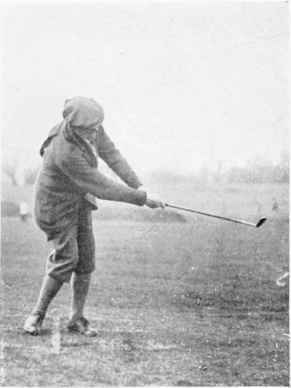
THE FINISH DUNCAN PLAYS A HALF SHOT WITH HIS MASHIE.
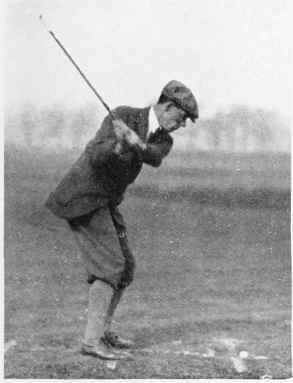
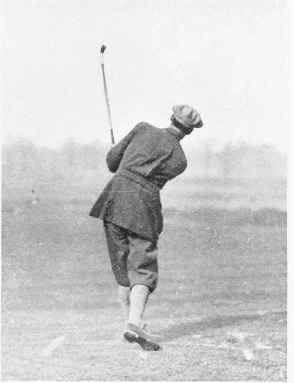
DUNCAN PLAYS A HALF PUSH SHOT WITH THE MID-IRON.
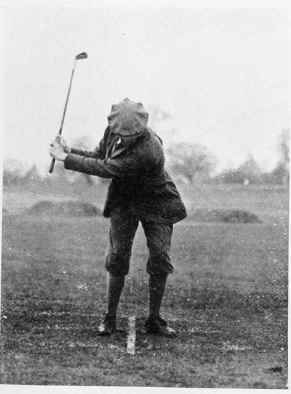

DUNCAN PLAYS A SEVENTY YARD PITCH Willi THE MASHIE NIBLICK.
Continue to:


My Books

