


Chapter V. Caddies
Description
This section is from the book "The World Of Golf", by Garden Smith. Also available from Amazon: The World Of Golf.
Chapter V. Caddies
CADDIES may be divided into three classes. There is the grown up, sometimes elderly, golfing mentor, who is still found at one or two old-established golfing centres in Scotland - the caddie of history and tradition; there is his younger, more modern, and less experienced brother; and there is the common loafer, or the raw and inexperienced youth or urchin who now, owing to the exigencies of modern golf, swell the ranks of the profession.
The old-fashioned Scotch caddie, though he is to-day about as rare as the capercailzie, was a competent and experienced man. Even if he were not a professional player, he could at least play the game tolerably well, and knew all its details to a nicety. He invariably carried for the same players, and the golfing capabilities and tempers of his clients were well known to him. To many an old-fashioned golfer, the services of his wonted caddie were indispensable for the full development and enjoyment of his game, and the average player would never dream of engaging in an important match without his assistance. The caddie was thus, in addition to his other functions, in some sort the guide, philosopher, and friend, for the time being, of his master, his private secretary, physician, and chaplain rolled into one, his trusted confidant, into whose ears was poured all the golfer's tale of mingled joy and sorrow.
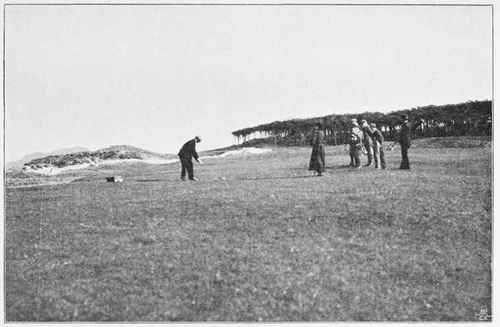
NORTH BERWICK LINKS. (From a photograph by Messrs, Hutchinson & Co., Berwick ».
These intimate and confidential relations between master and man were far-reaching in their consequences, for the caddie, feeling his own superiority at the game, and flattered by the august confidences of which he was the constant recipient, ended by concluding that Jack was every whit as good as his master. While this did not prevent him upholding the merits of his own particular masters as against those of his brethren, he came to adopt an authoritative and even disrespectful tone in administering professional counsel or reproof to his employers. He judged his master solely by his golfing capabilities.
"Onybody can teach a wheen loons Latin and Greek, but Gowf, ye see, Gowf requires a heid," as a St. Andrews caddie said to a learned professor at the university, is a remark which well illustrates the caddies' point of view. The fact that they were paid very much according to the wealth or liberality of the players, and that there was no one in direct authority over them, enabled them to develop various idiosyncracies of character, while their unique facilities for acquiring a knowledge of human nature, joined to the native talent for racy and graphic description, made their conversation as entertaining as it was instructive.
On the whole, however, this state of things, though it was productive of much that was interesting and amusing, had a bad effect on the caddies as a class. The constant association with wealthy men on holiday, who, as has been said, rather encouraged than resented their familiarity, had a demoralising effect on their uneducated minds. Though full of humour, they were for the most part improvident and impudent rascals, given to drink, and incapable of turning themselves to any other kind of work. In the winter, or whenever there happened to be a slack golfing time, they were often reduced to the greatest straits, and frequently had to depend for food and clothing upon the charity of their employers.
But the new conditions have changed all that. The spread of education, and the enormous increase in the number of golfers that has taken place in the last few years, have filled the ranks of the profession with a better educated and more self-respecting body of men, though it must be confessed that, as caddies, they are inferior to the older generation. Nearly every caddie nowadays has learned some other trade which he ultimately adopts altogether, or on which he can fall back when no caddying is to be done. Their fixed scale of payment, and their employment subject to the control of a caddie master, has shorn them of much of their independence and changed altogether their habits and character. The surging crowd of caddies, like Italian lazzaroni, that surrounded the golfer all the way to the clubhouse, soliciting employment with shouts of "Cairry for you, sir?" and "Cairried for you afore, sir!" is a thing of the past. At Musselburgh and on the East Lothian coast, the caddies, in making the request, had a curious, monkey-like movement of the right hand, of the nature of a salute. The forefinger was crooked, and the hand was raised up to the left eyebrow, and withdrawn downwards and across the body, with the rapidity of lightning. The nature of the action was not unlike the signing of the cross, and may have had its origin in the superstition of the fisherfolk of the east coast villages, many of which, escaping the wave of the Reformation, are still largely Roman Catholic.
The word "caddie" was originally spelt "cadie" or "cady," and is interesting, being derived from the French "cadet," as one of the many Scotch words in existence which were taken directly from the French, at the time when cordial relations existed between the two countries. It was used in Scotland as a name for a messenger or light porter, long before it came to be associated with golf.
In view of the new conditions, and of the complete transformation that has taken place in the caddie's nature and abilities, it seems time that the existing legislation dealing with their uses was altered.
The Ladies' Golf Union, with commendable enterprise-, and backed by the influential opinions of Mr. Horace Hutchinson and Dr. Laidlaw Purves, endeavoured, at the last championship meeting, to do away with the asking or receiving of advice from the caddie in course of play. It is to be regretted that, in quarters that are supposed to be authoritative, this suggestion was received but coldly. The fetish of tradition was again invoked, and it was pointed out that such an innovation would be against the time-honoured practice of the game.
Continue to:


My Books

