


Vienna. Part 17
Description
This section is from the book "Vienna - John L. Stoddard's Lectures", by John L. Stoddard. Also available from Amazon: John L. Stoddard's Lectures 13 Volume Set.
Vienna. Part 17
But there are other souvenirs at Schonbrunn than those connected with Napoleon. On my first visit, in 1874, as I was standing near the obelisk in the park, I suddenly saw approaching me, on horseback, a lady beautiful of face and form, who rode her horse with perfect grace ; and, marvelous to relate, was mother of the handsome Prince Rudolph, who rode beside her like a lover. The vision passed me like the wind, but not too rapidly for me to recognize the fact that I had seen one of the celebrated beauties of the world,-the Empress of Austria. In 1890 as I stood again within the shadow of that obelisk, or strolled about the pretty, artificial Roman ruins in these grounds, I thought with sadness of the changes which had taken place at Schonbrunn since that time; for now the Empress, a great invalid, lives chiefly on the distant Isle of Corfu in profound retirement, and the bright boy who rode so proudly at her side lies within the gloomy vault of Austria's imperial dead.
In the palace of Schonbrunn is another apartment of tragic interest to those who sympathize with Austria. It is the bedroom of the Emperor's brother, Maximilian, shot like a criminal in Mexico, - the dupe and victim of Napoleon III. His portrait hangs upon the wall, and near it is that of his wife, Carlotta. We saw, also, a sash embroidered by Car-lotta's hands, which, when she said farewell to her husband, she tied about him, - over the uniform he was doomed to wear, at last, to execution. Yet, even at the worst, his fate was preferable to hers. Poor Carlotta, driven insane through hopeless grief! So generous and kind-hearted was Maximilian, that even the soldiers, who were ordered to shoot him, shed tears at his untimely death, and their commanding officer asked. Maximilian to forgive him. " I have nothing to forgive," replied the Emperor, "for as a soldier, you are obliged to obey orders." Then, turning to the troops and pointing to his breast, he said, " Be so good as to aim here." A moment later his words were obeyed; but ere the volley was fired, he was heard to murmur, " Carlotta! Carlotta ! " The name of the woman he loved was the last on the lips of Maximilian of Mexico.
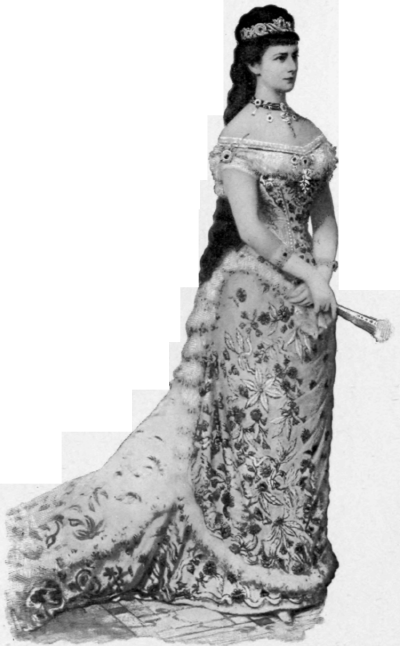
The Empress Of Austria.
In one of the halls at Schonbrunn we found an antidote to these melancholy souvenirs in the remarks of a young American tourist who was conducted with us through the palace. He was attended by a courier, who carefully translated for him the explanations of the palace guide. A prominent picture here portrays the baptism of Marie Antoinette, and one of the figures in the painting is that of the composer Mozart. "That is Mozart," translated the courier. "What!" cried the tourist in amazement, mistaking the name, " Moses ! Moses here in Vienna ! I hate to lug around this courier," he presently explained to me, "but I have to. At first I tried to play it alone, but it wouldn't go. I can't make head or tail out of this blamed language. When I was traveling by myself, I used to be carried by places where I wanted to stop, because I thought that the sign. 'Ausgaug,' in the station was the name of the town; and only after several such experiences did I finally learn that 'ausgang' is the German for ' exit.' "

The Bedroom Of Maximilian.
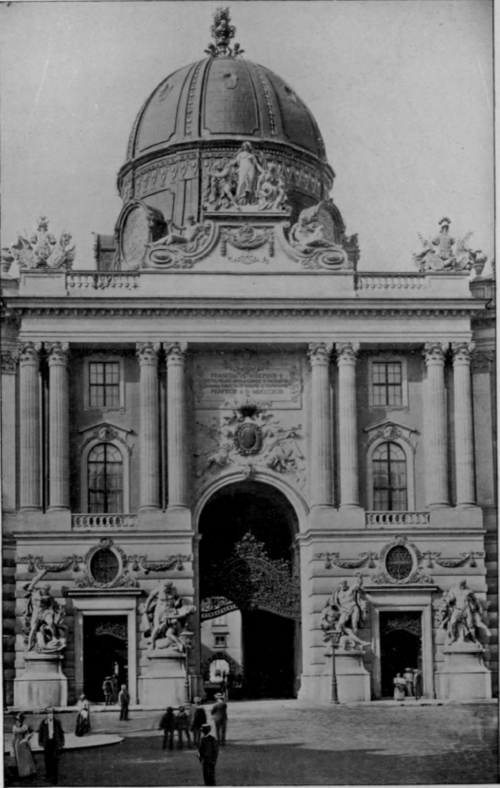
The New Palace Gate.
The pleasantest excursions in the vicinity of Vienna are to be made upon the Danube. In fact, the best way to approach Vienna from the west is to leave the railroad at Passau or Linz, and take a steamboat down the Danube to the Austrian capital. In any case, that portion of the river should not be omitted from the tourist's itinerary, or he will lose one of the most delightful experiences of European travel. The natural scenery of the Danube is far more beautiful than that of the Rhine. At times, environing mountains make the river look like some fair lake in Switzerland; at other points, advancing cliffs force it to rush on like a torrent in a canon. At every turn, an unseen hand seems to have drawn aside a curtain and revealed a new and ever-changing panorama, whose objects of attraction are splendid cities, ruined castles, stately palaces, and picturesque chateaux; varied by smiling villages, fertile valleys, imposing mountains, and black-bearded forests, all of which make a journey on these waters a continual series of surprises. Nor is the element of history wanting here. One of the ruins, towering above the Danube, is Durrenstein, the crumbling battlements of which acquire an added interest when we remember their peculiar history; for this, in 1192, was the prison-house of Richard, England's "lion-hearted" king - the bravest of those princely warriors, who bore the standard of the Cross against the Saracens in Palestine. Yet, if we may believe the well-known legend, Richard was not forgotten in this mountain fastness.
Continue to:


My Books

