


Vienna. Part 8
Description
This section is from the book "Vienna - John L. Stoddard's Lectures", by John L. Stoddard. Also available from Amazon: John L. Stoddard's Lectures 13 Volume Set.
Vienna. Part 8
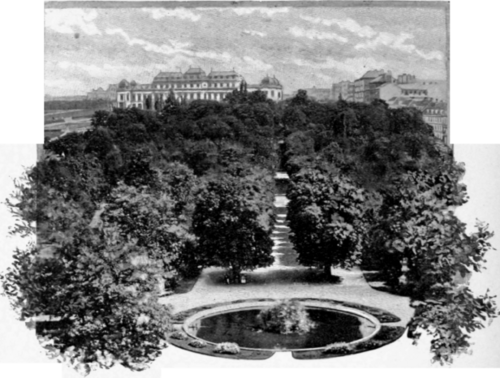
Schwartzenberg Park.
But, at last, the beautiful transparent shell of innocence and trust, in which she had lived for nearly twenty years, was rudely shattered at a blow, and she was suddenly thrust out from her child's paradise into the cruel maelstrom of the world; and on the day of that catastrophe, the little girl, whom had known, had died, and the sad-featured woman whom I saw before me in the garden had been born. I could see plainly, from where I sat, that the wings on which her hopes and high ideals had soared had become, like those of a wounded butterfly, torn and broken by the rough touch of life; that her illusions had fled; that the flowers of love had become scentless and artificial, and that even the sunshine was a scorching flame. It was evident that the remainder of the way through life seemed to her long and hard; for her feet were already weary; the dust of earth and falling tears had dimmed her aching eyes, and the song that used to pour forth from her throat, like the trill of a bird, was stilled forever. The realization of all this, and of the tragic undertone of life of which she was the exponent, made even Strauss' music that night unendurable ; and, unperceived by the sad woman who had replaced the happy child whom I had known, I left the park and walked alone beneath the stars.
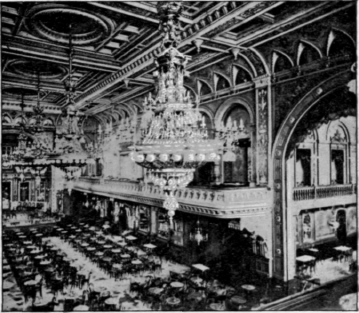
A Concert Hall.
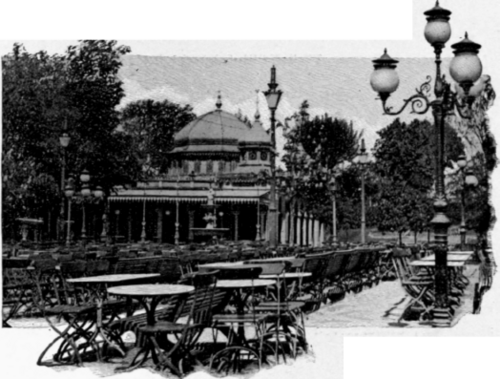
A Concert Garden.
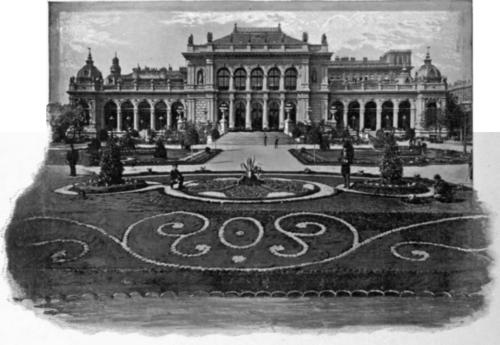
The Music-Hall, City Park.
One must not think of Vienna as being exclusively devoted to amusement; for, in the number and value of its libraries and art collections, it stands in the first rank among the cities of the world. Thus its Imperial- Library contains more than four hundred and ten thousand volumes, that of the University one hundred and ten thousand, the Emperor's private collection fifty thousand, Prince Lichtenstein's fifty thousand, and about a dozen other libraries have from twenty to fifty thousand volumes each. The collections of engravings in Vienna are unsurpassed, - the Imperial Library alone possessing nearly two hundred thousand, while those of Prince Esterhazy and the Archduke Charles would, if combined, exceed that number. The picture galleries of Vienna are, also, of great value, numbering in the aggregate nearly six thousand paintings, and all these collections are open to the public, free of charge.
From the Ringstrasse, at one point, a massive portal known as the Palace Gate, leads to a spacious area called the Heroes' Square. The name is comprehended at a glance, when the visitor perceives the two equestrian statues which, from the ends of the enclosure, seem to be charging upon each other like knights in a mediaeval tournament. One of them represents the Archduke Charles, the ablest general of Austria in the early part of this century; who, had he not been pitted against such a won- derful antagonist as Napoleon, would have acquired even greater military fame than has been accorded him. The statue portrays him waving exultantly the Austrian flag on the battle-field of Aspern, where, on the 21 st of May, 1809, a temporary check was given by his troops to the French army. The other statue, in this area, is that of Prince Eugene, one of the most distinguished generals and statesmen of the eighteenth century, and one of the most interesting figures in history.

The Heroes' Square.

The Statue Of The Archduke Charles.

The Statue Of Prince Eugene.
The story of his life reads like a romance. Born in Paris, and being a relative of the powerful Cardinal Mazarin, his talents would have been devoted to his native land but for a mortal affront given by Louis XIV., who, sneering at his insignificant personal appearance, refused him a commission in the army. The young man vowed he would never again set foot upon French soil, save as an enemy, and that the King should some day bitterly repent his conduct. Accordingly, leaving France, he offered his services to the Emperor of Austria, and was accepted. Here he soon demonstrated that he had military talents of the highest order. Only eight years after the royal insult offered him in Paris, he commanded the Austrian army against the French, and six years later, in 1697, gained a decisive victory over the Turks. In 1701 he again fought successfully against his native land, and captured the French marshal who opposed him. Alive now to his great abilities, Louis XIV. offered Eugene a marshal's staff, if he would return and enter the French army. It was a proud moment for the Austrian commander when he received the offer and - declined it. In 1704, in cooperation with the Duke of Marlborough, he again defeated the French in the great battle of Blenheim, and during the following year expelled the French from Italy. Moreover, these campaigns were followed, ten years later, by his brilliant victories over the Turks, by means of which he regained for Austria much disputed territory, especially the important city of Belgrade, now the capital of Servia. With such a record as a warrior, to which was added an illustrious career as a statesman, it is not strange that he became a favorite with the Austrian Court, and the idol of the people. His residence in Vienna, given him by the Emperor, was the Belvedere Palace, which, till quite recently, contained one of the finest picture galleries in Europe; but these art treasures have now been removed to the Imperial Museum on the Ringstrasse.
Continue to:


My Books

