


Belgium. Part 10
Description
This section is from the book "Belgium - John L. Stoddard's Lectures", by John L. Stoddard. Also available from Amazon: John L. Stoddard's Lectures 13 Volume Set.
Belgium. Part 10
Leaving this church, we walked a little distance to some mediaeval cloisters of rare beauty. Through their deserted walls the winds of centuries have blown, but they retain sufficient traces of their noble architecture to show us what they must have been. Alas! like many other historic structures in the Netherlands, these cloisters were defaced and sacked by Puritan fanatics; for in those dreadful days - when the Inquisition was making this fair land a place of fiendish torture and unutterable misery, goaded by years of persecution and looking upon all such architecture as emblematic of the power which persecuted them - a multitude of image breakers, armed with ropes and hammers, swept like a whirlwind through the realm. The damage done by these iconoclasts was irreparable. In the cathedrals, statues were hurled from their pedestals, and paintings were torn from the walls; glorious stained-glass windows were shiv-ered to atoms; ladders and ropes were used to reach the works of art, and lofty pinnacles and turrets, apparently inaccessible, were scaled by men who risked their lives to mar their beautiful decorations. Revolting scenes of sacrilege took place. Statues of Christ were thrown down with the rest; those of the Virgin suffered every insult; the sacred altars were defiled; the consecrated wine was drunk; the sacramental bread was thrown to dogs, and even the oil with which kings and priests had been anointed was used by these fanatics to grease their shoes. In one night thirty churches were sacked in Antwerp alone, and four hundred were despoiled in a single province within a few days. Thus, through a religious frenzy, easily understood, yet evermore to be regretted, the precious products of centuries of inspiration and persistent labor were completely ruined, and once more, as so many times before, the world was rendered poorer by the folly and bigotry of man.
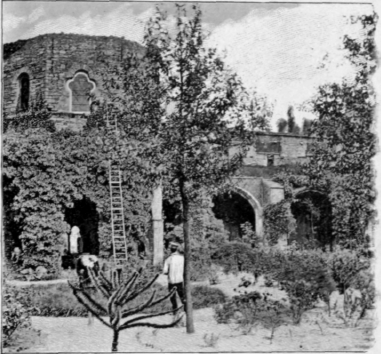
St. Bavon Abbey.

Cloister Of St. Bavon.

Historic Houses, Bruges.
A striking incident is told of a wealthy, though untitled, citizen of Ghent. One day, the mighty Emperor Charles V., needing two million florins, borrowed them all of this worthy man; and the same day, in token of his gratitude, promised that he would dine with him. The flattered merchant gave the Emperor a most magnificent repast; and, while they sipped their wine at the dessert, tore up the monarch's promissory note and passed the pieces to him on a plate. "Sire," he said, "two million florins is a small sum to pay for the honor which your Majesty has done me to-day."
Musing upon the history of this Flemish city, once so famous for its wealth and power, I fancied I could see moving along its liquid thoroughfares, like phantoms of the past, the stately ships from India and Persia, bringing to Ghent the treasures of the Orient. Once more I watched march proudly through the city's streets its famous manufacturing guilds, a single one of which numbered forty thousand men. I saw its artisans pass by in such vast crowds that, when the bells were rung at morning, noon, and night, all other citizens were warned not to obstruct the living current sweeping on its way. Vessels, meantime, were not allowed to pass the drawbridges, which were kept closed for the accommodation of the moving throng, and children were retained indoors, lest the industrial hosts should trample them to death. Larger than Paris even was this city in those days, and Charles V. had some justification for his famous pun on the French name of Ghent, when he said to the King of France, "I can put your Paris inside of my glove" (Je mcttrai voire Paris dans mon Gand).
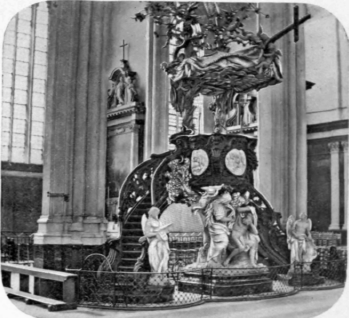
The Pulpi'.

Old Flemish Houses.
Saying farewell to Ghent, an hour's journey brought us to her former rival, - Bruges. There is no rivalry between the cities now. Ghent, though retaining but a shadow of her ancient glory, is still comparatively prosperous; but poor old Bruges shows little evidence of life and enterprise. Some stately buildings of the past remain, which give to her an air of wealth and dignity, and the old streets and market-places are, in form, the same; but few boats furrow now her deep canals, which, with the green scum floating on their stagnant surfaces, resemble unused country roads, half overgrown with grass. Even the numerous bridges of the town, which gave to her the Flemish title, Bruges, look lifeless and deserted, and most of the occupants of the handsome houses of the olden time are wealthy merchants who have retired from business, to spend the last years of their lives in absolute tranquillity. There seems to be no danger of its being disturbed.
Continue to:


My Books

