


Belgium. Part 9
Description
This section is from the book "Belgium - John L. Stoddard's Lectures", by John L. Stoddard. Also available from Amazon: John L. Stoddard's Lectures 13 Volume Set.
Belgium. Part 9
It is not necessary to recount the thrilling story of the battle. It has been told in every language of the civilized world, and many volumes have been written in explanation of its strategy and its result. Suffice it here to say, the plans of the two commanders were simple. That of Wellington was to hold his ground until the Prussians under Blucher should join him; that of Napoleon was to defeat the English before the Prussians could arrive, and then to annihilate Blucher. To this end, he had dispatched Marshal Grouchy, with thirty thousand men, to keep the Prussian army in check till he had finished with the English. By a strange fatality, therefore, the issue of the conflict was destined to rest ultimately not with Napoleon and Wellington, but with Grouchy and Blucher. In this tremendous crisis, the Frenchman failed; the Prussian succeeded.
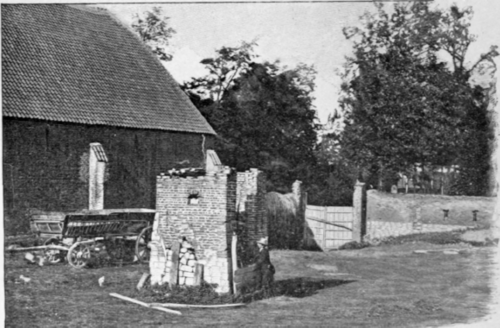
Hougomont.
Just as it was evident that the troops of Wellington, if unaided, were doomed to defeat, the force of Blu-cher arrived upon the field. It was half-past seven o'clock, and twilight was approaching. The French were-now outnumbered by fifty thousand men. The destinies of Europe hung in the balance. Napoleon's fate depended on the charge of the Old Guard. Approaching these companions in so many glorious victories, the Emperor uttered, for the last time, the words, "La Garde, En avant!" The veterans were commanded by Marshal Ney, the "Bravest of the Brave," who, having already had five horses shot under him, now advanced on foot. The heroes turned a farewell glance toward their loved Emperor. Like the old gladiators of the Colosseum, they might have cried, "O, Caesar, we, who are about to die, salute thee!" For soon, beneath a deadly cross-fire of shot and shell, they seemed to melt like frostwork in the sun. The rest of the army gave way; a mortal pallor overspread Napoleon's face, and he attempted to ride on to death. But he was pushed back by his officers; and one of them, grasping the bridle of his horse, led him at full gallop from the first overwhelming defeat that he had ever known.
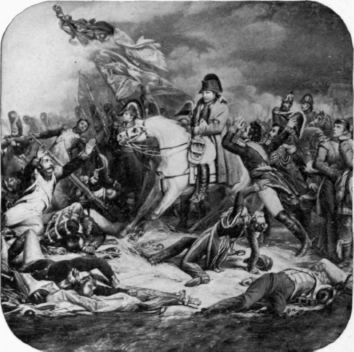
The Close Of The Battle.
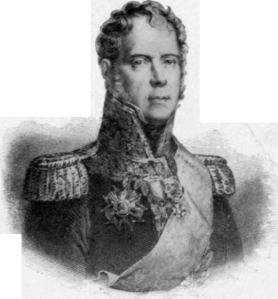
Ney.
"Be sure and stop at Ghent," a friend had said to us as we were leaving Brussels, "if you would see a genuine Flemish city of the olden time." When we beheld its picturesque old gateway, we rejoiced that we had taken his advice; for its pointed towers, pierced with narrow loopholes, and its gabled roof, rising like flights of steps to the high station of the sentinels, still fling their shadows across the ancient moat, just as they did when Ghent 1 was the proud capital of Flanders, and from out this gate the warlike Ghentians marched to rout the English army under Edward I.
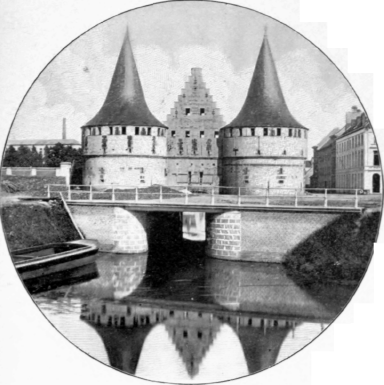
The Gate, Ghent.
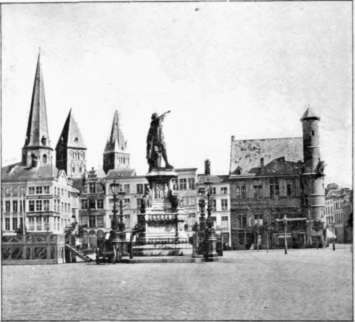
Statue Of Artevei.DE.
Especially interesting, from its historic associations, is the old market-place of Ghent, the forum of the Flemish capital. Here, homage was paid to the Counts of Flanders in a magnificence of style, rare at the present day even to royalty; and here, during the civil feuds, which were as desperate in Ghent as in mediaeval Florence, the different factions would assemble, fierce to avenge some real or fancied violation of their rights. In one such contest alone fifteen hundred men were slain.
The statue in the centre of this square is that of Jacques Van Ar-tevelde, the celebrated Brewer of Ghent, who, though of noble family, enrolled himself in the Guild of Brewers, that he might thus obtain the favor of the lower classes. Rich, eloquent, and able, he quickly rose to be for eight years the virtual sovereign of Flanders, putting to death or banishing those who ventured to oppose him, and filling all the offices with men obedient to his will; yet, near this square, where, with uplifted arm he had so often roused the populace to further his designs, he was at last assassinated by the very men who, while admiring his genius, would not brook his despotism.
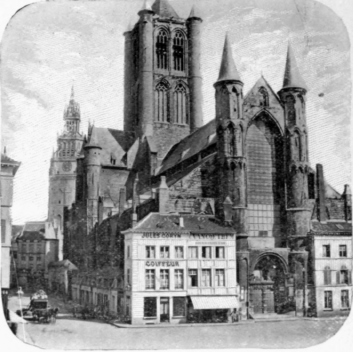
St. Nicholas Chirch.
Leaving this historic site, a short walk brought us to the oldest church in Ghent, founded nine hundred years ago. Around its base, like barnacles upon a stately ship, have gathered several small shops, which should be cleared away; but, in spite of these, the building has a rugged grandeur suited to its history. Its pointed turrets were already old when, in the time of the Crusaders, a Flemish Count brought back to decorate the summit of the neighboring spire a gilded dragon taken from the church of Santa Sophia at Constantinople; and they looked grimly down upon the lurid fires which in this square consumed so many victims of the Duke of Alva, the cruel minister of Philip II.
Continue to:


My Books

