


Canada. Part 18
Description
This section is from the book "Canada - John L. Stoddard's Lectures", by John L. Stoddard. Also available from Amazon: John L. Stoddard's Lectures 13 Volume Set.
Canada. Part 18

Bedford Basin, Halifax Harbor.

Northwest Arm, Halifax Harbor.
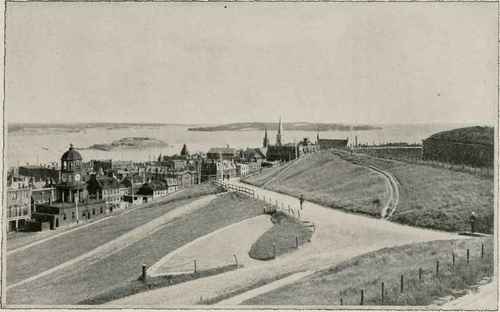
Halifax, From The Citadel.
Yet, in reality, beneath this fair expanse, which sunset causes to resemble Nature's palette of resplendent hues, are many deadly mines. Behind the carefully clipped sward stand formidable engines of destruction. The harbor's crystal mirror now reflects merely the tinted clouds and brilliant beauty of the sky; but at a word the whole scene may be changed. The serene bay can by a flash of electricity be rent by the explosion of torpedoes; the stainless heavens become obscured by the thick breath of brazen-throated guns; and shores, which answer now to laughter and the song of birds, may in an instant echo to the moans of suffering, as fingers, stiffening in the chill of death, clutch fibres of the flower-strewn grass.
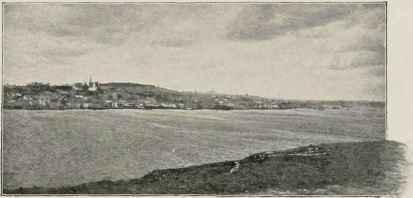
Halifax, From George's Channel.

Looking Seaward, Halifax Harbor.
Such contrasts have not been unusual in the history of this peninsula. There are few more pathetic stories than that of Acadia, or Acadie - a name which in the Indian tongue meant "Land of Plenty," and was applied in general to what are now the maritime provinces, but in particular to Nova Scotia. For in the bitter conflict waged almost incessantly for a century and a half by France and England for the possession of the North American continent, this lovely country suffered greatly: partly because of its situation, easily open to attack by sea; partly because it was a prize eagerly coveted by both antagonists. The people of New England were the special enemies of the French of this locality, and often made piratical descents upon their coasts. Accordingly, the good and evil fortunes of Acadia ebbed and flowed with well nigh as much violence and contrast as characterize the fearful tides that sweep through the adjoining Bay of Fundy. In the brief intervals of peace, when the exhausted combatants took breath, one of the nations would acknowledge Nova Scotia to be the property of its rival; but when the struggle was renewed, this was again the objective point of capture or of wanton pillage. Thus Port Royal (now Annapolis Royal), the former capital of the peninsula, was taken and retaken so many times that it seemed foolhardy for any one to return and live there after such experiences. In fact, the greater part of this attractive land, which now produces the delicious fruits whose flavor is so famous, has been the scene of thousands of those acts of cruelty, in which mankind so far exceeds the brutes, that one is often forced to respect dumb animals more than some specimens of the human race. For thoughtful tourists the interest of this country centres in the region bordering an inlet from the Bay of Fundy called the Basin of Minas. Over this valley, which endears itself to the beholder alike from its intrinsic beauty and its great misfortunes, Longfellow's verse has cast a never fading charm, and given it the title of the Land of Evangeline. In the provincial library of Halifax, in a small cabinet containing precious autographs, the visitor may see a letter written by the Rev. Samuel Longfellow, the poet's brother, in which occurs the following statement: "I have found the accompanying page in his handwriting. It seemed to me especially fitting for your purpose, as giving not only the autograph of the author of 'Evangeline,' but his own account of the origin of that poem." From this one turns to read with deepest interest the words of the poet, traced long ago with his own hand, in ink that has grown pale with time. They are as follows: "Hawthorne dined one day with L., and brought with him a friend from Salem. After dinner, the friend said, 'I have been trying to persuade Hawthorne to write a story based upon a legend of Aca-die, and still current there; the legend of a girl who, in the dispersion of the Acadi-ans, was separated from her lover, and passed her life in waiting and seeking for him, and only found him dying in a hospital when both were old.' L. wondered that this legend did not strike the fancy of Hawthorne, and said to him, 'If you have really made up your mind not to use it for a story, will you give it to me for a poem?' To this Hawthorne assented, and promised not to treat the subject in prose till L. had seen what he could do with it in poetry".
Continue to:


My Books

