


Canada. Part 24
Description
This section is from the book "Canada - John L. Stoddard's Lectures", by John L. Stoddard. Also available from Amazon: John L. Stoddard's Lectures 13 Volume Set.
Canada. Part 24

Ottawa, From Parliament Buildings.

House Of Parliament, Ottawa.
It gave me a curious sensation to stand before these splendid structures, material exponents of law and stable government, and to reflect that the locality, even as late as the end of the American Revolution, was a woodland wilderness, and had for many generations been conspicuous in the annals of the Indians as a place of slaughter. It was, indeed, for them a point of great strategical importance; for here two other good -sized rivers, the Rideau and the Gatineau, join the Ottawa, the three streams thenceforth rolling on in triune majesty to swell the flood of the St. Lawrence, and form with it, one hundred and twenty miles away, the Isle of Montreal. It may be doubted whether, necessary as these rivers are to the prosperity of the present inhabitants of Canada, they were not even more essential to the aborigines. For waterways were then the only feasible avenues of transportation ; the larger rivers being the roads, the smaller ones the paths, which took their devious courses through the forests - solid in winter, liquid in the spring, but always passable for sledges or canoes.
The lordly Ottawa in particular was the sole practicable route by which the Hurons and Algonquins could convey to the French settlements their annual stock of furs, obtained by months of care and labor in the northern wilds. This traffic was of great importance to the Indians, although the actual value of the objects bartered by the white men for the precious pelts was very small. The profits of the colonists, on the other hand, were enormous. As recently as 1850, in the northwest of Canada, the natives were expected to give, in return for an old flint lock musket, a pile of silver foxskins as high as the muzzle of a rifle, when held erect with its stock upon the ground. Accordingly, down the swift current of the Ottawa came, every year, a fleet of Indian canoes, laden with heaps of bear, moose, beaver, otter, fox, and marten skins for pale-faced purchasers; and here, near the tumultuous Chaudiere Falls, whose voice still thrills the life of Ottawa with a solemn undertone, the cruel Iroquois waited for their coming, keen to surprise, defeat, and torture their hereditary foes, as well as to possess themselves of the flotilla and its furs. Frightful indeed have been the scenes enacted here, the relatively recent dates of which appear almost incredible, when one surveys the modern city and its legislative halls; for now where, only about a century ago, were heard the war-whoops of half-naked savages, preliminary to some horrid massacre, the scalping knife and tomahawk seem as remote, and are, to all intents and purposes, as obsolete, as are the weapons of the Stone Age and the Cave Man.
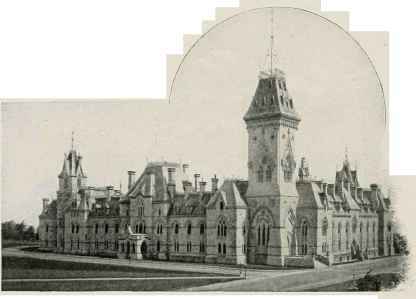
Eastern Block, Department Building, Ottawa.
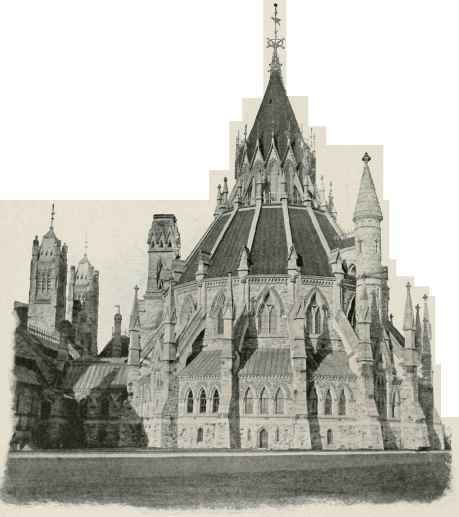
Parliament Library, Ottawa.

Ottawa, From Rideau Falls.
The Ottawa, with its affluents, still contributes generously to the welfare of Canadians, although the kind of treasure which it brings to them is different. The coveted cargoes of fine peltry that once floated down its waters are now few in number, and reach the public by another route; but they have been replaced by rafts of timber, cut in the vast, primeval forests of the north and west. Moreover, for the conversion of this product into marketable lumber, the Ottawa furnishes enormous water-power at the Chaudiere Falls. Near this impetuous cataract scores of huge sawmills have been built; not only on the shore, but, where more space was wanted than the land could give, on artificial embankments, and even over the water on a mass of piles. The noise in these establishments is, to a close observer, deafening in its endless din. The unaccustomed ear is almost stunned by the harsh droning of the crunching saws, the strident shrieks that mark the finish, and the fierce whir of exultation, as the liberated blades await the offering of another victim. In one not interested in the profits of this business, the ceaseless sacrifice of trees attending it inspires a sentiment of horror. Frequently, twenty-five or thirty mammoth saws, with vicious-looking teeth of monstrous size, are set in frames, called "gates"; and these, when started by machinery, shoot up and down in savage fury, as if they were the snapping jaws of some unearthly monster. Nothing apparently can satisfy its hunger, though night and day the hideous teeth attack the food forever furnished them. Tremendous guillotines they seem, whose glittering knives are not content with the decapitation of their prey, but cut relentlessly and swiftly through the stalwart bodies of the forest kings, which armies of invaders have hewn down, and brought hither as captives on the current of a river forced to abet them in their spoliation. It is like Armour's abattoir without the blood. One after another, the grand old trees which served so recently as stately columns in the leafy sanctuaries, where they had slowly risen heavenward for more than one hundred and fifty years, are pushed in toward the gnashing teeth, which in a moment bite them with a grip that never will relax, till they have eaten through the entire length of what they feed upon. By day this sight is bad enough, but anything more weird and gruesome than the scene at night, when it is outlined on a jet-black background in the glare of the electric light, can hardly be imagined. The coruscating saws, perpetually darting up and down, like harnessed lightning flashes; the gleam of the dank logs, forced forward to their fate; and the distorted shadows cast by the exaggerated figures of the workmen, together make this seem the torture room of a plutonian purgatory.
Continue to:


My Books

