


Canada. Part 44
Description
This section is from the book "Canada - John L. Stoddard's Lectures", by John L. Stoddard. Also available from Amazon: John L. Stoddard's Lectures 13 Volume Set.
Canada. Part 44
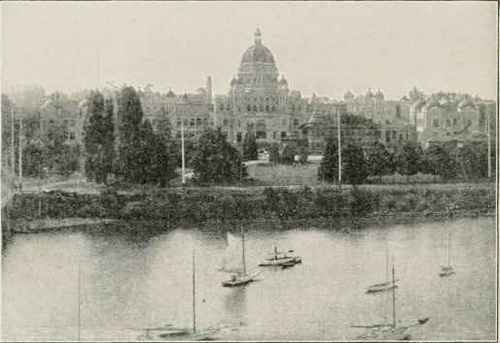
House Of Parliament, Victoria.
Three miles from the capital, and connected with it by an electric railway, is Esquimalt, the station for the British navy in the Pacific. This has another of those spacious harbors, with which this remarkable coast abounds, and forms an ideal rendezvous for the imperial fleet. It is noteworthy, too, that Esquimalt and Halifax, on the Atlantic, are the only places in the Dominion where British troops are seen, and both are correspondingly important to the empire. Accordingly, the fortifications here are of enormous strength; and a huge drydock has been made four hundred and eighty feet in length, into which a railway, speperhaps, on that account a more agreeable place of residence for those not actively engaged in business. It certainly is a paradise for lovers of flowers, as well as a health resort of almost unsurpassed advantages. The influence of the Kuro Siwo, whose power on the mainland we have already noted, renders the winter at Victoria as mild as spring in Maryland. Nor is there any sweltering, debilitating heat in summer. The maximum temperature ever reached here is eighty-four degrees, the minimum twenty-two degrees, Fahrenheit. Geraniums and roses may be gathered freely in the open air at Christmas, and flowers are blooming here the whole year round. In May and June Victoria is especially enchanting, for then its flora is in wonderful profusion. Roses and honeysuckles twine galore around the doors and porticos of pretty dwellings set in gardens; the well-made roads in the vicinity are often lined with fragrant hedges bright with bloom; while in the stately groves of conifers the air is positively delicious with the pungent perfume of the pine. One feels that such a land of noble trees, floral exuberance, luscious fruits, equable climate, and pure, exhilarating" air from mountains and from sea must soon be recognized as one of the finest natural sanatoriums of the world.
Initially constructed for the purpose, can draw out of the water the largest vessels that may need repairs.
All these advantages, together with the fact that a railroad brings to this station coal from the famous mines at Nanaimo, seventy miles away, make Esquimalt of almost priceless value to Great Britain as a naval base.
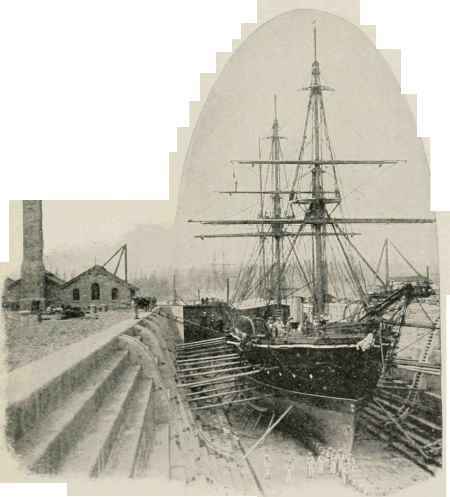
Dry Dock At Esquimalt.
Three miles from the capital, and connected with it by an electric railway, is Esquimalt, the station for the British navy in the Pacific. This has another of those spacious harbors, with which this remarkable coast abounds, and forms an ideal rendezvous for the imperial fleet. It is noteworthy, too, that Esquimalt and Halifax, on the Atlantic, are the only places in the Dominion where British troops are seen, and both are correspondingly important to the empire. Accordingly, the fortifications here are of enormous strength; and a huge drydock has been made four hundred and eighty feet in length, into which a railway, specially constructed tor the purpose, can draw out or the water the largest vessels that may need repairs.
House Of Parliament, Victoria.
Standing upon the western margin of the North American continent, whose natural treasures are so vast, and whose inhabitants both in Canada and the United States are so inventive, resolute, and daring, when one looks out upon the mighty ocean, no longer now a barrier, but a royal highway to the Orient, one wishes he could live a century longer, to see the marvelous changes sure to be evolved upon its islands and surrounding coasts. Ten years ago, in writing of Japan, the author said, " The most important dramas of the coming century will probably be enacted on the shores of the Pacific." What then seemed probable is now certain. At the time of this writing, Japan has proved herself in two campaigns to be a first-class military and naval power, and, as such, has become the ally of Great Britain. The United States have taken possession of the Hawaiian Islands and the Philippine archipelago. Russia has reached her goal in Chinese waters, and dominates, if she does not own, the enormous province of Manchuria. China herself is shaking off her immemorial lethargy, and may become erelong a formidable world power. France, Germany, and England have already large possessions on the Asiatic coast, and will inevitably acquire more, although the process will be attended with grave international complications ; while the increasing strength and population of Australia and New Zealand must become potent factors in the problem of the greater East. Cables are being laid between the United States and their new colonies; and it is quite within the range of possibility that before many years the President may talk over a submarine telephone with the administration at Manila, and the Governor General of Canada converse by the same means with the Australian Parliament. Finally, most significant and wonderful of all, the two Americas will soon be separated by a waterway, connecting the Atlantic and Pacific, and revolutionizing trade throughout the world. What the results will be of all this transformation of earth's greatest ocean, and the expansion thitherward of her leading nations, none can tell; but they are sure to be more startling and epoch-making than anything that has transpired since the discovery of the western hemisphere. Canada, with her vast resources, her territory fronting on two oceans, her railway which unites them, her admirable lines of steamships, and her greater navigable nearness to Japan through her position on the shoulder of the globe, will doubtless take a prominent part in the opening drama of the Orient, and will secure a just reward. It cannot possibly be otherwise; for her inhabitants are conquerors of half a continent, and most of them are scions of the race, whose bugle-call rings round the world.
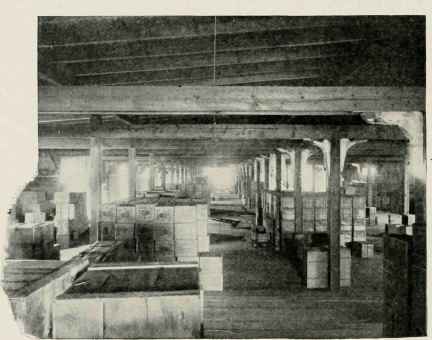
A Tea Shed, Vancouver.
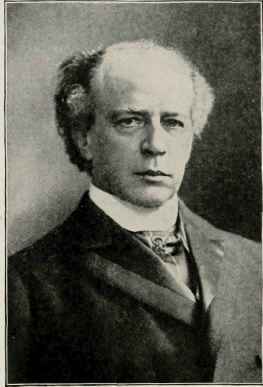
Sir Wilfred Laurier.
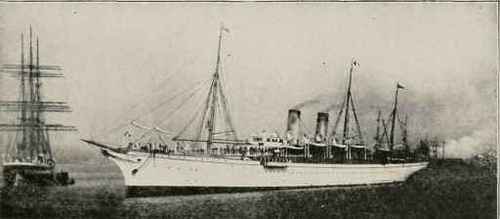
Canadian Pacific Railroad Steamship "Empress Of Japan".
Continue to:


My Books

